Keyboard Instruments

Mascioni Organ

38 replies 7,903 views

Started by

Francesco

Member

Member

Opening post by Francesco

Posts
251
City
Torino

Hello everyone

I am starting this new discussion to talk to you (and ask you) about a very interesting instrument that I had already known for some time, but which I have only recently "rediscovered" and "revalued," fully learning its beauty.

It is a 1972 Mascioni organ (opus 949), in the Parish near my house: it is a two-manual with pedalboard, 30 stops, electric transmission.

I played this instrument a couple of years ago, but without understanding its real timbral and expressive potential (forgive me, but I was also 9-10 years old).

Almost by chance, two weeks ago I saw the console open, I sat down and tried to make it produce some sound.

Wonder of wonders.

That sound, so deep, bright, clear, I would almost dare say angelic, made me fall in love with the instrument.

The following week (last Saturday) I spent two hours in the afternoon and three in the evening (from 9 to midnight!) playing.

You surely know that I am not a "serious" pianist, nor by any means an organist, but this instrument has fascinated me enough that I want to know more about it.

What I would like to understand, for example, is what condition the organ is in: hearing it play, it would seem to be in good condition, but not being part of the organ world, I cannot say for certain. Therefore, I am turning to those who know a little more about the subject: what do I need to do to understand more about its condition? For example, are there certain stops that are more easily damaged and that, therefore, I should listen to carefully to see if something is wrong?

The organ was "cleaned" only a couple of years ago, but no repairs were made (funds were relatively limited).

I will proceed (probably on Saturday) to obtain the organ's stop list, and perhaps prepare some recordings, so that I can let you hear it.

In the meantime, experienced organists or interested musicians, please step forward

Member

Reply 3 by Organista94

Posts
194

> What should I do to understand more about its condition?
> For example, are there certain stops that get damaged
> more easily and that, therefore, I should listen to carefully to see if something is wrong?

One important thing is that the organ does not remain stationary, so it should be played regularly to keep the mechanisms "oiled"; if you hear that no one plays it, it could be an opportunity to suggest to the parish priest that you be allowed to use it with some freedom.

>The organ was "cleaned" only a couple of years ago, but no repairs were made (funds were relatively limited).
Usually, during cleaning, it is completely disassembled, so it is retuned (and obviously tuned). If there had been something broken or visibly worn, it would have at least been reported... is there a technical note on the work performed? (ask the priest)

>I will proceed (probably on Saturday) to obtain the organ's stop list, and perhaps prepare
> some recordings, so that I can let you hear them.
Good idea

Member

Reply 4 by Boesendorfer

Posts
103
City
Tirol

Is Op. 949 Mascioni located in the church of Madonna di Campagna in Turin?

If it might interest you, in those parts there is the Santo Volto church, where in 2006 the organ building company Flli Ruffatti

built a mechanical action organ with three manuals.

It is very useful to get used to playing on different instruments: this is especially true for the organ.

Member

Reply 5 by Francesco

Posts
251
City
Torino
Organista94 wrote:

> What should I do to understand more about its condition?

> For example, are there certain stops that get damaged

> more easily and that, therefore, I should listen to carefully to understand if something is wrong?

One important thing is that the organ does not remain stationary, so it should be played regularly to keep the mechanisms "oiled"; if you hear that no one plays it, it could be an opportunity to suggest to the parish priest that you be allowed to use it with a certain degree of freedom.

>The organ was "cleaned" only a couple of years ago, but no repairs were made (funds were relatively limited).

Usually during cleaning, it is completely disassembled, so it is revoiced (and obviously tuned). If there had been something broken or visibly worn, it would have at least been reported... is there a technical note on the work performed? (ask the priest)

>I will proceed (probably on Saturday) to obtain the organ's stop list, and perhaps prepare

> some recordings, so that I can let you hear it.

Good idea

Thank you!

The organ is played sometimes, but not regularly or very much: from what I know, it is played "seriously" for about half an hour a week (usually on Saturday evenings), then on Sundays it is only used on one or two stops. In short, there are stops that almost never sound (especially on the second manual). My good fortune is that I have known the parish priest for years, so I don't think there will be any problems if I asked to go and play with some regularity on Saturday afternoons.

I will also inquire about the work performed, although, based on your words, I wonder: right, if they cleaned everything, why not revoice it? And I answer myself: probably only a minimal part was cleaned (and voiced)... Is that possible?

Boesendorfer wrote:

Is the Mascioni op. 949 located in the church of Madonna di Campagna in Turin?

If it might interest you, in those parts there is the Santo Volto church, where in 2006 the organ building company Flli Ruffatti

built a mechanical action organ with three manuals.

It is very useful to get used to playing on different instruments: this is especially true for the organ.

Yes, it is the one in Madonna di Campagna, but I have almost no trouble asking to play, I know the priest... At Santo Volto I don't know anyone. Besides, the only time I heard the Santo Volto organ being played, every minute or two a "small pop" could be heard coming from behind the facade... It was only audible during moments of silence, so it wasn't disturbing, but I noticed it. Could it be a problem with the bellows?

Member

Reply 6 by Francesco

Posts
251
City
Torino

I am informing you that I have just made arrangements with a monk from the parish, for tomorrow afternoon. Barring any unforeseen circumstances, I will be able to procure what is needed.

Member

Reply 7 by Francesco

Posts
251
City
Torino

Finally I have some updates.

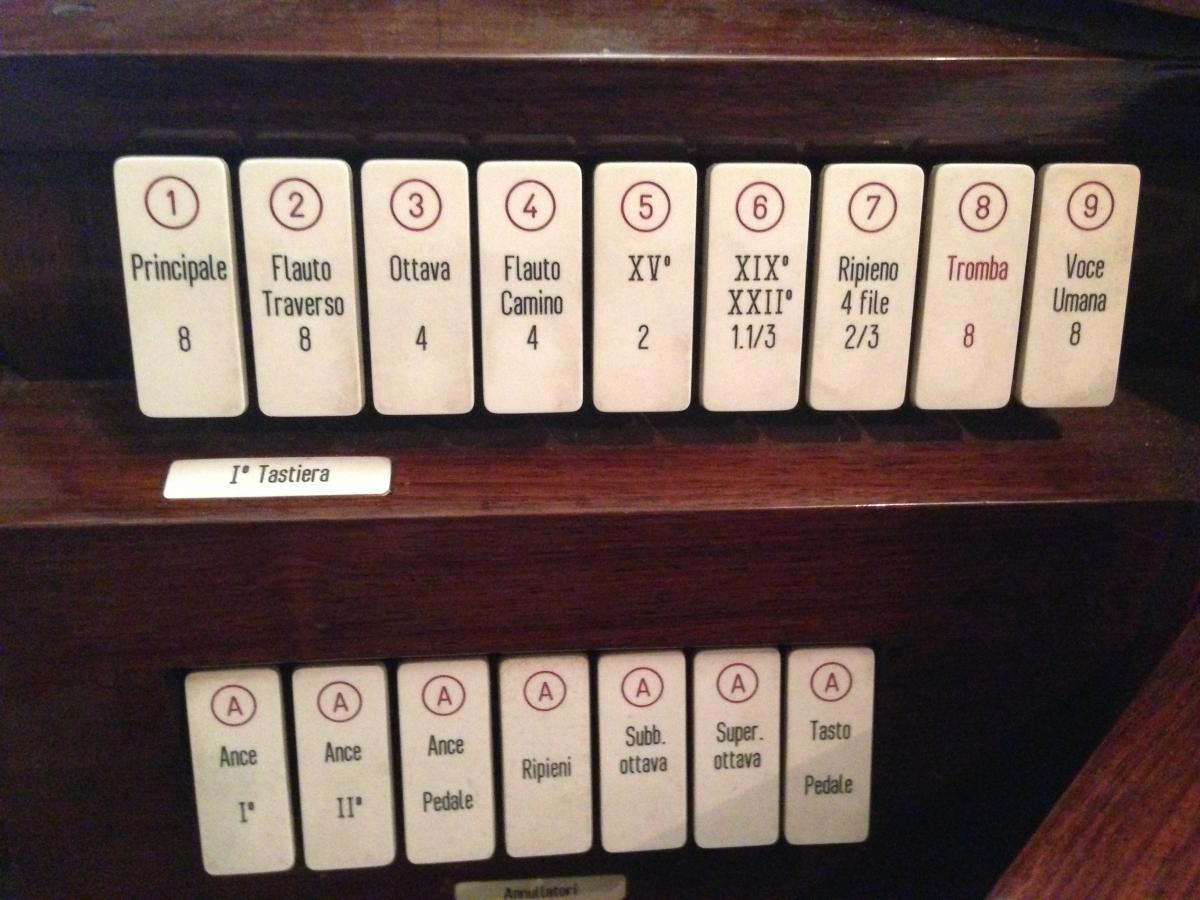
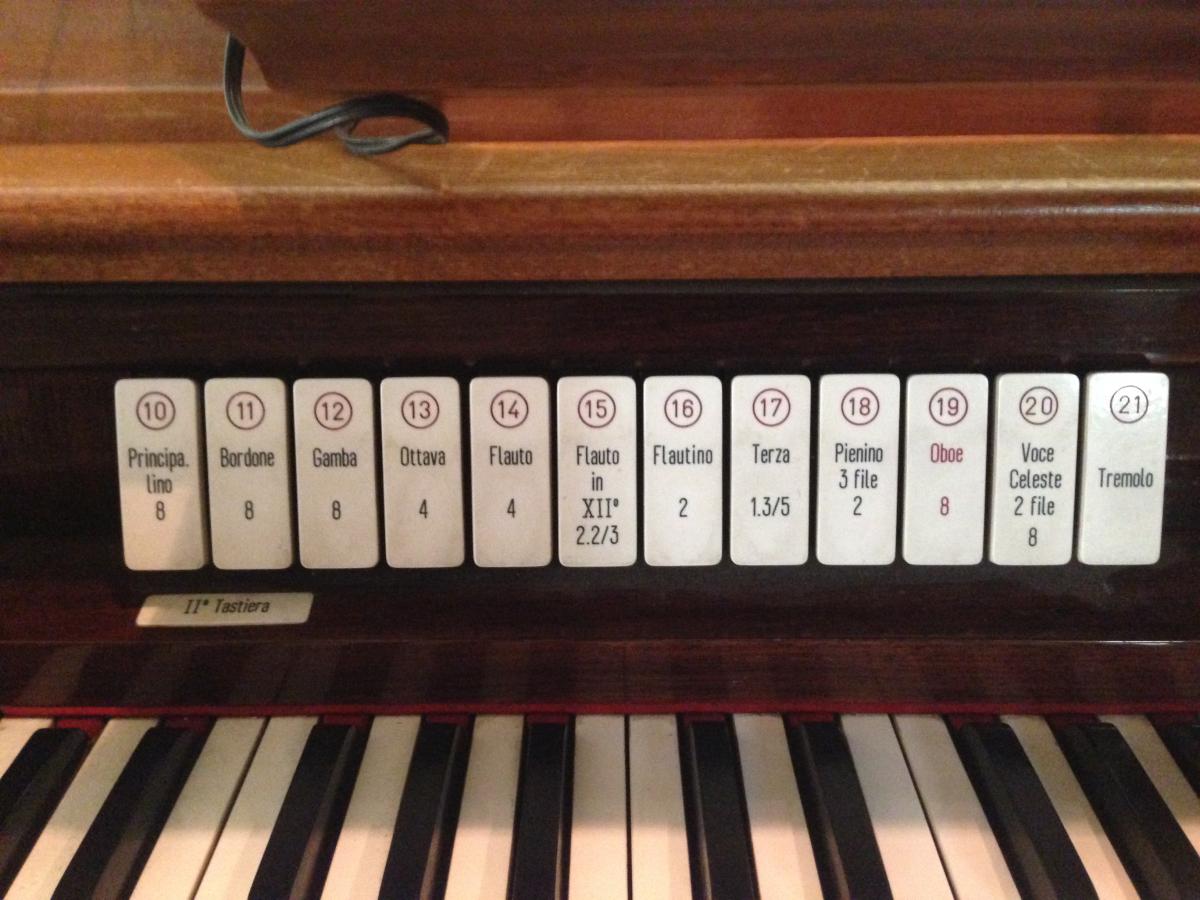
First of all, the tonal specification:

I manual:

Principal 8'

Traverso Flute 8'

Octave 4'

Chimney Flute 4'

XV° 2'

XIX° XXII° 1.1/3' (?)

Ripieno 4 ranks 2/3'

Trumpet 8'

Voce umana 8'

II manual:

Principalino 8'

Bourdon 8'

Gamba 8'

Octave 4'

Flute 4'

Flute in XII° 2.2/3'

Flautino 2'

Terza 1.3/5'

Pienino 3 ranks 2'

Oboe 8'

Voce celeste 2 ranks 8'

Tremolo (unfortunately almost completely non-functional)

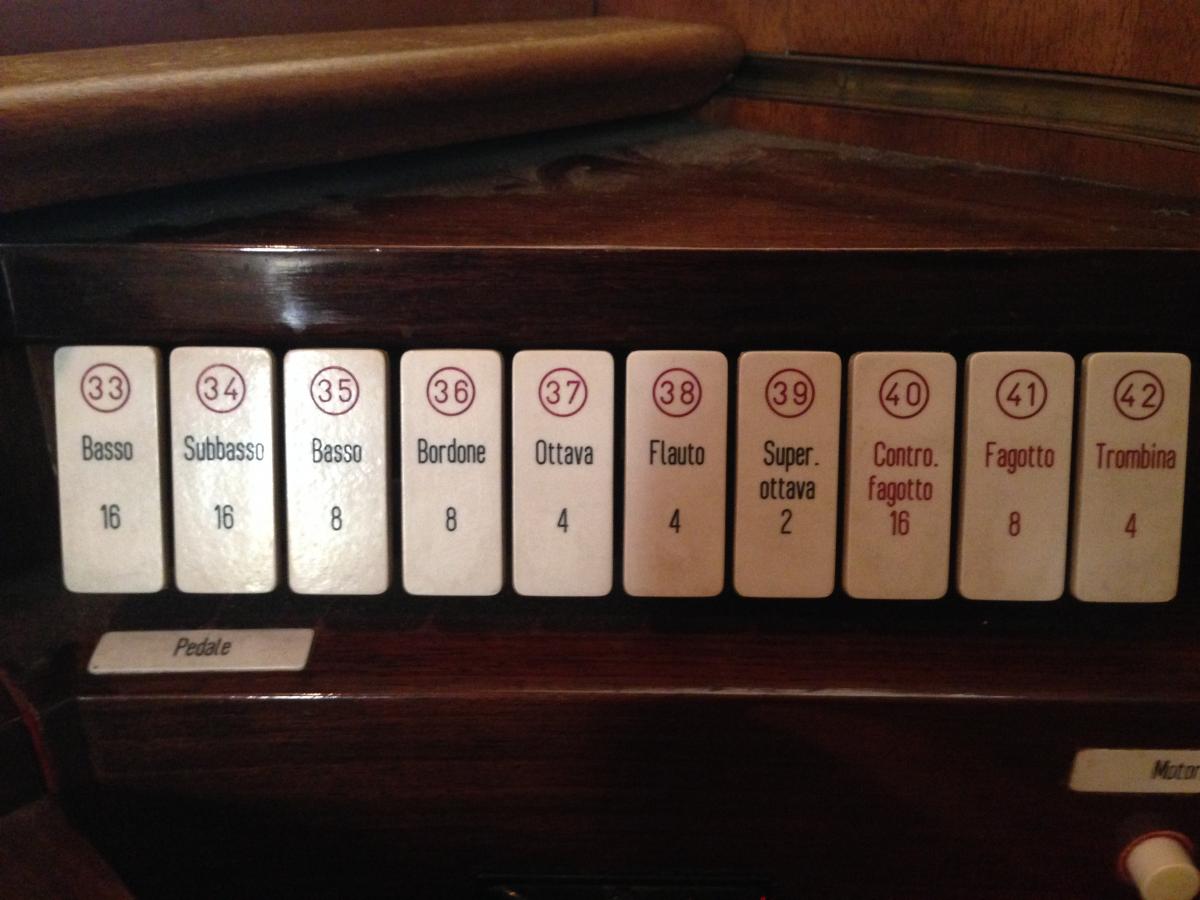
Pedalboard:

Bass 16'

Subbass 16'

Bass 8'

Bourdon 8'

Octave 4'

Flute 4'

Super octave 2'

Contra fagotto 16'

Fagotto 8'

Trombina 4'

+ the various couplings and combinations.

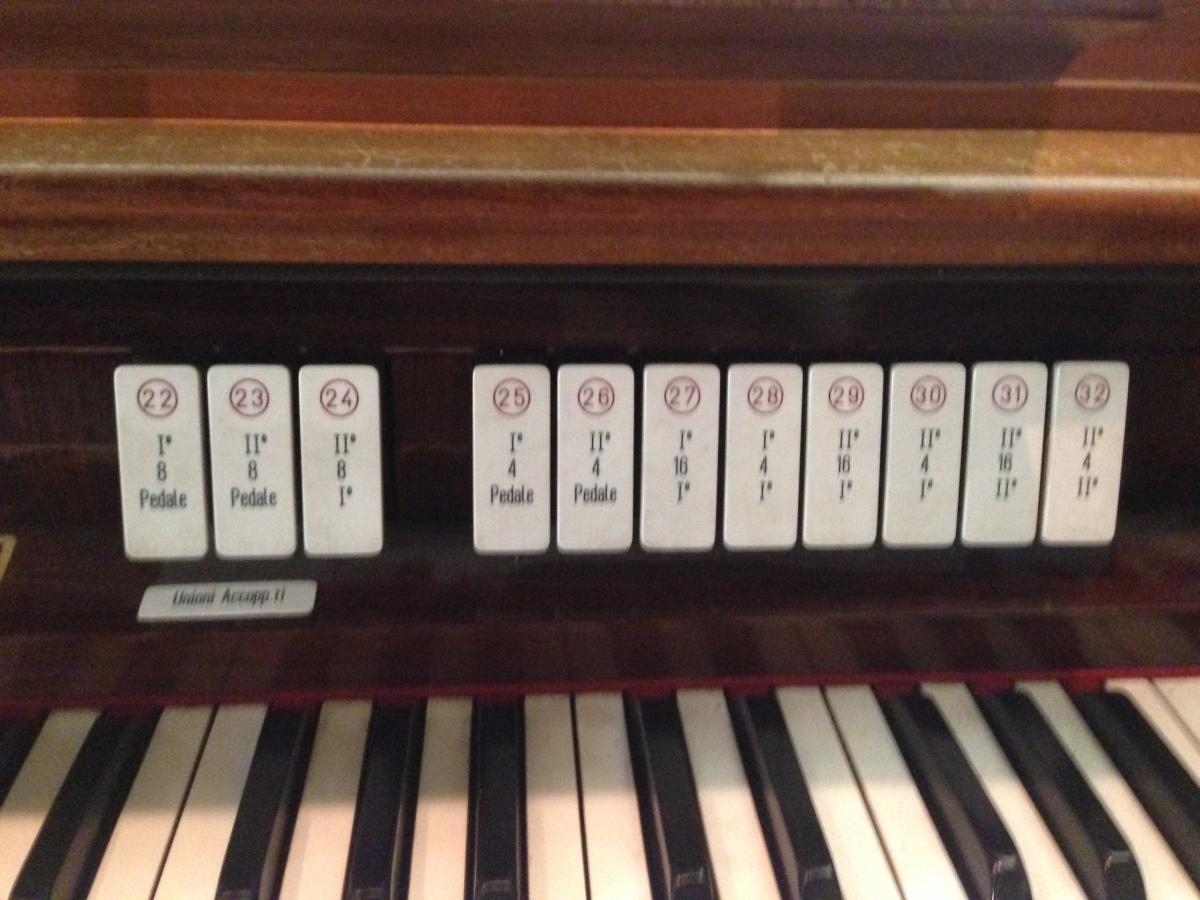
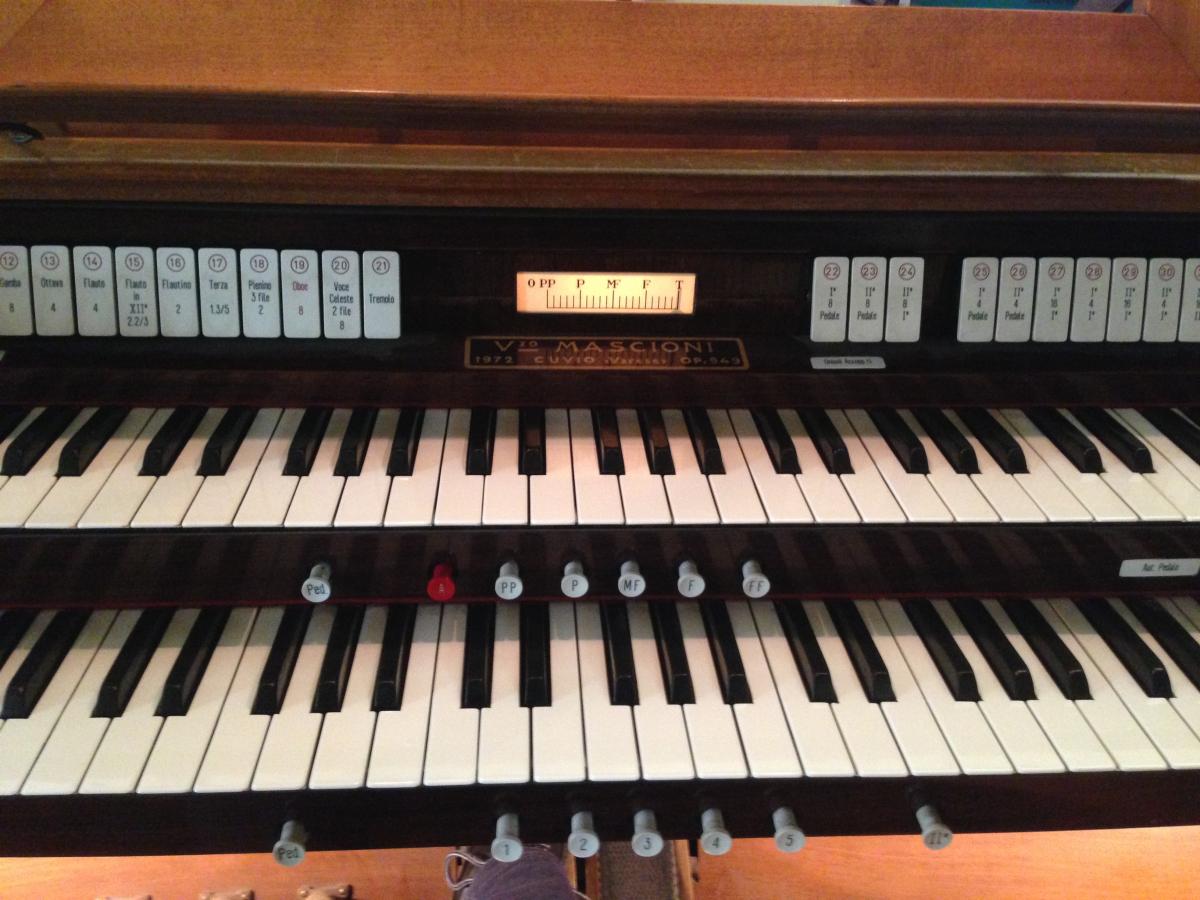
I am attaching some photos of the console, taken this morning: unfortunately I couldn't photograph the facade of the instrument (they were already giving me dirty looks just while I was photographing the console).

The only photo I managed to find of the facade dates back to 1974, but I am attaching that one too.

In the meantime, I will take the opportunity to ask for some information from those more familiar with organs.

1. I noticed that the high B of the first manual does not sound, with any stop. Most likely a console problem, right?

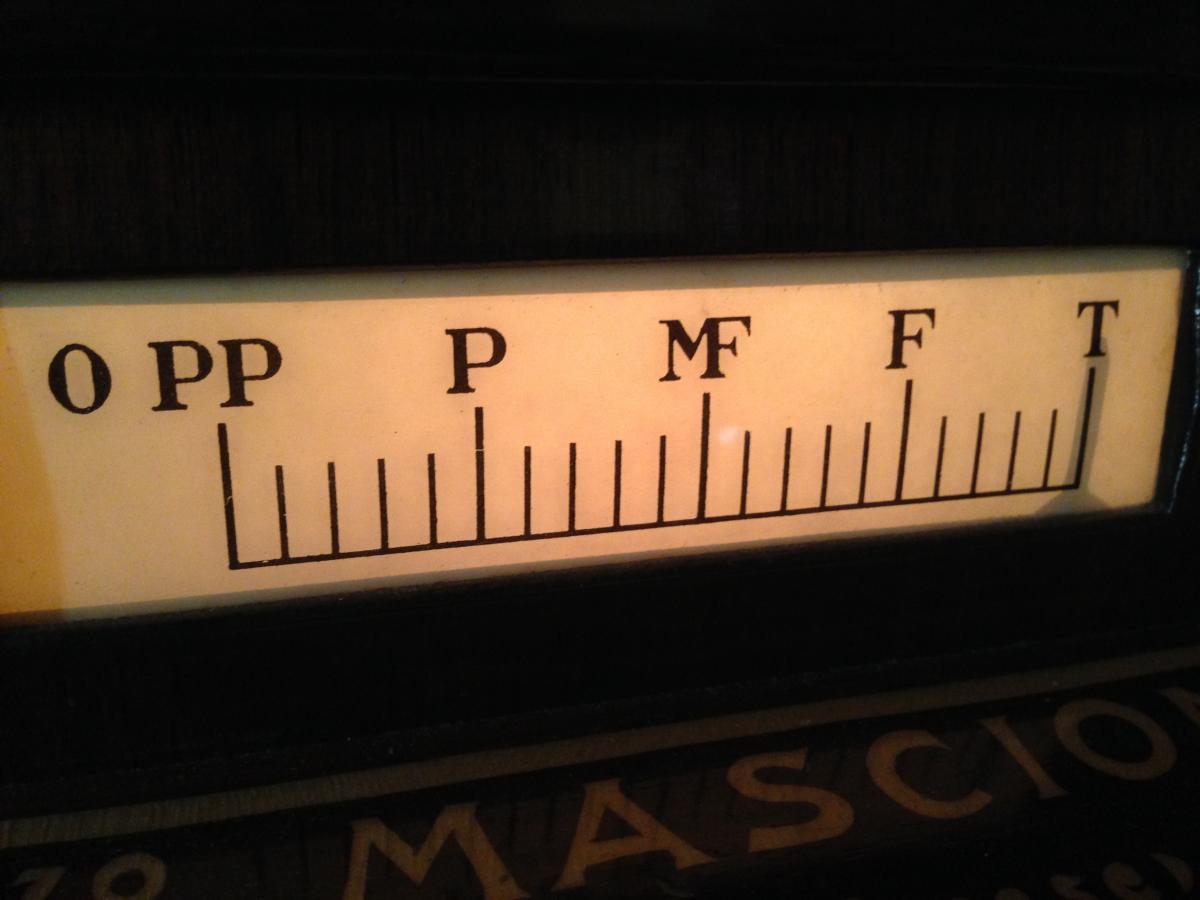
2. Between the two manuals, there are small pistons with certain dynamics indicated (p, mf, f, etc.; see attached photo). Are these an alternative to the pedal (which operates the light indicator typical of Mascioni organs, see photo), or are they independent? If they are independent, how do they affect the sound?

3. There are two small pistons for "Automatic pedal", one for engagement and the other for disengagement. Despite my attempts, I haven't been able to understand quite what they are. The same goes for the two "Pedal" pistons, one on the first and the other on the second manual.

4 and last. What are the annullatori (cancelers)? O.o

I apologize for the not-so-excellent audio quality, and especially for the excessive reverberation (I couldn't position the microphones at the organ facade), but I am also attaching a recording, made somewhat quickly, to let you hear at least summarily the sound of the instrument. (https://app.box.com/s/uzq6biedwawlqhnvk8jt)

Thanks to anyone who will provide clarifications

https://app.box.com/s/uzq6biedwawlqhnvk8jtAttachmentAttachmentAttachmentAttachmentAttachmentAttachment

Member

Reply 8 by Francesco

Posts
251
City
Torino

Perhaps I made a mistake. Looking at the stop tablets, I noticed that the one for the tremolo (which I thought was not working) has no octave indication (8, 4, 16, etc., like in the others).

Not being an organist, I couldn't have known, but at this point I assume that the tremolo is not a register "in itself," but rather an "effect" (an ugly term in this case, I know) to be applied to other registers, also on the second manual.

I have understood this; now I am missing the couplers and the various pistons.

Member

Reply 10 by Organista94

Posts
194

...even if it is called pianoconcerto...much more is also discussed. I fear I haven't understood the question ...

Member

Reply 11 by Silbermann

Posts
109
City
MI

I took the topic to be somewhat self-descriptive/informative at times. If anything is needed, I am here

Member

Reply 13 by Francesco

Posts
251
City
Torino
Organista94 wrote:

...even if it is called pianoconcerto...much more is also discussed. I fear I didn't understand the question ...

Silbermann wrote:

I took the topic as occasionally self-descriptive/informative. If anything is needed, I am here

The question was rhetorical; it was to see if I was talking to myself here, or if there is someone who can give me a couple of pointers

Member

Reply 14 by Organista94

Posts
194
Francesco wrote:

someone who can give me a couple of pointers

But of course, if I know something I'll gladly share it

What did you want pointers regarding? About large organs in general, organ repertoire, orchestration for the organ, organ technique, organ composition? ...etc.

In my opinion, to prevent issues from being forgotten, it is better for you to open ad hoc and well-focused topics, so that others can immediately understand how to contribute.

Member

Reply 15 by Francesco

Posts
251
City
Torino

Maybe you are right, but I would clog up the forum...

I will update you on what I have discovered in recent weeks.

Regarding the health of the instrument.

The biggest inconvenience is that of extraneous noises (faint whistles can be heard "playing" even without any stop engaged), present mainly on the keyboards and less on the pedalboard.

Secondly, the tuning of some stops would need to be completely redone (the principal and traverse of the I keyboard are truly very out of tune): however, I cannot understand if it is "just" dust to be removed, or if a retuning is actually necessary.

Another unpleasant discovery was the highest B on the I keyboard: it does not sound with any stop. I thought it was a console problem, perhaps some contacts to clean or fix, but then I realized that, by engaging the coupling of the I / II keyboard, the key in question works (naturally acting only on the stops of the second). Obviously there is a reason, but I am ignorant in this matter. Who can explain to me why this happens?

I was also perplexed by the tremolo: most likely it does not work, as I do not seem to hear any difference when engaging it. Now a doubt arises: how much would this difference actually be perceived, in case of a working tremolo?

Finally: what are the main maintenance interventions carried out on organs like this, and what are (indicatively) their costs?

Regarding the "management" of the instrument.

As a piano student, sitting at an organ console was obviously (in part) a novelty for me: I am referring first and foremost to the stops, but also to that set of "controls" (forgive me, but I don't know what else to call them) that intervene to modify the timbre of the instrument.

What I believe I have understood (correct me if I am wrong): the right lever controls the opening of the swell box, the left lever progressively engages the stops. The small buttons with indicated dynamics would therefore be an alternative to said lever. Is that correct?

What I haven't understood: the function of two small pedals, indicated as "R1" and "R2"; the difference between couplings (unioni) and registrations (accoppiamenti).

And finally, the strangest question. How much electricity does an organ of these dimensions consume?

Member

Reply 16 by Silbermann

Posts
109
City
MI
Francesco wrote:

The tremolo also left me perplexed: most likely it doesn't work, as I don't seem to hear any difference when inserting it. Now a doubt arises: how much would this difference actually be perceived, in case of a working tremolo?

You should hear the tremolo... I have never heard a bowed instrument when using this technique where the use of it is not evident compared to the sound ordinarily produced by the bow.

Member

Reply 17 by Silbermann

Posts
109
City
MI
Francesco wrote:

As far as the health of the instrument is concerned.

Secondly, the tuning of some stops would need to be completely redone (the principal and traverse of the I keyboard are really very out of tune): however, I cannot understand if it is "just" a matter of removing dust, or if a retuning is actually necessary.

In winter, even in the best organs, it is predictable; before concerts, they are usually always tuned, and woe to the parish priest if he heats the church

Member

Reply 18 by Silbermann

Posts
109
City
MI
Francesco wrote:

Another unpleasant discovery was the sharpest note of Keyboard I: it does not sound with any stop. I thought it was a console problem, perhaps some contact to clean or fix, but then I realized that, by using the Keyboard I / II coupling, the key in question works (naturally acting only on the stops of the second). Obviously there is a reason for this, but I am ignorant on the matter. Who can explain to me why this happens?

If it works via the coupling, then part of the possible problems are certainly ruled out. I advise that an on-site inspection would be necessary

Member

Reply 19 by Silbermann

Posts
109
City
MI
Francesco wrote:

As far as the "management" of the instrument is concerned.

As a piano student, obviously sitting at the console of an organ was (in part) a novelty for me: I am referring first and foremost to the stops, but also to that set of "controls" (excuse me, but I don't know what else to call them) that intervene to modify the timbre of the instrument.


More than the timbre, which is unique for each stop, it is the combination of them... which is why one speaks of organ instrumentation or orchestration.

Member

Reply 20 by Silbermann

Posts
109
City
MI

> How much does an organ of these dimensions consume?

Do you mean at the current level? If so, you must calculate the power of the compressors that supply air to the pipes.

In general, regarding the different mechanisms available for dosing the stops: you can combine them manually (or with a stop change) or use "pre-set" combinations in order to have different sound situations during improvisation/performance.

Regarding repertoire, clearly targeted choices are made guided by the orchestration/indication of the composer... to accompany the liturgy, one can be less demanding

Log in to participate