Orchestration

Orchestral sections

13 replies 4,649 views

Started by

jenn

Member

Member

Opening post by jenn

Posts
59
City
Italy

Hi!

I don't know if this could eventually be the right "section", but I don't see anything completely dedicated to orchestration...

So, I'll give it a try

Do you know what the sections in an orchestra are? I am talking about a medium-sized orchestra (symphonic)

Administrator

Reply 2 by Thesimon

Posts
4,504
City
Ariccia, RM

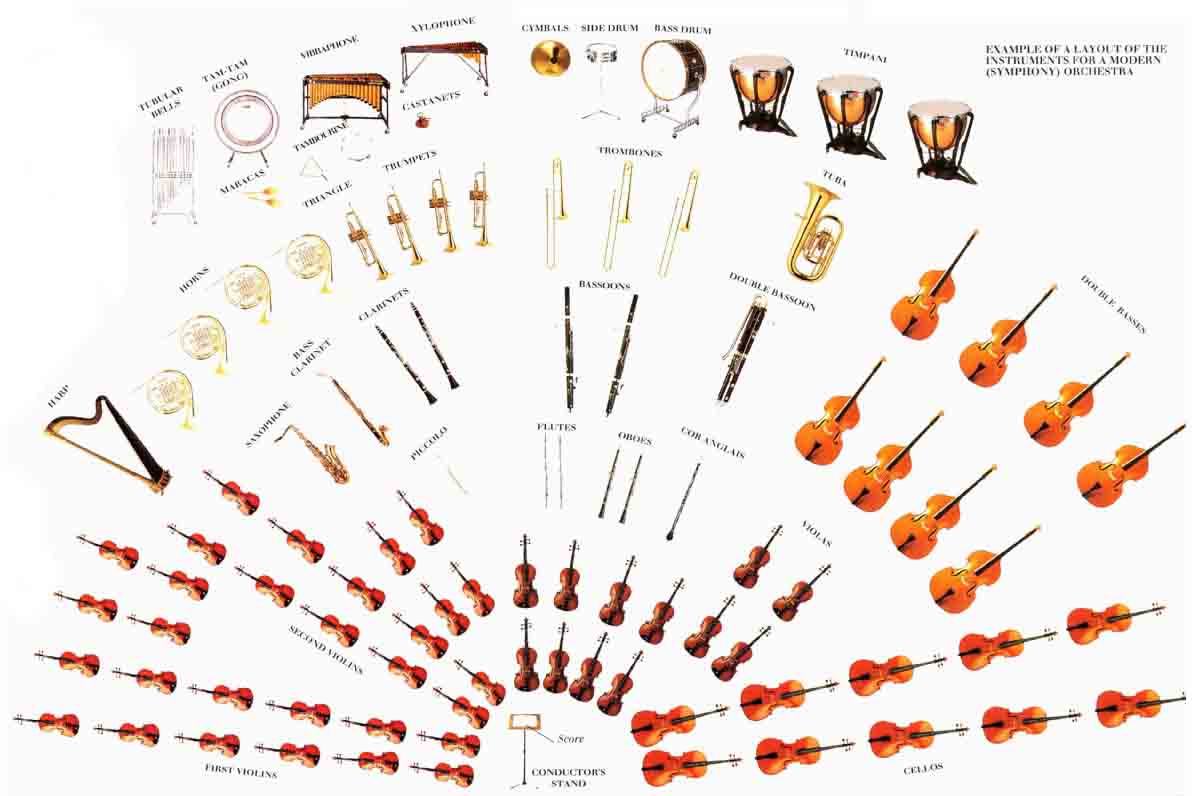
In orchestras, a set of instruments determines a section... For example, for the strings, which are those closest to the conductor, we find the section of First Violins, Second Violins, violas, cellos, and double basses. Here is an image that might clarify things for you...

Attachment

Member

Reply 3 by jenn

Posts
59
City
Italy

Hi! thanks

My doubt arose after reading Korsakov's book - Principles of Orchestration - which says:

In a medium-sized orchestra, it can be taken for granted that in "p" passages, the totality, for example, of the first and second violins is equivalent in power to that of a single wind instrument

then he gives an example -> (1st Violins = 1 Flute), and in "f" passages to two wind instruments (1st Violins = 2 Flutes = 1 Oboe + 1 Clarinet)

However, just above he said "first and second violins" - is there perhaps a writing error? instead of "and" should there be an "or"?

Then he says:

The addition of a single wind instrument to an entire section in unison has the only effect of thickening the sound of the strings while the woodwind timbre is lost.

Then he gives some examples:

Violins I + Violins II + Oboe or:
Violas + Cellos + 1 Clarinet or:
Cellos + Double Basses + 1 Bassoon

In your opinion, when he says "entire section" does he mean specifically Violins I and II - Violas and Cellos, or Cellos and double basses? or even Violins and Cellos at that point...

whereas for section (single section) does he mean only Violins I, or Violins II, Violas etc?

It is not clear to me

Administrator

Reply 4 by Thesimon

Posts
4,504
City
Ariccia, RM

Given that a composer's response would be more appropriate to such a question, I will tell you my impressions, which are mostly dictated by my limited experience with orchestras... It is no coincidence that the wood changes depending on the string sections being called upon. For violins, the oboe evidently strengthens the sound of the violins without compromising the general timbre; for violas and cellos, the clarinet; and for cellos and double basses, the bassoon.

Regarding the issue of power, one must see which single wind instrument we are talking about. If we speak of the flute, we have a certain emission; if we speak of the trumpet, we have another (certainly more powerful than the former). In any case, I believe it refers to both sections: Violins I + Violins II.

Member

Reply 5 by Dante

Posts
275

Is this section for orchestration

http://www.pianoconcerto.it/forum/index.php?/forum/116-orchestrazione/

Member

Reply 6 by Dante

Posts
275

You can post the original pages, I can't fit the questions into the sentence fragments you are reporting. I mean, if there were a real error, someone would have noticed it a long time ago.

Member

Reply 7 by jenn

Posts
59
City
Italy

Hello guys

I posted a question regarding orchestration in the wrong section and now, thanks to Dante, who pointed me to this space, I would like to ask it here.

First, I'll paste the link ->

http://www.pianoconcerto.it/forum/index.php?/topic/6145-sezioni-in-orchestra/

If possible, I am attaching the PDF manual of Korsakov - Principles of Orchestration (pages 40-41)

...I'm pasting the content of the first discussion..

My doubt arose after reading Korsakov's book - Principles of Orchestration - which says:

In a medium-sized orchestra, it can be taken for granted that in "p" passages, the totality, for example, of the first and second violins is equivalent in power to that of a single wind instrument, and in "f" passages, to two wind instruments,

then he gives examples -> (1st Violins = 1 Flute) - (1st Violins = 2 Flutes = 1 Oboe + 1 Clarinet)

However, just above he said "first and second violins" - is there perhaps a writing error? Instead of "and", should it be "or"?

Then he says:

The addition of a single wind instrument to an entire section in unison has the only effect of thickening the sound of the strings while the woodwind timbre is lost.

Then he gives examples:

Violins I + Violins II + Oboe or:
Violas + Cellos + 1 Clarinet or:
Cellos + Double Basses + 1 Bassoon

In your opinion, when he says "entire section," does he mean specifically Violins I and II - Violas and Cellos, or Cellos and double basses? Or even Violins and Cellos at that point...

whereas for section (single section), does he mean only Violins I, or Violins II, only Violas, only Cellos etc.?

It is not clear to me

Member

Reply 8 by Ettore

Posts
376
City
-

The example seems to exemplify his thought

jenn wrote:

The addition of a single wind instrument to an entire section in unison has the only effect of thickening the sound of the strings while the timbre of the wood is lost.

Then he gives examples:

Violins I + Violins II + Oboe or:
Violas + Cellos + 1 Clarinet or:
Cellos + Double Basses + 1 Bassoon

In your opinion, when he says "entire section" does he mean exactly Violins I and II - Violas and Cellos, or Cellos and double basses? Or even Violins and Cellos at this point...

whereas for section (single section) does he mean only Violins I, or Violins II, only Violas, only Cellos etc?

It is not clear to me

The sections are Violins I, Violins II, Violas, Cellos and Double Basses, and consider that in a band there are also clarinet sections, for example (in the symphonic orchestra clarinets range from 1 to 3... but even more depending on the composer's needs).

Member

Reply 9 by jenn

Posts
59
City
Italy

Hi Ettore, thanks for the answer, but I still don't understand

To recap:

16 Violins I = one section

14 Violins II = one section

12 Violas = one section

10 Cellos = one section

8 Double basses = one section

(in the symphony orchestra)

but what does he mean by entire section?

Member

Reply 10 by Marcello

Posts
112
City
-

In my opinion, "Entire" depends on the context. For me, a section is I, or II, or Violas, etc.

However, if it refers to timbre, it might mean Violins I+II, Violas, Cellos and CB. In any case, all orchestration manuals treat Violins I separately from II, even by number... as Korsakov rightly does (16 against 14).

Moderator

Reply 11 by Frank

Posts
3,838
City
-

In my opinion, he means violins in a broad sense; you can associate an oboe with the firsts or the seconds, given the small number of fewer instrumentalists between firsts and seconds, the result is quite similar.

The message that should get through to you is to properly dose the string/woodwind pairing based on the dynamic context ... and it seems well explained to me as well.

Member

Reply 12 by jenn

Posts
59
City
Italy
Frank wrote:

The message that should reach you is how to properly dose the approach between strings/woodwinds based on the dynamic context ... and it also seems well explained to me.

In fact, you are absolutely right!

Thank you

Moderator

Reply 13 by Frank

Posts
3,838
City
-

...even if later, dear Jenn, the treatment of the woods must also take into account the register and the fact that there are double reed woods; "coincidentally" the oboe is mentioned

Member

Reply 14 by jenn

Posts
59
City
Italy
Frank wrote:

...even if later, dear Jenn, the treatment of woodwinds must also take into account the register and the fact that there are double-reed woodwinds; "coincidentally" the oboe is mentioned

That's right

Anyway, woodwinds have always been my weak point!

Log in to participate