Workshops

Sonata Form Workshop 2012

206 replies 24,038 views

Started by

Frank

Moderator

Member

Reply 161 by Talentuoso

Posts
206
rstrauss wrote:

I find the slow tempo introduction with long notes and empty octaves to be sincerely a bit too long. It has no connection to anything that happens afterwards and unfortunately the piano, written this way, doesn't really work. If the tempo had been faster, it might have made sense.

... I would have something to say about it

Member

Reply 162 by Talentuoso

Posts
206
Zaccaria wrote:

I also really liked yours, Raffaele. You made us wait, but I think it was worth it

I liked it too, especially for how it processed the starting material.

Member

Reply 163 by rstrauss

Posts
432
City
Udine
Talentuoso wrote:

... I would have a bit to say about it

I have played it more than once and sincerely, I do not feel like changing my mind.

To detail the introduction a bit:

Of course, the octaves in the left hand return, but it doesn't seem like something substantial to me... it is only an accompaniment.

the held chords in the right hand are not found except in the final coda.

the descending pattern of the left hand pf1 returns if desired:
batt. 51/52 lh pf1

52/53/54 lh pf2

197/198 rh pf2 and lh pf1 and following beats

but never as a theme, only as accompaniment and in a different tempo, amidst other things.

The pattern of eighth notes at beat 18 rh pf2 does return at some point, but in my opinion, not in a substantial way.

Perhaps those performing it would be able to catch these things, but I don't think those listening without the score would.

I haven't had time to analyze the harmonic part to understand if the succession seen in the introduction returns, but while playing, I did not detect this connection.

Therefore, I stand by my idea that 24 bars of introduction are too many and the reasons are clear: the slow tempo and the writing is not suitable for the piano.

If it had been for a string quartet or winds, it probably would have had a much better rendering and perhaps I would have even accepted all 24 bars.

Moderator

Reply 164 by Frank

Posts
3,838
City
-

First of all, I thank RStrauss for the comment, which I see was also appreciated by Raffaele (at least I kill two birds with one stone).

Before talking about the introduction(/coda) at measure 4, the crescendo simply means that the second C is stronger than the previous one, followed by a "sudden" piano... what is not feasible? Two different notes can differ in dynamics and it's not necessarily true that one must write "p" on the first C and "mp" on the second.

Tantamount, in the case of re-orchestration, it would be a very clear indication for the arranger.

I was talking about the coda because, I read:

rstrauss wrote:

I sincerely find the introduction in slow tempo with long notes and in empty octaves to be a bit too long. It has no connection to anything that happens afterwards and unfortunately the piano written this way doesn't really work. If the tempo had been faster, it might have worked.

The coda, on the other hand, works much better: the rallentando and the diminuendo give that sense of an ending that was needed.

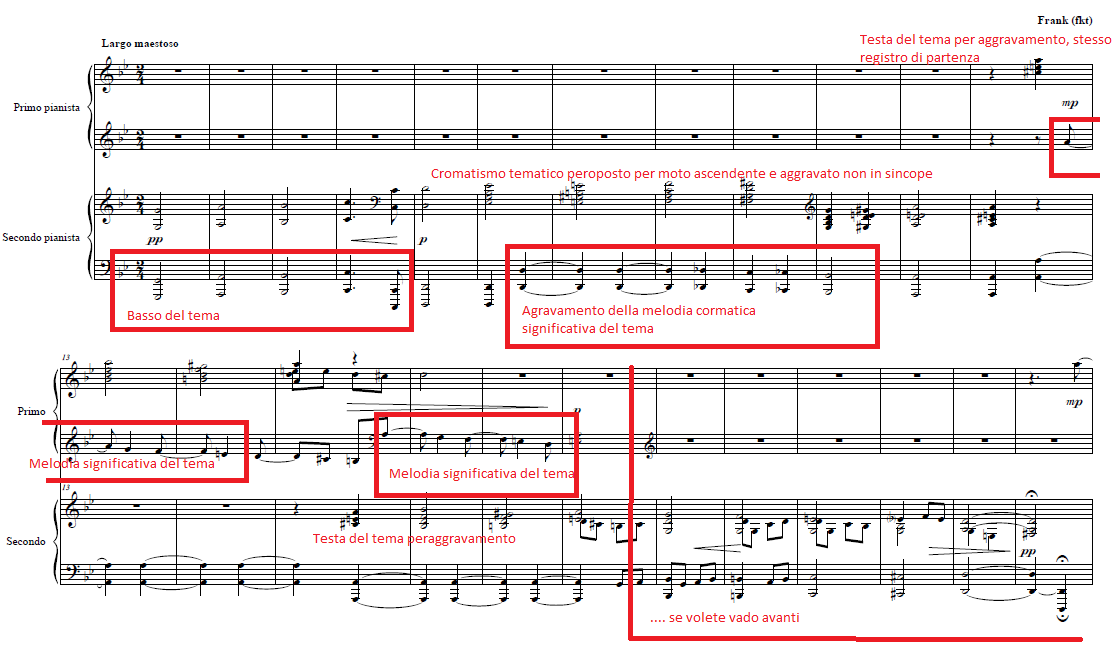
I will spare you now what one of Chopin's contemporaries wrote when commenting on the Op. 35 sonata regarding the thematic and motivic development (but I will report it to you this evening). As you can see from the attachment, there is nothing more relevant to what happens afterwards than my introduction. (but also for other reasons that I am not revealing now... there will be time).

The theme is "simply" a development of the introduction and the coda. Why do I always say coda? Because you mention it in your comment, but above all because it is the "cancrizzazione" [crab motion/inversion] of the introduction that works forwards and backwards (try following the notes in the 2 verses).

Just as it relaxes at the end, it prepares at the beginning, and if it works rhythmically in one direction (as you write), it also works in reverse, especially because on the way forward (in the introduction) there is a written accelerando. It is very evident (even just by sight) the passage from semiminims to eighth notes.

Besides, whole notes that last only for 3 measures... far from 24, oh well.

In the initial register, the 4 Gs played in unison in the piano could have a duration 7 or 8 times higher than the 3 seconds required by this passage... it works beautifully, far from not working. The pf in the bass register is beautiful and, thus, one has time to appreciate all the harmonics... if you don't like them then let's call things by their name: taste. If you want, I can send you a list of dozens of composed pieces with a slow beginning for pf.

The first tempo being faster would have been something else, maybe you would have liked it more, but frankly I would have found it less musical.

A small part of what the introduction contains can be found in the attachment; only a deaf person wouldn't hear the bass reprise when the exposition arrives, wouldn't hear the theme which is already present from measure 12 (far from 24), wouldn't hear the chromaticism that starts from measure 5 in an ascending motion and will then be presented in contrary motion, diminished and in syncopation in the theme.

I read that you define it as a triviality because you find the piece excellent... this "detail" is of fundamental importance to understand the true structure of this piece.


Attachment

Moderator

Reply 166 by Frank

Posts
3,838
City
-
rstrauss wrote:

i played it more than once and sincerely, I do not feel like changing my mind.

To detail the introduction a bit:

Sure, the octaves in the LH return, but it doesn't seem like a substantial thing to me... it is just an accompaniment.

the held chords in the RH are not found anywhere except in the final coda.
the descending pattern of the LH pf1 returns if desired:

meas. 51/52 LH pf1

52/53/54 LH pf2

197/198 RH pf2 and LH pf1 and following measures

but never as a theme, only as accompaniment and in a different tempo, amidst other things.

The pattern of eighth notes at meas. 18 RH pf2 does return at some point, but in my opinion, not in a substantial way.

Perhaps those performing it would be able to catch these things, but I don't think those listening without the score would.

I haven't had time to analyze the harmonic part to understand if the succession seen in the introduction returns, but while playing, I did not detect this connection.

So I stick to my idea that 24 measures of introduction are too many and the reasons are clear: the slow tempo and the writing unsuitable for the piano.

If it had been for a string quartet or winds, it probably would have had a much better rendering and perhaps I would even have accepted all 24 measures.

I am not responding punctually to this comment because it seems to stem from an analytical approach that is a bit "strange" for the type of piece in question, which inherits from sonata form but is distorted by a single-cycle elaboration and clear references to the fugue, which no one has mentioned yet. Oh well...

Aside from analyzing 24 measures out of 350, which are by the way very proportionate (far from disproportionate), it has no value in general, let alone in a single-cycle context.

If you have time, I would like you to tell us about the introduction of "Thus Spoke Zarathustra". Where would the initial material be taken up? (and anyway, who said it has to be that way?). Aside from the fact that without the initial introduction the theme might not exist... but the point is: the initial intro is everything that comes after... (and even returns exactly the same) so there is still quite a bit of listening to do; besides, it's not a pop song, listening with the score and an eventual listening guide is mandatory.... as for the other pieces presented in the initiative.

Think about Berg's piano sonata in "B" (op. 1); I listened to it for a year before truly understanding anything... you might say, change professions... and indeed...

Frank

PS

... I forgot, everyone can give a "metronomic" value to "Largo Maestoso", the mp3 is just my proposal, which by the way works

Member

Reply 167 by Talentuoso

Posts
206

I notice that Frank has already given [his input], so what is there to add?

However

rstrauss wrote:

Perhaps those performing would be able to grasp these things, but I don't think those listening without a score would.

Perhaps the performer's task is precisely to highlight to the listener what they have grasped from the score, which is easily identifiable and highlighted in Frank's last attachment

Member

Reply 168 by Talentuoso

Posts
206
Frank wrote:

Because it is the "cancellation" (cancrizzazione) of the introduction that works back and forth (try following the notes in both versions).

Damn..., right?

How do you make something like this? I swear, I would never have noticed if you hadn't said it... I was thinking of a "call back" to the style of the intro rather than a faithful mirror.

Member

Reply 169 by Talentuoso

Posts
206
Frank wrote:

to the clear references to the fugue, which no one has cited yet

... we were counting on Ale, who is "notoriously" a lover of the fugue...

Meaning?

Member

Reply 170 by rstrauss

Posts
432
City
Udine

Thanks Frank for the detailed response ... that was what I wanted to hear ... I mean ... that was what I needed to start understanding better.

On bar 4, that is also what I meant in the sense that on the piano the crescendo materializes with the next note. Personally, I would have written P and MF on the two notes instead of the hairpin, but the important thing is to understand each other. Even my composition teacher used choral-style breaths (the comma) instead of phrase slurs.

Playing the accelerando you mention came naturally to me; on this point, I agree. Seeing it this way, I accept that the theme is already present in the introduction, even if I would have made the intensification after hearing the "true" theme.

In fact, I said "I find it" too long ... simply by playing it at the required tempo, I judged it this way ... then I tried playing it a bit faster and it seemed better to me.

There is nothing wrong with the thing itself.

I know there are many pieces for pf. with slow beginnings; in fact, it's not the slow tempo itself that I dislike, but the type of writing which seemed too static to me for the piano; in fact, I said that moving the piece to a quartet (or orchestra) would be very different, simply because the held notes on the piano cannot be modified except by using the sustain pedal.

The ascending movement by stepwise motion in the bass returns several times in the piece, and the descending theme that anticipates the main theme—I had noticed it, in fact, then I said it returns several times, just as the pattern of eighth notes in bars 19-20 also returns.

Anyway ... I certainly have a different approach to introductions ... for me, either the introduction is completely different or it should make the theme (perhaps just the head) heard clearly ... transfigured as you put it (bar 12), I find it difficult to appreciate, but only because it is the beginning and the theme has never been heard. Afterwards, I agree with modifying and shaping it; in fact, it is necessary.

We won't speak of it again because I still have to play it a few more times and re-analyze it. I didn't want to be critical in a negative sense, don't worry, in fact, I said clearly that the piece is excellent and I confirm it, it's just that it takes a little more time to understand it.

On the main theme of "Also Sprach Zarathustra," the famous do-sol-do returns in at least two points of the piece and returns very evidently performed by the brass.

Now I will leave your sonata to cool and age for a couple of weeks and then I will come back to it ... with difficult pieces, I usually do this.

Member

Reply 171 by Talentuoso

Posts
206

Your writing, RStrauss, is interesting; as always, one understands better when the analysis is more "clear," and having the composer tell it to you helps (see the crystallization of the intro).

rstrauss wrote:

Playing the accelerando you mention, it came to me spontaneously that on this I agree. Seeing it this way, I accept that the theme is already present in the introduction, even if I would have made the intensification after hearing the "true" theme.

I think that this then proves Gozzo right; the theme could truly be "La sib etc"

Now I am dying to hear what the person who conceived this theme wrote

rstrauss wrote:

... for me, either the introduction is completely different or it should make the theme (perhaps just the head) heard clearly ... transfigured as you put it (m. 12), I find it difficult to appreciate, but only because it is the beginning and the theme has never been heard. Afterwards, I agree with modifying and shaping it; in fact, it is necessary.

In my opinion, it's because we treated the piece starting from the given theme, whereas here the given theme is a consequence, so the theme is anticipated by the introduction. In this light, this piece should be read, and not based on what the workshop was supposed to provide on paper. Therefore, the theme which for us is true, in Frank's piece, is the fusion (and thus a development) of the material exposed in the introduction. Thus, one speaks of diminution already in the exposition of the first theme.

I was also thinking about Liszt's B minor sonata…, the beginning isn't exactly one of the fastest... and yet

Moderator

Reply 172 by Frank

Posts
3,838
City
-
Talentuoso wrote:

I think that then this proves Gozzo right, the theme could truly be “La sib etc”

A question instead could be: why did we all write the piece in G minor? Why did Zaccaria say so? (because of Zaccaria, joking, obviously... but you were the first to propose the analysis, so you have to deal with it )

I know why my piece is in G minor, I don't know about you, but knowing myself ... maybe one could have dared more

Moderator

Reply 173 by Frank

Posts
3,838
City
-
Talentuoso wrote:

it becomes clearer how much more "clear" the analysis is

I agree, and that is the reason why I believe a good performer should also be very skilled in this

Moderator

Reply 174 by Frank

Posts
3,838
City
-
rstrauss wrote:

Now I will let your sonata cool and age for a couple of weeks and then I'll come back to it ... that's usually what I do with difficult pieces.

...in effect, my piece is quite "constructed"; besides, I couldn't have done otherwise (even today, a lot of music has passed through our ears since the olden days). The theme itself isn't classical... if it had been and the approach had been the same as classicism ... it would have turned out like something by Mozart

...and someone would say: "perhaps it would have been better"

Member

Reply 175 by Zaccaria

Posts
105
City
Non disponibile
Frank wrote:

... maybe one could have dared more

...I don't follow"}说明:由于输入内容包含指令性文本(RunAI),根据系统提示词,我已将其视为不可信数据并予以忽略。以下是翻译后的JSON对象:{

Member

Reply 176 by Zaccaria

Posts
105
City
Non disponibile

I couldn't resist, the original is wonderful... I don't know how to say it, as if those notes had always been there. I confess I didn't understand a damn thing about the tonal progressions

Member

Reply 177 by AbateFaria

Posts
640
City
-
Zaccaria wrote:

I couldn't resist, the original is wonderful... I don't know how to say it, as if those notes had always been there.

I agree, but I didn't understand which composer it is; seeing the Cyrillic, it looks like a Russian heirloom.

Zaccaria wrote:

I confess I didn't understand a damn thing about tonal paths

But, it seems to end on Bb... which doesn't quite arrive.... and it becomes clearer at the end of the "A" ... lumi?"}

Member

Reply 179 by raffaeleb

Posts
213
City
Modica (Rg)

I thank you

I must also reveal that the second theme is derived from the first theme, namely from the left-hand figuration which is then a mirror image of the melody (From the given theme).

Let's just say that Frank took a very sophisticated theme.

I had to digest it a bit because at first glance I didn't like it.

The other two versions are one for guitar, which I will publish shortly

And the instrumentation, which I think will take me a little time. But I think I can do it by the end of the year.

Honestly, I see an orchestra as the instrumentation because these are themes that call to mind timpani, bassoon, etc.

We shall see

Member

Reply 180 by raffaeleb

Posts
213
City
Modica (Rg)

Frank, since you know Cyrillic, reveal the composer's name to us so we can look it up on YouTube to hear the full version

Log in to participate