

Hi, I've been following you for a while, lovely atmosphere...congratulations.
I never hear anyone talking about Beethoven's death, just curiosity? Who was at the funeral? I don't know...anything that comes to mind.
Started by
Fenice
Member
Member
Hi, I've been following you for a while, lovely atmosphere...congratulations.
I never hear anyone talking about Beethoven's death, just curiosity? Who was at the funeral? I don't know...anything that comes to mind.

Member
As far as I know, at B.'s funeral there was F. Schubert
Member
I would never have thought it, as far as I know there was bad blood between the two... am I wrong?
Member
Beethoven never died, he is Immortal like his Art.

Administrator
It is said that at Beethoven's funeral there were more than 10,000 people. Is it true? Despite his popularity as a composer, he certainly had not earned the sympathy of certain classes, given his rather tough character...
Moderator
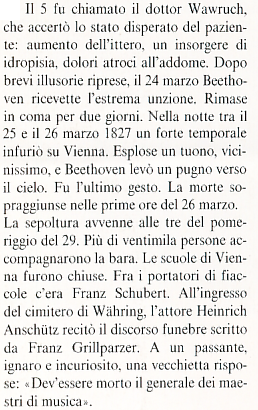
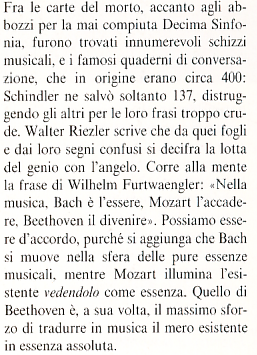
I have never been interested in the matter (I certainly read about it a few decades ago...) , I am dusting off a snippet from a text from the '80s, I don't know what its musicological claims are but there are also some curiosities that you will discover reading it
Moderator
Interesting comment from the old lady... how could they have ever immortalized that phrase ... ? ...
Beautiful, eh!... maybe even spot on for the era ... mah ...
Moderator
TheSimon wrote:It is said that at Beethoven's funeral there were more than 10,000 people. Is it true?
...it seems like more than 20,000 ....evidently he was more likable than musicologists want us to believe .... ah ah
Member
Truly thanks to everyone for the interest, Frank in particular... can the source be revealed?
Moderator
Fenice wrote:...can the source be revealed?
I thought I wouldn't be able to get to the bottom of it because at first I hadn't found the bibliography, then I realized it is taken from an essay by Quirino Principe; for those who didn't know him (I didn't), I found this on wiki
http://it.wikipedia....uirino_Principe
I don't know if someone can reference it
Member
Hello everyone!
The best contribution regarding the subject treated (at least in modern times) is the excellent book by Artemio Focher, published in 2001. The details of the book can be found here. Detailed descriptions of the last days, but also of the days following his death. The funeral, the funeral orations. Also splendid is the book "Life of Beethoven" by Moscheles, Boston, 1841. Among other things, one also finds the parts of the three "Equals" transcribed for male choir that Seyfried arranged specifically for Ludwig's funeral. A true musical gem!
Friendship,
Member
First of all, thanks to you too Orlandi Armando... are there translations?
Another question, since you surely know these books... do they confirm what Quirino Principe wrote?
Member
Ah, sorry, I didn't realize that the "here" was a link (it's even blue )...I saw that it is in Italian
Member
Yes, yes, Focher is very Italian. Unfortunately, Moscheles has not been translated; however, his current relevance derives precisely from his antiquity. That is to say, he is part of that small group of witness-books by those who saw B. (Schindler, Moscheles, Breuning, Wegeler, Ries and company) and who wrote specifically about Ludwig. Books to be taken with due caution, like Schindler's Beethoven Leben, which bent reality to suit necessity (to HIS necessity). The article that Quirino --- always too kind ---- rightly cites from Fank of the --- is objectively extremely correct. The only note that can be made is regarding the tenth [article], perhaps used here in a somewhat evocative way, but, as we know, even articles need a rhythm that only a certain pathos can provide. Regarding the quantity of people, they were indeed very many. Perhaps the figure is exaggerated, but the square in front of the church was excessively crowded, and several eyewitnesses were unable to reach the coffin.
Administrator
Regarding Schindler, however, I read that he discarded many letters because they were against the emperor and not as reported in the article: "...destroying the others because they contained phrases that were too crude..."
Member
no no Quirino Principe reports a sacred truth! When he met B. Schindler, he was little more than a boy; he served as his manservant for some time, handling various material tasks for him. Beethoven despised him immensely, but, as a type of character, he was ideal to be by his side. Finally, he re-entered the inner circle only at the end of B.'s life, supplanting Holz, who, as far as is known, was a companion. History has been manipulated by Schindler. That is to say, he deliberately destroyed part of B.'s last correspondence, but above all, he destroyed at least 135-140 of the 402 notebooks estimated in the inventory of April 4, 1827. Not satisfied with this, he also manipulated part of the 1826 notebooks with his broomstick handwriting, erasing B.'s writings! The worst misfortune is that he wrote a biography with many omissions and many false dates..... The greatest witness turns out to be the least reliable! Why he did this is obvious; a) to (re)habilitate himself in the eyes of posterity, b) to shift the dates of the "WP" so that he had been present (even during the years of the quarrel), c) he eliminated all the insulting phrases that B. wrote against him, obviously, d) and this is the most "noble" part of the "questio": Schindler was a more vulgar and reactionary man of the nineteenth century (one only needs to see his only photo to realize how stiff an individual he was). Therefore, he eliminated not only, as he said, the references to the Emperor and his court, but also the list of brothels, notes on venereal diseases, comments on the sexual performance of his friends' wives, references to "ignoble" diseases such as diarrhea or abscesses, etc.... in short, he contributed to making B. not a man, but a demigod. Scientifically speaking, one could define it as a "mess" that unfortunately spread its nefarious miasma from 1840 through the entire 20th century. So much so that Thayer did not finish his monumental work precisely because he systematically studied all the sources and discovered that B. was....... a man!!!
Member
... but how many do you know?
Thanks again!
Administrator
Very interesting Armando. You should write a book on Beethoven, or have you already done so? If so, I would be pleased to read it...
Member
True TheSimon, let us know Armando
Member
Forgive the rant, but sometimes I think about the "grace" that fate has granted this man (Schindler, I mean). If it is true that the man Beethoven was bound to be difficult to endure, it is equally true that being in the presence of the musician was like being in Vulcan's Forge. I, who search for sketches and fragments, can only imagine the quantity of drafted projects he might have seen; perhaps even the Tenth, or the Requiem, or the Bach overture.... how many musical notes were contained in those destroyed notebooks? How many would our unfortunate man have preserved? Where were you, Wegeler and Breuning!!! The "good" Schindler had free access to the Swarzspanierhaus for at least 24 full hours; he took (I say stole) many objects that only Bodmer's moral quality brought "home."
As for books, don't make me blush! I have written a little something, but above all, I dedicate myself to minutiae. That is to say, like every "old-timer," I do not dare speak of the Saints (from the Missa downwards). So I dedicate myself to less known paths. If I do not bore you, I will write down a few titles:
(Appeared in "ABF Revue - Association Beethoven France" - in French)
Schiller's "Fiesco" project -
The Hess 47 trio and the Beethovenian transcriptions
The new life of the Anhang 3 trio
The Macbeth overture Biamonti 454
The six string quartets Anhang 2 - A WP
The historical origins of the "Vestal Fire" myth
The Tarpeian Rock in Rome and the reception of the legend
in the Triumphmarsch Tarpeja WoO 2a
Opus 126: The monetary system in Austria in B.'s time.
On the Neue Beethoven Studien of Bonn:
Volume 9: Beethoven and the Art of Horology (part 1)
the second part with the detailed description of the repair I performed on Ludwig's pendulum clock in September 2011 at the Beethovenarchiv, will be released in January in volume 10. (but it is already ready in our language)
Kind friends - too kind - I did not make this small list of pamphlets to say what I have done (I would never do that), but only to tell you that, if you are interested in any article (and others that I omit), I will be happy to publish it on this beautiful forum!
With warm friendship,