With great pleasure. We look forward to your publications. Here there is always a hunger for knowledge, and arguments presented in this way, almost like a story, fascinate and do not tire. Anyway, given your dialectic, which it is impossible not to notice, I would think about writing a book, Armando. I'm planting a seed in your head... Who knows if some opening lines from those reading you won't move you.
As always, you are very kind and affectionate. In life, I have always taken the judgments of others very seriously. In fact, while studying with Beltrami senior, near the time of my graduation, there was much talk regarding my musical quality. It was poor, rather poor... It is not a bad thing to say - and admit - that for certain aspects of life, I can only reserve limited gratifications for myself. I would never have been a musician. That is all. I did not experience this "limitation" with true pain; nowadays I cannot do many things that at twenty years old I could do beautifully. The stringent analysis of my possibilities led me toward the infinitely small; (as Giovanni Guanti told me, it is in the infinitely small that the infinitely large is found----- but perhaps he was quoting Pasteur!!!) that is to say, by exploiting my - these indeed are - undoubted capacities for "Vertigo of the Catalogue" as Umberto Eco calls it, I have dedicated myself to Beethovenian sketches. In this field, I can - and must - operate. My ability (if one can call it that) must be put at the service of the Internet and its amazing users. Some time ago we spoke of a possible section dedicated to great musicians; well, in the hope that the little I know might be of interest, my friend, here I am ready... at your service!
E
Eagle
Member
Reply 23 by Eagle
Posts
264
OrlandiArmando wrote:
A long time ago we spoke about a possible section dedicated to great musicians;
It seems interesting to me; from what I have read, it could perhaps also be linkable from your website on Beethoven?
..............A truly fitting description is right here; sometimes the solution is indeed "homemade," but those who look far ahead do not see the glasses on their own nose. And here I also add a little face, perhaps perplexed:
And after the confusion, I see that I still owe a small reply to Eagle. Please excuse my delay. No, the articles are not on the site, but if you wish, we will open a small post where I will transcribe every single article, if that would please you. In the meantime, on the site, I am adding every single description for every work of B., and I have practically covered all works from 1 to 138 (opus 84, 113 and 117 are still missing, and a little else). Furthermore, I should be receiving the scans of the manuscript that was sold at auction just a few days ago for an insane amount. The Mp3s will be online soon.
Armando, thank you for these beautiful contributions that you gift us. I would also be pleased to know if you have written or will write a book about the Great One. His Music is a "thunder" in history and playing it one perceives the "fire". Compliments
Paolo
A
Arzigovolato3
Member
Reply 28 by Arzigovolato3
Posts
26
Does anyone know the cause of death of Ludwig van Beethoven?
Thank you Paolo and sorry for the late reply. I don't deserve praise, truly!
One could say "of what he did NOT die"! There are entire treatises on Beethoven's pathologies, and you can find some titles in the bibliography section of the site. Throughout his life, he was a chronically ill man.
Answering this question succinctly would be an injustice to Ludwig and perhaps would even go beyond a simple post; therefore, I will limit myself to answering the question directly: Does anyone know the cause of Ludwig van Beethoven's death? The answer: Hepatic complication derived from a lung infection (bronchitis-pneumonia or bronchopneumonia) contracted in late December 1826, with an unfortunate course. (Cardiac arrest, intestinal or renal blockages, but the bronchopneumonias themselves resulted unfavorably from various previous diseases). For this reason I stop here: I would feel like discussing the nineteenth-century meaning of Cancer, Fever, Colic, Humor, but that is already going beyond the general scope.
Cirrhosis is misleading: one thinks of alcoholic liver cirrhosis..... at this point, here are Weissenbach's words: The liver was « reduced to half its normal volume, tough and of a bluish-green color, full of nodules the size of a bean, both on the tuberculated surface and within ».
So we are talking about macro-nodular cirrhosis here, i.e., post-hepatic, and not micronodular cirrhosis which is proverbially linked to alcoholism. In fact, Beethoven's hepatitis had a long course, as demonstrated by his clinical history starting from 1821, and flared up after the cold suffered during the journey from Gneixendorf to Vienna. Such active chronic hepatitis, associated with colitis, rheumatism, repeated catarrh, abscesses, cryopathy (ailments caused by exposure to cold), ophthalmia, and skin diseases, leads us to think deterministically of an immunopathy of the connective tissue. In this case, the clinical picture would be perfectly explained, unlike alcoholism. (this is not an ethical opinion!!!)
L
Lucas
Member
Reply 32 by Lucas
Posts
71
I don't remember where I read it, but it seems that at the time, to enhance the taste of wine and make it more "appetizing" to those who might be more accustomed to it, for example due to the effects of alcoholism, lead glasses (or treated with this material) were used... which evidently was not good at all or at least constituted an aggravating factor.
Although Saturnism was discussed in the past, Beethoven's illness does not appear to be a direct result of lead poisoning. In fact, the two pathologies have similar symptoms: abdominal pain, abdominal pain, asthenia, ashen complexion (whereas B. was ruddy), altered metabolism, gout, diarrhea, vomiting, nausea, intense thirst (the burning thirst of December 1826 is to be attributed to bacterial fever). I saw Beethoven's tableware at the BH—spoons, forks, sugar bowl, etc... all in silver-plated or gold-plated silver on the inside. There were practically no lead pipes left... However, adulterated wine was a classic; lead was used to remove the acidic taste and make it more "mellow" (of those cursed Ciravegna ante litteram?) but our man, when he could, drank Rhine wine of Wegeler provenance. In fact, a handkerchief with a little sulfur was enough to generate an unmistakable blackish stain upon contact.... I know that in taverns, passersby always had some behind them....
But how this topic teases! I also see that this section is flying... very, very well!
G
Gatto
Member
Reply 34 by Gatto
Posts
13
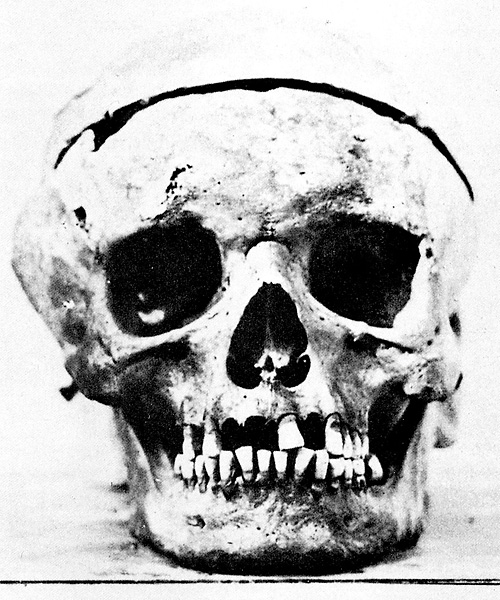
But how is it done, centuries later, to make such precise diagnoses? ... I understand the testimonies, etc.
They couldn't have exhumed Beethoven's remains?... at least I hope so...
Hi Gatto and hi everyone. To satisfy curiosity, here is a (nice?) photo of Beethoven's skull. (note the sawed parietal bones, the partial ablation of the teeth and the jaw temporarily repositioned in place)
As for the autopsy examinations, as well as the diagnoses, the doctors were extremely competent. Palpations, deductive examinations, smells, humors, led to excellent results. The real problem was this: establishing a cure! It is true that they could discover a tumor only with experience..... but then? Placebos, toxic medicines and devastating surgical operations, with toxic or absent anesthetics.....
Last response: B.'s body was exhumed 2 times, in 1863 and in 1888. On this occasion, however, it was noted that the skeleton was in very poor condition. A definitive article was written by William Meredith, and you can read an excerpt here: http://www.scribd.co...lliam-Meredith As Mike used to say: Cheerfulness!!!
Well, the exhumation was performed for relocation first and for reconnaissance afterwards. Modern techniques were used to analyze the numerous strands of hair to identify the causes of his ailments and his death. In 1994, Dr. Walsh obtained authorization from the owner (Dr. Guevara, whom I had the pleasure of knowing) to perform analyses on 20 of the composer's hairs, comparing the results with those of a control group. The research found extremely high concentrations of lead, approximately 43 times higher than those of a normal man. These results show how lead poisoning, although it was not the cause of death, could have been the cause of many ailments that accompanied Beethoven throughout his life, such as digestive disorders and very intense abdominal pains. Furthermore, the research shows that traces of drug metabolites are absent and that no combinations of metals were found that would suggest glucose disorders or assimilation pathologies. In this regard, I recommend the fine book by Russell Martin, Beethoven's Hair, Piemme edizioni, p. 287.
I am also responding very quickly to Marce (hi Marce!) "...I have always been curious, after his death, was Beethoven's greatness immediately recognized?" Certainly. Even during his lifetime, Beethoven was a celebrity! He was very well known and esteemed, and in his notebooks there is this handwritten phrase: "Let it be! anyway, no one will take my place in the history of music away from me" (November 1823......)
Phrase reported from an interview regarding Rossini's music which was causing a sensation in Vienna during the years 1820-1825; from Mosé to the Barber; perhaps one can notice a certain "languor" of Ludwig that is felt - so to speak - a little less "fashionable" among his (bought) Viennese fellow citizens. Many are the "tranchants" phrases and judgments on the music and taste of the Pesarese native. (in truth, more from friends than from B. himself)