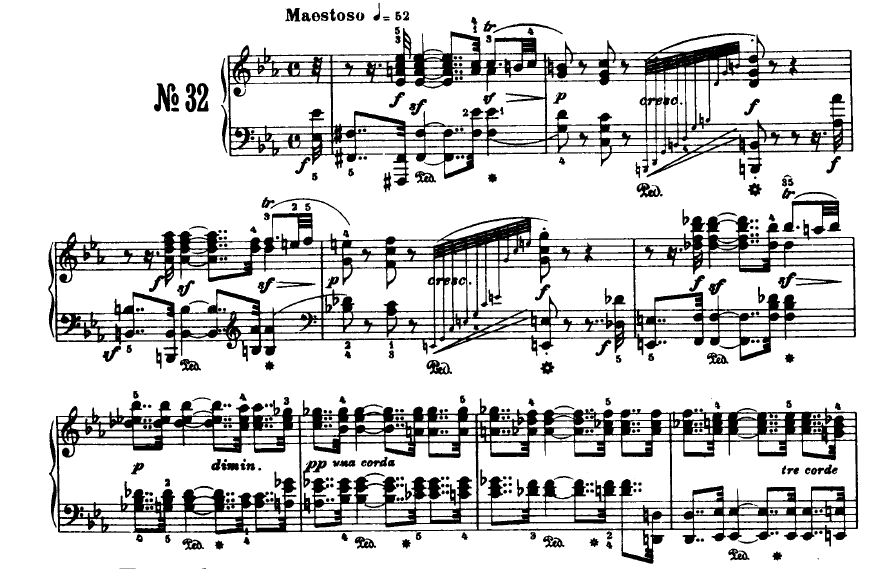
We all know that a value point increases the note by half of its value,
Every additional value point adds half of the previous value.
Now, setting aside this theoretical notion, apart from in Pozzoli's exercise book, are there pieces that make use of multi-point notation? It seems to me that I have never encountered any; does a theoretical notion exist without practical application in the repertoire?
yet another confirmation that the values are not "absolute", and that our music theory is flawed... musical notation always derives from performance styles and should be interpreted in light of praxis
M
Marta23
Member
Reply 12 by Marta23
Posts
153
Vale wrote:
Carl Philip Emanuel, Bach's son, explains it well. All simple points were double in the Baroque era. They must be performed double!
Reading, however, I have raised some doubts. In Baroque music, small groups like the basso continuo were at the discretion of the performer (who became an improviser). Is it not possible that this is also applicable to the 'punti di valore'?
The trill must be played double. Anyway, Baroque is Baroque, so the performer has their liberties, within the limits of the style. As I have already written above: there are harpsichord treatises that explain it. First of all, that of Carl Philip Emanuel (Essay on the True Art of Playing Keyboard Instruments), just as there are many other treatises that explain it. It is a PHILOLOGICAL research, it's not just fantasy
Interesting! I understood the meaning. I saw in a brief internet search that the book mentioned by Vale is one in which Carl also predicted knowing how to vary (therefore improvise) the pieces chosen to be performed, in addition to technical-musical interpretive reading. I think it will be one of my next purchases.
Vale, in your opinion, why would it be worth owning?
Regarding treatises, apart from that of C.P.E. Bach (mentioned in passing by "Vale") composed of 2 volumes, the second of which is very interesting because it deals with Basso Continuo, one can delve much deeper into Baroque performance practice (including ornamentation, another thorny subject) also through the treatises of Türk, Telemann, and Mattheson.
Those who are particularly masochistic (missing only the sadistic smile, eh eh) there is also that of the musicologist Hans Klotz.
yet another confirmation that the values are not "absolute", and that our musical theory is flawed... musical notation always derives from performance styles and should be interpreted in light of practice
Am I the only one who didn't understand? I truly didn't understand