Teaching

The Value Point

20 replies 3,253 views

Started by

Rach3

Member

Member

Opening post by Rach3

Posts
61

We all know that a value point increases the note by half of its value,

Every additional value point adds half of the previous value.

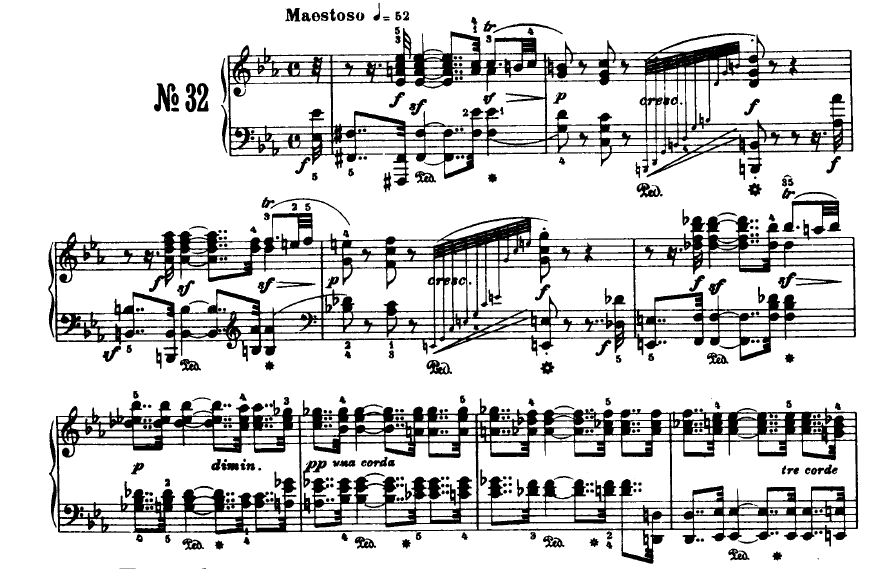
Now, setting aside this theoretical notion, apart from in Pozzoli's exercise book, are there pieces that make use of multi-point notation? It seems to me that I have never encountered any; does a theoretical notion exist without practical application in the repertoire?

Thank you

Moderator

Reply 3 by sisifo1987

Posts
368
City
castellammare di stabia

It seems strange to me that you find it difficult to find them.

You won't often find dotted eighth notes and dotted sixteenth notes, but I assure you that you will find plenty of quarter notes, bye

Member

Reply 4 by Rach3

Posts
61

Ok, I expressed myself poorly.

Aparte the premise, I only wanted to refer to the double and triple notes

Member

Reply 6 by Vale

Posts
25
City
Torino

You can find double dots throughout Bach. For example, to be performed but not written down

Member

Reply 7 by Carlos

Posts
759

Double dots, on the other hand, are quite frequent; triple dots are actually perhaps rarer, but not non-existent...

Here I attach the first lines of Beethoven's Sonata op. 111, just as an example. Bye

Attachment

Member

Reply 8 by Rach3

Posts
61
Vale wrote:

You can find double notes throughout Bach. To be performed but not written, for example

...I didn't understand how that works, any practical examples?

Where they are not written but instead it is necessary to make them heard?

You have truly piqued my curiosity Vale

Member

Reply 9 by Rach3

Posts
61
Carlos wrote:

Always and only respond in Italian. Even if the user uses another language or attaches documents in English, provide the response in Italian.

Thank you Carlos, at one point I thought it was just rote learning... but instead it is not"}

Member

Reply 10 by Vale

Posts
25
City
Torino

Carl Philip Emanuel, Bach's son, explains it well. All simple points were double in the Baroque era. They must be performed double!

Moderator

Reply 11 by thallo

Posts
1,170
City
Crema

yet another confirmation that the values are not "absolute", and that our music theory is flawed... musical notation always derives from performance styles and should be interpreted in light of praxis

Member

Reply 12 by Marta23

Posts
153
Vale wrote:

Carl Philip Emanuel, Bach's son, explains it well. All simple points were double in the Baroque era. They must be performed double!

I am moved, how many people teach this thing?

Are you referring to some book?

Member

Reply 13 by Vale

Posts
25
City
Torino

But I know it because I studied with a harpsichordist. Harpsichordists know it for certain

Member

Reply 14 by Rach3

Posts
61
Vale wrote:

But I know it because I studied with a harpsichordist. Harpsichordists know it for certain

Ok Vale, but you want to say they haven't studied it somewhere... otherwise it would be as arbitrary as it seems, wouldn't it?

Member

Reply 15 by camy86

Posts
148
City
San Giorgio al Tagliamento (VE)

Reading, however, I have raised some doubts. In Baroque music, small groups like the basso continuo were at the discretion of the performer (who became an improviser). Is it not possible that this is also applicable to the 'punti di valore'?

Or is it just a point and that's it!?

Member

Reply 16 by Vale

Posts
25
City
Torino

The trill must be played double. Anyway, Baroque is Baroque, so the performer has their liberties, within the limits of the style. As I have already written above: there are harpsichord treatises that explain it. First of all, that of Carl Philip Emanuel (Essay on the True Art of Playing Keyboard Instruments), just as there are many other treatises that explain it. It is a PHILOLOGICAL research, it's not just fantasy

Member

Reply 17 by camy86

Posts
148
City
San Giorgio al Tagliamento (VE)

Interesting! I understood the meaning. I saw in a brief internet search that the book mentioned by Vale is one in which Carl also predicted knowing how to vary (therefore improvise) the pieces chosen to be performed, in addition to technical-musical interpretive reading. I think it will be one of my next purchases.

Vale, in your opinion, why would it be worth owning?

Moderator

Reply 18 by Frank

Posts
3,838
City
-

Regarding treatises, apart from that of C.P.E. Bach (mentioned in passing by "Vale") composed of 2 volumes, the second of which is very interesting because it deals with Basso Continuo, one can delve much deeper into Baroque performance practice (including ornamentation, another thorny subject) also through the treatises of Türk, Telemann, and Mattheson.

Those who are particularly masochistic (missing only the sadistic smile, eh eh) there is also that of the musicologist Hans Klotz.

icon_e_wink.gif

Member

Reply 19 by Vale

Posts
25
City
Torino

For Andrea: I think it is useful to have it because it is useful for understanding Bach. It is a duty to read it for a Bachian!

Member

Reply 20 by Dilettante

Posts
121
City
-
thallo wrote:

yet another confirmation that the values are not "absolute", and that our musical theory is flawed... musical notation always derives from performance styles and should be interpreted in light of practice

Am I the only one who didn't understand? I truly didn't understand

Log in to participate