

I would also be interested....
Kindly Simone, could you send the link to me as well?
The tuner has recently visited, and I feel desolately ignorant regarding this art...
Thank you.

Started by
Member

Member
I would also be interested....
Kindly Simone, could you send the link to me as well?
The tuner has recently visited, and I feel desolately ignorant regarding this art...
Thank you.

Administrator
Gorino wrote:I would also be interested....
Kindly Simone, could you send the link to me as well?
The tuner has recently passed by, and I feel desolately ignorant regarding this art...
Thank you.
Sent
Member
Thank you very much!
Administrator
Don't worry, I hope I was precise in my explanation but if you have questions or points to clarify, I am here...
Member
Hi simone how are you? well I hope. Could you send a copy to me as well?
P.s. I am always waiting to try your software, when do you plan to release it?
Regards Giovanni
Administrator
Hi Giovanni, I sent you the link via private message.
Unfortunately, the tuning software project will not be moving forward. For my thesis, the supervisors and I have opted to develop a Kontakt Piano library instead.
I plan to also create a free version, with fewer layers, to release online to promote our website.
I don't know if, once my studies are finished and time permitting, I will start developing the tuning software as well.
Best regards, and if you feel like it, let me have some feedback on the work I sent you.
Member
I liked it very much, thank you again for sending it to me. Compliments on your work
In what sense will you make a sample library? With sampling methods different from the typical ones?
Administrator
Hi Mica, there are various lines of thought regarding the capture methods used to create a piano sample library. Obviously, since companies must produce products that suit various musical styles, they opt for the simultaneous placement of a large number of microphones, which are then appropriately mixed and blended to achieve different types of perspectives. The choice is also, naturally, influenced by the need to maximize sales. Miking techniques using close microphones near the strings in AB or XY configurations are used for Jazz; some major brands have even created microphone models that are inserted directly inside the piano, clipped to the frame, or have an arc that rests on the sides of the wooden panels. Of course, even though these microphones are tuned not to have an excessively percussive sound, they do not adapt very well to classical music (see the DPA 4099, for example).
Another fact is that while increasing the number of microphones does increase the mixing possibilities to obtain a full sound, it is equally true that what increases is also the background noise. This phenomenon is quite clear, especially in the East West Pianos library where, when playing a loud chord while holding the sustain pedal, an increasing background noise occurs which, once the pedal is released, stops abruptly, ruining the naturalness of the sound. In fact, this would never happen when listening to a live piano. Furthermore, one is very constrained by the number of layers. Just consider that the library with the highest number of Layers reports "only" 18. The need to not disproportionately increase the number of sampled Layers is due to the fact that every time we add a Layer to a library, we significantly increase the RAM usage and utilize more system resources (CPU load). Since they must market a product that is also compatible with computers that are not from NASA, they choose an unexaggerated number of Layers. It should also be added that professional libraries (the most highly rated ones) often have the ability to mix various perspectives to allow for the sound we like most to be obtained. There are two fundamental problems: the first is that most people proceed blindly because they haven't the slightest idea how to properly mix perspectives; the second problem is that each perspective has its own samples, so by adding every perspective, the number of samples doubles: for example, one perspective is 1000 samples, two perspectives are 2000, etc. By adding samples, we constantly increase CPU and RAM load, making it much easier to encounter phenomena such as inhuman latency (a library unplayable live) or even MIDI desynchronization—meaning the latency is so great that the PC cannot reproduce as many samples as there are MIDI data points being sent to it. Once a certain latency limit is exceeded, the system crashes with the usual error screen. This is why there is a need for increasingly powerful hardware. As if that weren't enough, in modern libraries it is always possible to choose a convolution reverb (which is very heavy on the CPU since for every cycle it must calculate a convolution product, which is not a normal product but a specific integral product), and this further burdens the CPU. This is without considering that in the quality hierarchy of reverbs, Convolution Reverb Software comes last, followed by Hardware (like T.C. Electronic), and finally the natural reverb of the environment (undoubtedly the best of all, since machines and plugins attempt to emulate exactly this type of reverb).
Considering these points and difficulties, I thought of this:
- I don't need to create a library for the sole purpose of selling it, so it is not necessary to try to create a library that adapts to various styles; I think it is better to specialize it and direct it toward the classical field.
- If I am to specialize it in the classical field, I don't need 2000 perspectives; the classic AB technique outside the piano is enough for me.
- I don't need a reverb; I can decide to use the natural one and dose it simply by moving the microphones further from or closer to the piano, while still keeping reverb levels that are not excessively pushed but close to being just right (the kind heard in old recordings of great pianists, which is the most beautiful in my opinion); if necessary, it is always possible to add an external plugin on the Channel Strip or on a Bus to increase its effect.
In this way, I save a lot of memory and many, many system resources because the Kontakt engine should only function as a player, and this allows me to add more levels: by rough calculation, I could easily reach about
23/25 sampling at 24 bit 96KHz and then, at the limit, performing a sample rate resampling to 44100 with dithering.
For classical music, it would be perfect for several reasons:
- Sound is already good and ready without the need to tinker for hours and hours.
- Finally a good set of levels that always penalize classical performers
I am thinking about the possibility of sampling harmonics to create a software simulation of sympathetic vibration between strings when playing a chord while holding the sustain pedal, but I certainly won't make it in time for my thesis because the developing harmonics vary in intensity depending on the distance from the vibrating string and the force with which the latter is struck. Furthermore, an empirical law would need to be found by playing a note with the pedal depressed and blocking the vibration of this single chorus of strings to evaluate the developed harmonics through a spectrum study; in short, it's not something you can do in a month, so I will postpone this for the second version of the library.
Member
Naaaaa the software for tonal emulation is awesome, it must be done!!! I agree though, I think it will take much more than a month for something of this type.
Administrator
In reality, there is a function similar to what I would like to do on the Garritan Authorized Steinway libraries, but it's not quite the same thing. In Garritan, there is the possibility to choose the "amount" of Sympathetic Resonance, so it is assumed that they have sampled the fundamental harmonics of certain strings and that their volume can be raised or lowered. The problem is that the development of harmonics when playing multiple notes together is the result of the collaboration of multiple harmonics and fundamentals from a chorus of strings that stimulate others to vibrate by sympathy; therefore, the issue is much more complex and should be analyzed case by case. If something like this could be achieved, the libraries would move one step closer to the real sound of the piano, even if, I repeat, one will never truly get there... To make a philosophical parallel: "Human knowledge is like a polygon inscribed in a circle; no matter how many sides we add to the polygon, it will never be a circle"; it's a bit like that here. No matter how much progress can be made, a software instrument will never surpass a sampled piano; it is a limit that we must know how to accept... With philosophy
Member
Dear Simone, the feedback can only be positive; every time I am amazed by your competence and simplicity in explaining things. I found your work very convincing, and for this, I can only congratulate you. A sincere thank you from me and surely from the other users for sharing your work with us.
As for the piano sound library, I can't wait to try it and compare it with my own well-nourished personal collection (Leap Piano Gold Edition, Ivory 2 American Concert D, Italian Grand, and various Native Instruments).
See you soon
Administrator
Thank you Giovanni, I am very pleased that you liked my work.
Just yesterday I was discussing the thesis project with one of my two supervisors. According to them, the difficulty in creating the library could lie in the lows (27 Hz are hard to make homogeneous with the rest of the frequencies at play and on the summer). I don't want to be wrong, but I believe that the summing algorithm is already implemented within Kontakt. I can't find anything about it either on the internet or in the Kontakt programming book I bought (the only one existing in English) in this regard. All that's left for me to do is run some tests.
If you are interested, I will keep you updated like a logbook...
Member
Thank you, I would be honored.
Speaking of basses, is it just my impression or do almost all libraries have this limitation? In the sense that I hear the basses as a bit muddy, if you'll allow me the term “boomy” when compared to a high-quality keyboard, especially the Leap Pianos, Imperfect Faziolis etc... perhaps I would save the Ivory libraries where everything is very crystalline, homogeneous and pleasant to the ear, what do you think?
Administrator
Dear Giovanni, in my opinion, your judgments stem mostly from an Hi-Fi type of listening. Headphones and Hi-Fi quality listening provide a loudness effect, meaning you cannot expect to judge an almost continuous range of frequencies on a non-linear system... In reality, even our ears are not linear, but reference listenings are calibrated to give us the illusion of linearity. Probably if you had the chance to listen to the same things on reference monitors like Genelec or Tannoy, your judgment would change. I have listened to various studio libraries and I assure you that many are frightening. Also, if you remember, we even did a small test of the type "can you recognize the acoustic one among many digital ones". Let me know with what device you listened to these sounds.
Member
So do you think it's just a speaker problem or is there something else? Look, at this point I'll give you a small list of what I own:
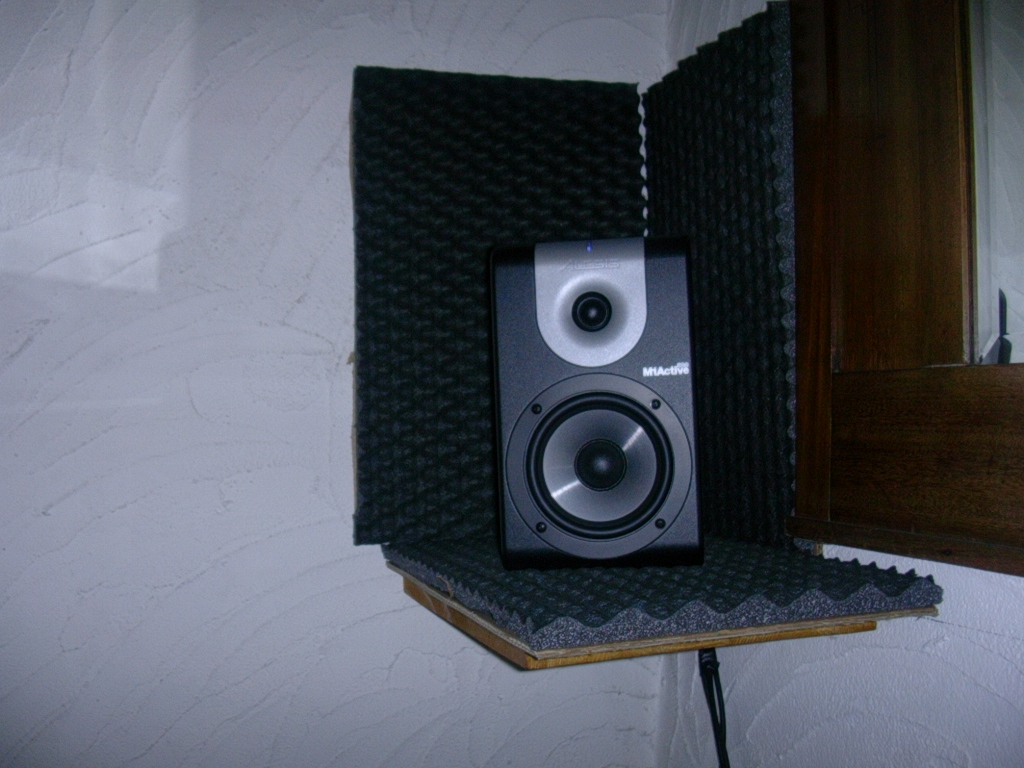
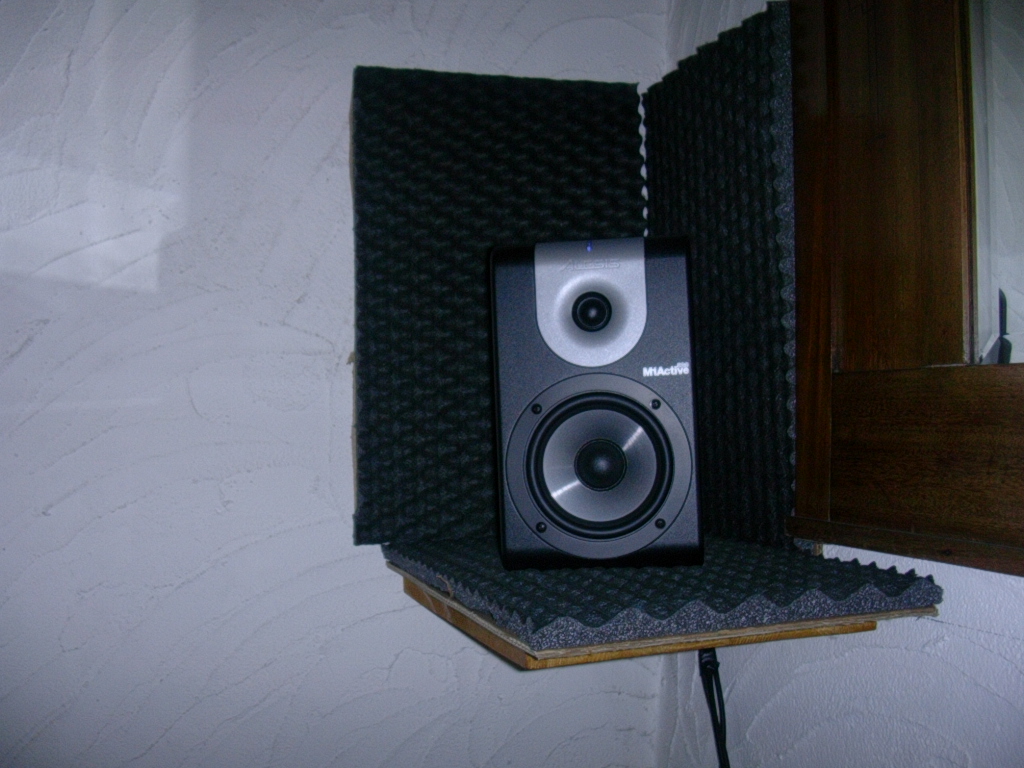
Asus ultrabook with Samsung pro ssd (I removed the hard disk) with only usb3.0 ports, Focusrite Scarlett 212 audio interface, professional gold-plated balanced jack cables, and finally a pair of Alesis M1 Active 520 studio monitors; they certainly aren't Genelecs, but it's what I have.
Administrator
Well, it seems like a good setup to me. In which library in particular are you encountering that problem at the low end? Can you also send me some examples of what you consider correct and what you don't consider correct?
Maybe with different listens we can understand better...
Member
Dear Simone, the mystery has been solved. I had the solution right under my nose and didn't see it; it was enough to soundproof the bottom and sides of the speakers to eliminate the annoying problem.
Anyway, I think they have a slightly small cone (6'' woofer); in your opinion, is it better to add a subwoofer or wait until I have the possibility to purchase better speakers, perhaps two Genelecs.
I accept advice for a possible model or an alternative.
Administrator
Monitors with small cones, whether Alesis or Genelec, lack bass strength; this is a fact and a physical limitation. In both cases, you must add a sub and tune it properly, which is not easy because a room measurement must be performed with specific software, and the room must be treated at strategic points with bass traps, sound-absorbing panels, and 2D Schroeder diffusers, or even better 3D ones if you have the possibility to create them. Everything depends on how much you want to spend. Regarding the resonances, I almost wanted to tell you in my last message; I was waiting for listening files though, because if I hadn't heard the defects you reported, I would have specifically advised you to work on the room acoustics.
Member
Thanks simone, always very kind and ready to provide answers. I think I will opt for speakers with larger cones, it seems to me the simplest and least expensive solution...
Administrator
Before spending money on speakers, let's talk about the room. The size and power of the speakers depend on the size of the room (Law of spherical divergence). How big is this room?