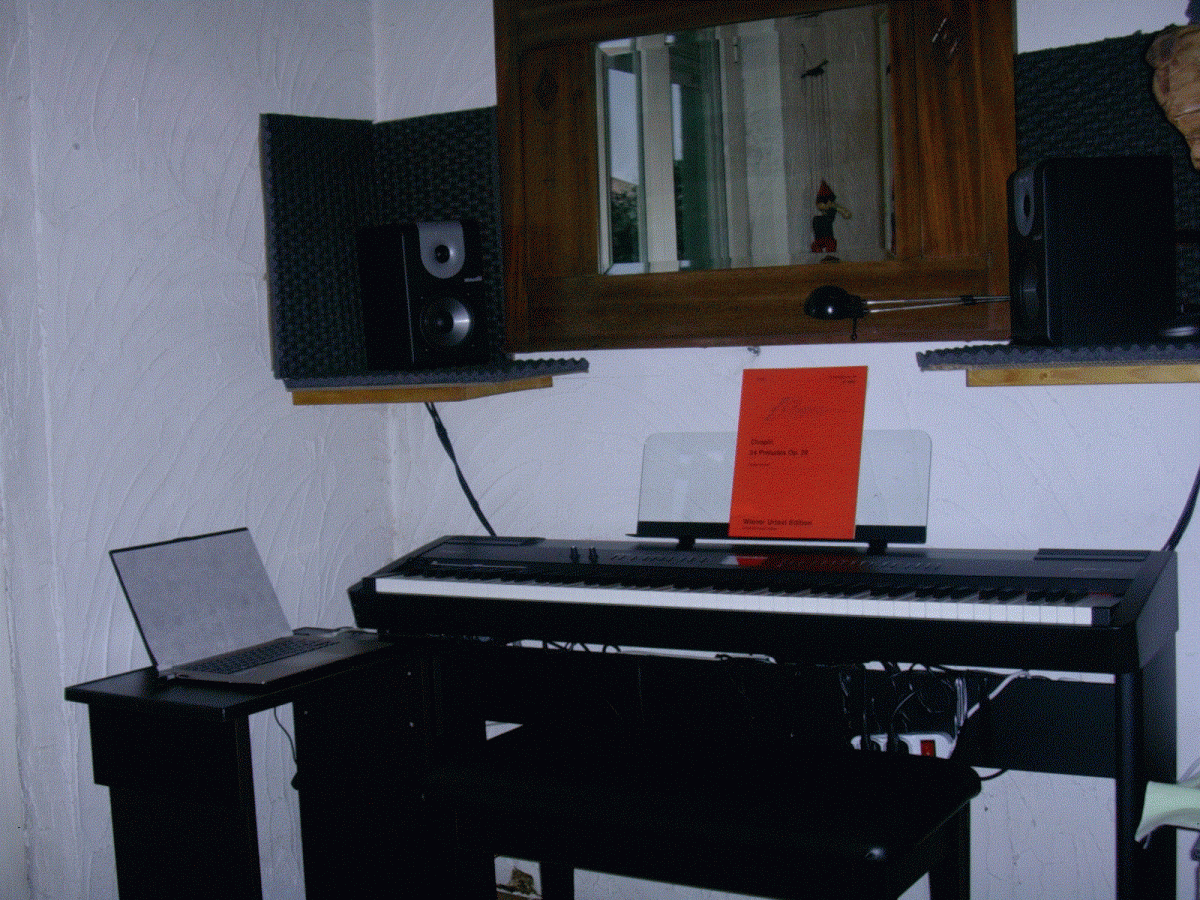
The room measures 6.00m x 3.50m, it was created in the basement of the house, and is used as a small bar/lounge area with furniture and everything else.
I cannot make a recording studio there; I might risk eviction or even worse, being lynched by someone I know.
I am sending you photos to help you understand how I have positioned everything.
Despite the room being small, it's not a matter of making a recording studio, and I would even tell you that if you made the right corrections, your neighbor should thank you. I see some problems already from the photo. The speakers are pointing right towards the corners, sound-absorbing panels are not advisable, and now I also understand why you hear the bass as very muddy. The problem is that low frequencies are not directional; they expand in all directions because they more easily bypass objects of smaller dimensions. Around 20 Hz, the wavelength is in the order of 17 meters. This is also why outside nightclubs, one often only hears the low frequencies, which can easily bypass objects of incomparable dimensions. My advice is to put bass traps in the corners of the room.
I understand it's a very small room, but even though those monitors are Near Field, you should change their focus. Perhaps use headphones for playing, but for mixing, stay a little further away, let's say at 2/3 of the length of the room (since the room is small). You should then measure it and correct it with Schroeder Diffusers and sound-absorbing panels. If you have some woodworking practice, you can even make the diffusers yourself; maybe I can do the calculations for you and send you the dimensions of the diffuser. You have to buy the panels, there's no other way. Do not wallpaper the walls with egg cartons like many used to do because they are absolutely useless. The absorption coefficient is calculated based on porous materials, which is exactly what sound-absorbing panels are made of. The height of the pyramid then affects the absorption coefficient and the absorbed frequencies. As we were saying before, the larger the size of a material, the more low frequencies are absorbed.
Obviously, to make the right calculations, it is necessary to perform a room measurement, with a frequency response graph of the room. This way, the deficiencies and resonances can be understood and acted upon accordingly.
Preparing an acoustic environment completely changes the sound; the RT60 measurement and subsequent reduction is then a matter of taste.
@Marcolone
Sure, I'll send them to you privately.
G
giovannip
Member
Reply 44 by giovannip
Posts
553
Hi simone I was only able to read your response today I will give you an answer as soon as possible forgive me...
as soon as I received the link I downloaded the video and the paper. I found them very interesting and useful for me as an enthusiast of the subject. I would like to ask if you could write on this forum or email me a slightly more detailed description (step by step) of the procedure you follow to tune the central sector of the temperament using fifths and fourths instead of major thirds and sixths. What are the advantages/disadvantages of one method versus the other? Why is the first method (fifths) preferable for you?
Hi Mario, I'm glad you liked my paper. Getting down to business...
The step-by-step procedure is already depicted in the essay. There are two tables with all the beats to be established between dyads. Each row of the table represents a subsequent step. There are no differences or advantages/disadvantages in choosing to tune by thirds and sixths or fourths and fifths. It simply depends on those that we can hear better, therefore it is purely subjective; both lead to the exact same result. Both methods stem from mathematical calculations (in the video I talk about how to find the correct beat frequency to tune the middle octave). The middle octave is not tuned by chance, there is a reason... The middle octave is where the mathematical calculations work well (because it is the least disharmonious octave). When reporting the subsequent octaves, only the ear is needed because it is necessary to keep the octave dyads steady, i.e., with a beat frequency of zero. However, since it is not easy to distinguish the "steadiness" of a dyad especially at the high and low ends (these are psychoacoustic effects that vary from person to person), it is not possible to design software that tunes the piano perfectly. The taste of the tuning depends on the ear. But why tune by fourths and fifths or thirds and sixths? If one wanted, one could even opt to tune by seconds and sevenths by finding the beats relative to these two dyads. The problem is that, probably, the isofrequency harmonics would then create beats "out of range" for our ear (I am hypothesizing, I haven't verified, but my intuition tells me this) since the ear can perceive beat frequencies in the order of 15/20 Hz, depending on the sensitivity of the ear; if the frequencies in different dyads were 30 beats, just to give an example, one could still tune theoretically, but in practice you would no longer be able to distinguish the beats at that frequency, you would perceive a rough, indistinct sound and it would not be possible to tune. Regardless, I challenge you to try to tune, even if you wanted to, with beat frequencies in the order of the third decade. How would you count them?
from the tables of the two algorithms in the thesis, it is evident that, whether one tunes the central octave A2-A3 by fourths and fifths, or tunes it by thirds and sixths, one must still always deal with the thirds A2-C#3, Db3-F3, and F3-A3, adjusting them to approximately 8, 11, and 13 beats/s. However, hearing 8, 11, 13 beats/s is not for everyone, because, since the beats of the thirds originate from iso-frequency harmonics far from their respective first harmonic frequencies, they are not easily perceptible by everyone. One solution could be the following: since the beat rate of an interval doubles at the next octave and halves in the previous one exactly like the frequency of the notes, one could initially tune A1 in octaves from A2 as well. Then, from A1, tune the three consecutive thirds (A1-C#2, Db2-F2, and F2-A2) to a beat rate of, for example, approximately 4, 5, 6 beats/s (which can be counted more easily) and then tune C#3 from C#2, Db3 from Db2, and F3 from F2 to obtain the desired beat rates of approximately 8, 11, 13. What do you think? Let me know your opinion.
It cannot be done for a very simple reason. The inharmonicity down there is truly considerable. By tuning starting from the octave down there, you carry along all the problems deriving from it. The division of the central octave is made precisely because it is the least inharmonic one, and therefore all the mathematical considerations we made before apply to it. The theoretical harmonics with which we count the beats deviate very little (a few tenths of a Hz) from the real harmonics, so in this frequency band we can consider the inharmonicity to be zero. The fact that it is not easy to count 13 beats and that it is not something everyone can do is pure truth, and it is precisely for this reason that piano tuning is more difficult compared to that of any other instrument. In essence, not everyone can do it; only those who have an ear can do it, and this ear must also be well-trained! Moreover, the lower you go, the more the human ear tends to perceive frequencies as being higher; in the treble, the opposite happens, and indeed, if you measure the frequency curve once the piano has been tuned by ear and plot the frequencies on a logarithmic scale, you will notice that there is no linearity which theoretically should represent perfect tuning. We must always contend with the ear. Unfortunately, a piano tuned only mathematically sounds very bad. A piano tuned by ear sounds good even if it is mathematically wrong in most of its sections. If you perform mathematical tuning, you will notice that your ear will only like the central octave where you perform the division because only there, where the inharmonicity is very low, do the mathematical rules apply; as you go down or up, it will always get worse.
so, based on your considerations, it seems to me that the tuning of the A3-A2 octave could be achieved with an electronic tuner, since in that section of the piano the inharmonicity is almost nil and for this reason we could apply the mathematical model which the tuner surely also follows, even if the latter does not take into account dyads, but only single notes. Reading here and there on the subject on the Internet, wanting to also perform the tuning of the middle octave by ear, I saw that other algorithms are also proposed for fourths and fifths: for some all fourths should be made wide compared to pure (by how much? for some all equal, for others progressively wide) and fifths narrow compared to pure (by how much? for some all equal, for others progressively narrow). Others write that if the upper note of the fourth is in common with the lower note of the fifth, then the fourth and fifth must have the same beat rate (e.g., A2-D3-A3); if the fourth and fifth overlap, meaning they have in common either the upper note or the lower note of their respective dyads (e.g., A2-D3 and D3-G2), the fourth should have a beat ratio of 3:2 relative to the fifth. What do you think? Can you clarify how things stand? Is it necessary to perform mathematical calculations on the middle octave even when tuning it by ear?
All of this is correct, but these are accommodations that fall outside the mathematical discussion we have had so far... That overlapping fourths and fifths must have the same number of beats as ascending fourths and descending fifths is not entirely accurate (they must have approximately the same number of beats), also because it is impossible to think one can succeed in establishing the precise mathematical number of beats when tuning. The famous C# 8.73... But who is capable of tuning this dyad with 8.73 beats? Perhaps one might manage to tune it within a range between 8.6 and 9.8... Just to give you an idea. The fact remains that the method for partitioning the middle octave arises from the considerations we made earlier.
Fair observation regarding tuners like Tunelab. They work well in the central part, but then they do not work below and above due to the point I was making in my previous post, namely why the ear tends to modify acoustic phenomena subjectively, from person to person, and therefore mathematics, which is an objective science, cannot function in a field of a subjective nature.
I consider what you express to be right and precious, but I believe that a tuner, when tuning any piano by ear, hardly has awareness of the mathematical calculations at the base of the tuning work, and this even and especially when they are tempering the central octave. If it were not so, before tuning any piano, the tuner would have to perform mathematical calculations to get indications on the number of beats; furthermore, since every piano has its own inharmonicity, this would invalidate the indication of a certain number of beats for this or that fifth, for this or that fourth, for that third, sixth, etc. Also because eventually, on every piano, one would have to perform calculations that would result in being different from instrument to instrument even within the same octave. I think, instead, that every tuner, based on their artistic ear, has built their own method that is modular and adaptable to any piano they have in front of them, but which will surely lead them to the final artistic product, i.e., the tuning that will please the pianist above all else, as well as themselves; in other words, a method that guides them in tempering all the intervals of the central octave even without mathematical calculations, serving as a starting point for then tuning the other sections of the piano. And the methods, from what I am reading on many web pages, are many, and, if dissected in a mathematical key, the results would most likely be different, if not even discordant with each other. Tell me if I am wrong or not.
I think we misunderstood each other. Tuners don't sit down to do calculations; they use those already made by counting the beats by ear. The difficulty of tuning is precisely this: gaining confidence with the ear-counting of beats. We all use cell phones, but certainly we don't have the need to know how they work electronically; if we do know, it is our cultural wealth. The tuner knows that between one note and another of a dyad, "x" beats must occur, and he counts them. Then he should also know how those beats are calculated and why, but that is another matter; it should be part of his culture—even without knowing the mathematical procedure, if you know the beats in a dyad, a piano can be tuned, if you have the ear for it.