Tuning

Upright Piano Regulation

28 replies 19,564 views

Started by

Fra

Member

Member

Reply 21 by Fra

Posts
266

You always have some anecdote to tell us :-D

No Paolo, I'm not obsessed with numbers, quite the opposite... measurement is the objective verification of a phenomenon, while our sensations are subjective and tied to a specific scenario. So it is true that acoustics, instrument placement, etc., are elements of primary importance.

For example, I keep this Schulze Pollman in my home entrance in a space limited by three walls of 3 sqm where, obviously, it cannot give its best, being also a rather loud instrument with a timbre that isn't exactly clean...

This is also the reason why it always sounds out of tune... I will be moving house soon and we shall see.

I am responding to Simone. The tuning was done by ear and I must say that of all of them, it is the one that satisfied me most; the tenths finally sound as expected and overall one certainly cannot complain. Perhaps it cannot be properly evaluated from videos made with a camcorder.

I was intrigued by your reference to unequal temperaments... imagine that the tuner was telling me about them while he worked because shortly after he was supposed to speak about unequal temperaments as a speaker at a meeting held at Santa Cecilia, as part of a course.

Regarding my own needs, however, I say that the S-P is giving me satisfaction nonetheless: I am not a pianist, my musical experiences are linked to choral conducting, particularly in the context of folk music in Sardinia: I am actually from Oristano but for work reasons I have lived in Milan for about three years, so I had to abandon my choir, my friends, my interests and more...

I had therefore completely neglected the musical discussion when at a certain point it occurred to me to buy a piano to fill this void (the first was a restored Anelli)....a few months ago I also decided to take some lessons (can you start studying the piano at 30???) and Bach's little preludes are right in my study path, let's call it that. I have a poorly played little prelude on the Schulze Pollman for you to hear....I am not ashamed only because I am used to hearing my teacher tell me that my execution is a bit crappy, that my hands don't work together, that I am not precise with the tempo, that the voice that should be heard does not emerge, and I am also well aware of this (obviously)!!! Anyway, I always remind him that it is not my profession and that I am definitely better at designing heating systems, as sad as that may be...

for the "amateurs thrown into the deep end" series, here is the video:

http://www.youtube.com/watch?v=JNv0hdER3W8

Member

Reply 22 by torrese

Posts
242
City
casorate sempione varese

Please always and only respond in Italian. Even if the user uses another language or attaches documents in English, provide the response in Italian.

Member

Reply 23 by maquieto

Posts
665
City
Massa Carrara

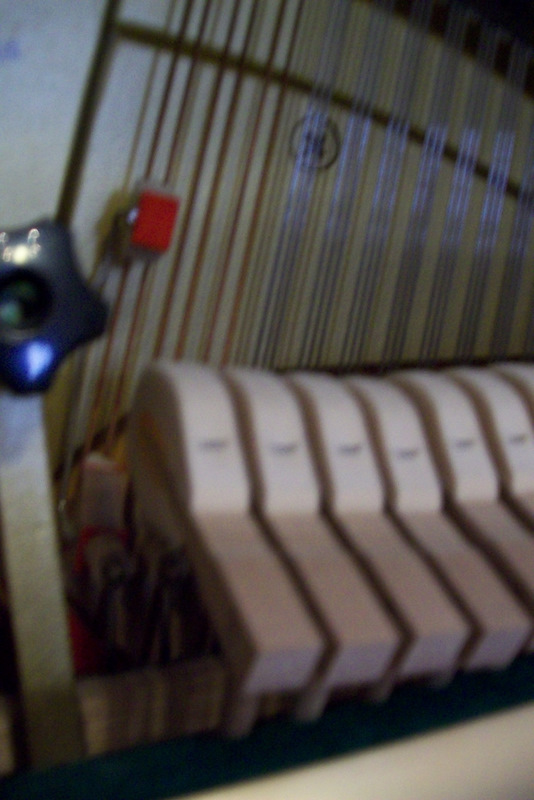
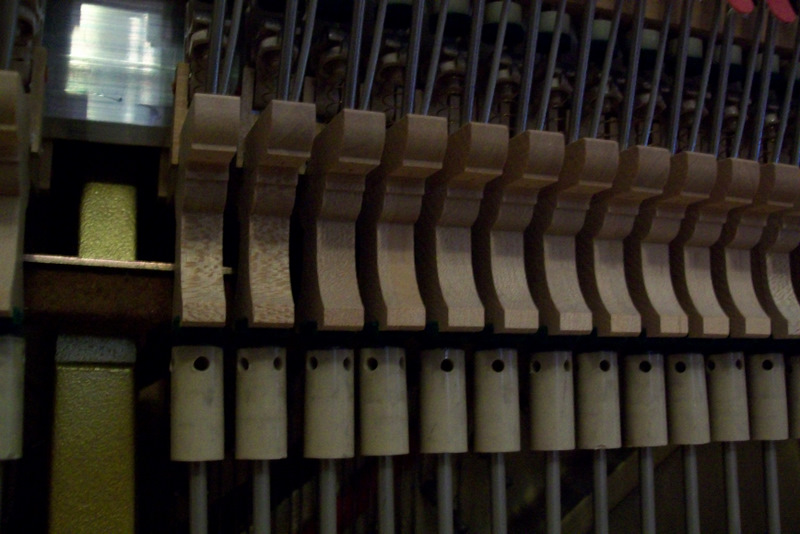
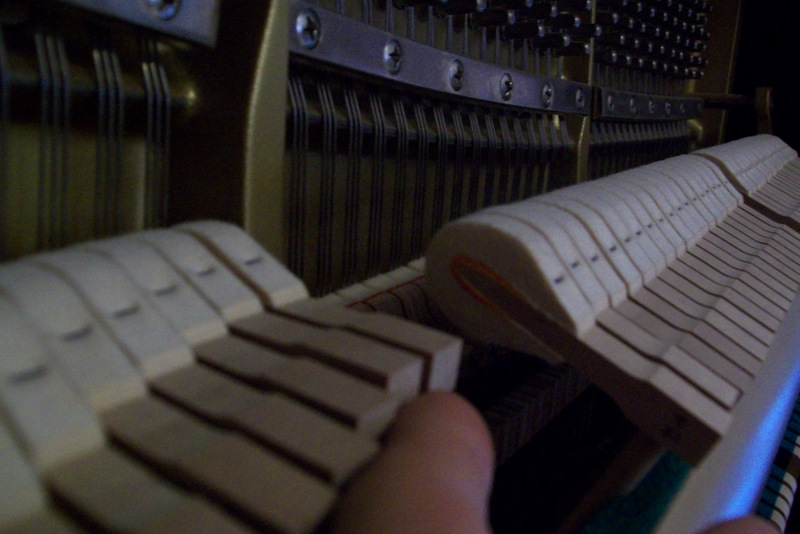
Hi Paolo. As I mentioned to you some time ago, I am sending you some photos of my piano: a Yamaha U3 upright piano which, after being regulated, has lost some of its characteristics. For example, in the cantabile, it is not possible to achieve that beautiful "hollow" sound it once had. It seems a bit gray, so to speak, and less dynamic in terms of the key weight you apply to obtain more sonority. Let me know if you see anything that is wrong. Thank you in advance.

AttachmentAttachmentAttachment

Moderator

Reply 24 by pianoexpert

Posts
3,876
City
rocca di papa

You talk about the highs, but you don't show them to me. Anyway, from the mid-highs it seems to me that they have been shaved, slightly altering the shape. Then one would need to see and hear how they were voiced. One should also check the planarity of the strings and the parallelism of the hammer faces. Furthermore, when shaving hammers, the striking point must be checked. With shaved hammers (vertically), the striking point is lower relative to the capotasto.

Member

Reply 25 by camy86

Posts
148
City
San Giorgio al Tagliamento (VE)

Excuse my ignorance: from what I have understood, tuning by ear compared to an electronic instrument is preferable, why?

Moderator

Reply 26 by pianoexpert

Posts
3,876
City
rocca di papa

A good electronic instrument must be able to measure, "detect" the degree of inharmonicity of the instrument; otherwise, the tuning will not result as good. The "partial" sounds of the piano (so called because they are parts of the fundamental sound) are not "exact," meaning they do not coincide with the exact multiples of the fundamental sound itself. This is due to the "physicality" of the strings, which do not produce "perfect harmonics."

Let's say that technology has gone very far (see VERITUNER and TUNELAB). I prefer the ear. Perhaps it is a cultural "choice" of mine. In any case, the ear is a wise and severe judge of the relationships between sounds. Conversely, it is often deficient in judging absolute pitch. The matter is more complex, and please do not blame me for having synthesized it.

Member

Reply 27 by camy86

Posts
148
City
San Giorgio al Tagliamento (VE)

It was I who failed to explain myself and perhaps you anticipated what I was thinking, let me explain: the tuning of unisons string by string is undoubtedly more precise (I would venture to say cold) with digital detection, but when playing for example fifths or fourths, the different overlap of partials gives sensations that cannot be detected by any electronic instrument because the ear-brain processing prefers different configurations of string loading which consequently produce different tunings. Did I say something stupid?

Moderator

Reply 28 by pianoexpert

Posts
3,876
City
rocca di papa

The problem lies precisely in the partials. Anyway, sophisticated instruments detect the inharmonicity of this or that piano. I must say that the results are satisfactory. Even unisons sometimes do not have to be "perfect". On a good piano (grand), the left string is tuned down minimally. This makes the instrument more cantabile. This slight "detuning", almost an "oscillation", is acceptable precisely because, among three strings, the other two prevail at perfect unison. When the piano plays with the "UNA CORDA" pedal, that specific string is excluded and it plays only on the two in perfect unison. NEVER do this to the right string (as I have unfortunately heard people say!!!!). In fact, playing with the "una corda" pedal would exclude one of the strings in perfect unison and the game would be even: one against one. Extremely annoying and contrary to logic.

With sophisticated digital instruments, even fifths, fourths, and octaves work. Sometimes, however, some pianists have requested an "by ear" intervention and were more satisfied. Perhaps due to misuse of the device or........I don't know.

Administrator

Reply 29 by Thesimon

Posts
4,504
City
Ariccia, RM

If you permit, I will interject by bringing to light an issue that has not been considered.

With digital tuners, let us remember that there is a small mic-related technicality, namely its frequency response.

Perfect confidence in a digital tuning tool is obtained when the microphone is totally flat, and I want to specify that truly flat microphones do not exist, even if there are many that come close, but at a cost of no less than 2000 euros per microphone.

One should research to evaluate whether the frequency is still acquired as the real one by the microphone even if its volume differs from the source. One would have to ask a microphone manufacturer. In any case, the point is that if the error (or small = |Hzreal - Hzperc|) viewed as the absolute difference between the real frequency and the frequency perceived by the microphone is less than 10^-2 Hz, in this case the error is negligible and therefore the tuner must necessarily be recognized as precise and thus more reliable than the ear. Let us not forget that tuning by ear requires counting beats for those tuning by moving through fourths and fifths or those by thirds; thus, tuning by ear in this case could be less precise. It should be said, however, to the detriment of my criticism, that I far prefer tuning by ear, at least on my piano. Is this also a matter of timbre beyond pure frequency?

Log in to participate