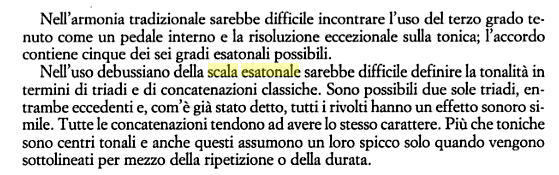
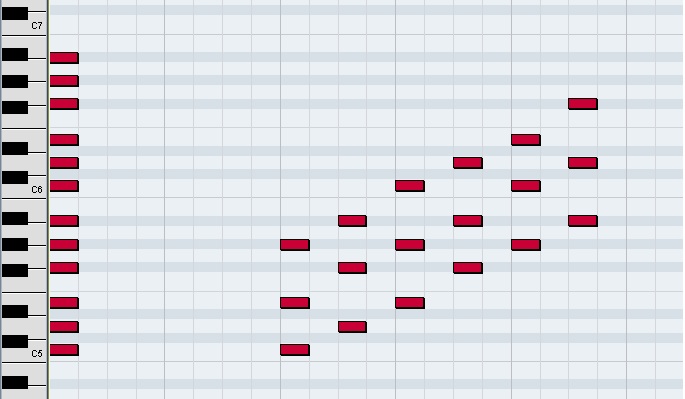
I was reading on the piston (see attachment) but I'm having trouble making sense of it... I had already opened a discussion about the third degree in the past
But here the discussion seems to connect with the whole tone scale including augmented triads, which from what I understand are typical of the third degree in the minor scale.
I was practicing the whole tone scale, starting from C because it's easier
C D E# G# A# C
Deriving the chords built on the third degree, I can't make sense of it... I was expecting 6 similar chords...
Understanding the list of triads and seeing if they are truly augmented would already be a great success ... something is missing to me, which is probably why I won't include the discussion about the third degree ...
so, in a whole tone scale, for example the one you indicated, considering triads by 3rd intervals we only have 3 augmented triads: C+ (C E G#); D+ (D F# A#); E+ (E G# B#). if you go further in the scale, you only find inversions of these 3 triads.
now, suppose you are in a minor key and want to use the III with a dominant function: the III in minor does not have the leading tone (Eb G Bb), so the 5th must be raised to have the leading tone (Eb G B), thus creating an augmented triad.
we have seen that an augmented triad can refer back to a whole tone scale, because indeed augmented 5th chords are contained within this scale.
that being said (hoping it is correct), I have no idea where Piston wants to go with this
considering the scale, the 3rd interval triad built on F# is:
F# A# D (D+ in 1st inversion)
J
JazzMania
Member
Reply 10 by JazzMania
Posts
116
AleGozzo wrote:
fa# la# do
non è una triade per intervallo di 3a.
Pensa ad un bel F#b5 aggiungici un bel mi (la settima) ... guarda che bel colore è saltato fuori. Ecco che la scala esatonale contiene un bel po' di Jazz
"considering the scale, the x 3e triad built on F# is:
F# A# D (D+ in 1st inversion)"
I realized that this indication can be misleading if referred to a whole-tone scale. Do you mean "by thirds" with the principle of "one note yes, one no", as chords are built in a "normal" scale.
do (ok) re (no) mi (ok) fa# (no) sol# (ok) la# (no) etc