

I had never noticed this section of the forum, no harm done.
The question is simple, why did Beethoven write a will?
Started by
Kappa
Member
Member
I had never noticed this section of the forum, no harm done.
The question is simple, why did Beethoven write a will?
Member
...I was just about to ask that. But did he make a will?
Member
Kappa wrote:The question is simple, why did Beethoven split a will?
... are you referring to the musical or the legal one?
Member
Help..... I was writing for the other post, but my pre-dinner is overflowing here: Beethoven wrote two testaments: (Dino comes very close to the truth with a single stroke) One Spiritual, in 1802, and one legal (more touching to me) on his deathbed, in March 1827. The first is the famous "Heiligenstadt Testament: October 6, 1802
To my brothers Carl and ..................(here goes the name of the other brother) Beethoven
"O you men who consider me and call me an irritable, stubborn, misanthropic being, what wrong you do me! You ignore the secret reason for why I appear so to you! My heart, my spirit were inclined toward the delicate sentiment of benevolence. I have always been willing to perform great deeds. But imagine that for six years I have been struck by an illness without hope of cure, aggravated by incapable doctors. Year after year deceived in the hope of improvement, finally forced to accept the eventualities of a lasting infirmity whose cure may take years or is entirely impossible, endowed with an ardent and lively temperament, once prone to the diversions of society, I have had to quickly isolate myself, and spend my life in solitude. I also wanted, sometimes, to rise above all this, but how harshly I have been rejected by the renewed, sad experience of my infirm hearing! and it was still impossible for me to say to men: “speak louder, shout, I am deaf”. Ah! how to confess the weakness of a sense that in me should be of a more perfect degree than in others, of a sense that I once possessed with immense perfection, with such perfection that few musicians certainly have or have ever had? Oh, I cannot. Forgive me then if you see me withdraw as much as I would gladly join you. My misfortune causes me double pain because for it I must be misunderstood. It is no longer permitted for me to seek solace in the company of men, in noble conversation, in mutual confidences. Completely alone, or almost, I can join society only for that little which requires the most pressing necessity. I must live like an outcast. As soon as I approach men I feel seized by a terrible anguish because I am afraid of being exposed to the risk of making my condition known. So it has been also in these six months that I have spent in the countryside. Advised by my wise doctor to save my hearing as much as possible, he almost met my present natural disposition, although, sometimes pushed against my tendency, he would let me be convinced to participate. But what humiliation when someone near me perceived a flute from afar and I heard nothing, or when someone else heard the shepherd singing, and I heard nothing. Such facts brought me almost to despair: it was close that I would have ended my days. Only you, art, have held me back. Ah, it seemed impossible to me to leave the world before having expressed everything for which I felt created, and so I prolonged this miserable life of mine, truly miserable, with a body so sensitive that a somewhat abrupt change can throw me from a better state of health to a worse one.
Patience! This means that I must choose patience as my guide: and I have patience. Lasting, I hope, must be my purpose to resist until the inexorable Fates please to cut the thread of my life. Perhaps it will go better, perhaps not: I am resigned. To be forced to become a philosopher at 28 is not easy, and for an artist it is more difficult than for any other man. Divinity! You look into my innermost being, you know my heart; you know that within it dwell love for humanity, the inclination to do good. O men, if one day you read these my words, think that you have done me wrong, and let the unfortunate man console himself by finding an unfortunate man like him who, despite all the obstacles of nature, has done everything in his power to be welcomed into the circle of artists and worthy men. And you, my brothers Carl and ............, as soon as I am dead, if Professor Schmidt is still alive, pray him on my behalf to describe my illness and add this sheet written by me to the history of my infirmity so that after my death, as much as will be possible for him at least, he may reconcile with me. At the same time I declare you two heirs to my small estate (if it can be called such). Divide it honestly, be in agreement and help one another. What you have done to me, you know, I have long since forgiven you. And I thank you particularly, brother Carl, for the devotion you have shown me in these recent times. My wish is that a better life may fall to you, less tormented by worries than mine. Teach your children virtue; it alone can make them happy, not [the]"
money; I speak from experience. It was she who lifted me out of misery; to her, besides my art, I owe if I have not ended my life by suicide. Farewell, love one another! I thank all my friends, especially Prince Lichnowsky and Professor Schmidt. It is my wish that Prince Lichnowsky's instruments be preserved by one of you; but let it not be a cause of strife among you. If, however, they can serve you for something more useful, sell them. How happy I am if even from my grave I can be of use to you! So be it! With joy I go towards death. If it comes before I have had the chance to explain all my qualities as an artist, it will come too soon despite my hard fate, and I would certainly wish it to come later. Yet I would be happy nonetheless: does it not free me from a state of endless suffering? Come when you want: I meet you courageously. Farewell, and do not forget me entirely when I am dead. I have deserved it from you because during my life I often thought of you, of making you happy; be so!
LUDWIG VAN BEETHOVEN
Heiligenstadt, October 10
I take my leave of you, and with sorrow. Yes, the sweet hope that I nurtured here below of being able to recover at least to a certain point, must now abandon me completely. As the dead leaves of autumn fall, and are withered, so too has it withered for me. I go away almost as I came. The same courage that often animated me in the beautiful summer days has vanished. O Providence, let a pure day of joy appear to me! For a long time, the last echo of true joy has been foreign to my heart. When, when, O Divinity, will I be able to feel it again in the temple of nature and of men? Never? No, that would be too cruel!
For those who had the patience to read it, some news (but also for others, I wouldn't have read it all) Heiligenstadt was a small village near Vienna, now it is a wretched suburb of the city..... I will omit the moral and spiritual details, which you can find everywhere, but I add some historical notes: it was found in a drawer of B.'s desk and never sent; then sold at the "Beethoven succession" auction. Property of Jenny Lind, it was donated to the Hamburg Library where it is now. It is addressed to the brothers Kaspar Karl (1774-1815) and Nikolaus Johann (1776-1831) whose names are omitted three times. The doctor he speaks of is Adam Schmidt, professor at the University of Vienna and ophthalmologist. Prince Lichnowsky is Carl Lichnowsky (1758-1814), pupil and friend of Mozart, protector of B. ("Protector" is not a bad word, Marziano! but I will answer you in another Post)
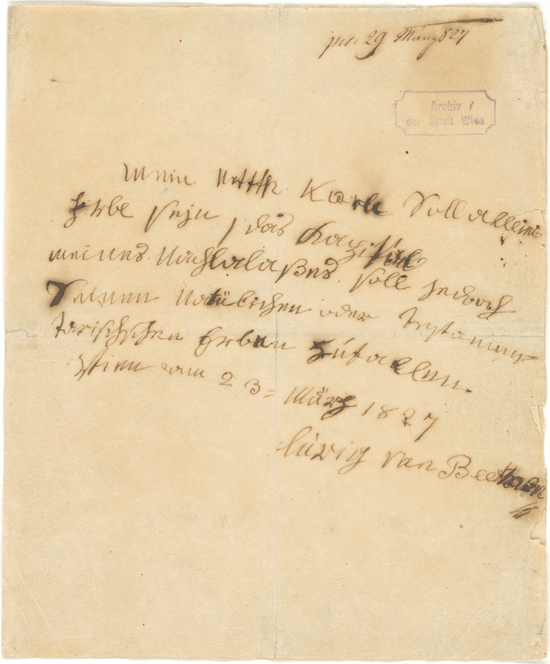
The second will is this:
And it says, more or less textually: I leave all my assets to my nephew Karl etc.... Lu(d)wig van Beethoven.
Moving, a few hours before dying.... Note the signature: he cannot write straight and omits the "D" ... what heartbreak, poor man!!!
Member
Interesting Armando
OrlandiArmando wrote:Beethoven wrote two testaments: (Dino comes very close to the truth with a single blow) A Spiritual one, in 1802, and a legal one (more touching for me) on his deathbed, in March 1827.
Hans von Bülow did not define the 32 sonatas as the "New Testament" of the piano?
Member
Morning task: I must not speak ill of Von Bülow, I must not speak ill of Von Bülow, I must not speak ill of Von Bülow.... I'll write it 100 times on the blackboard like Bart Simpson in the opening credits of the eponymous series. What a completely romantic idea, to write something for some instrument and think of leaving a testament.... maybe I'll have a stroke now and you will read this as a spiritual testament. (don't worry: I am doing great and anyway I leave everything to my wife) Hans von Bülow, son (and father and grandson) of his time, was no stranger to such assertions (do you remember that joke about the harpsichord and Scarlatti???). Looking "ad postera", it seems formidable to me that certain boutades are still taken into consideration by certain criticism or criticisms, I would say, of an old nineteenth-century stamp. (I admit, I am completely "celiac" when digesting a certain nineteenth-century criticism, just as I cannot understand many of Adorno's "tirate", my own problem and limitation, I am coming to terms with it, alas) but also a problem for Schiff, who, pro domo sua, continues to report them. Therefore, the Quartetto Italiano could have said that B.'s spiritual testament is the last string quartets.... but Bruno Walter said it was the Ninth Symphony that was B.'s testament. I, as a simple craftsman, who considers music one of the greatest examples of craftsmanship, which sometimes becomes ART (but also the wooden frame of a painting, or a piece of furniture, a pediment of a palace, and so on), think that when one is alive, and still enjoys decent health, one does not think about writing spiritual testaments. Obviously, it will be said to me, it's the usual talk: "the highest page written for piano" or "written so musicians would want to sign up for employment lists" etc.... Obviously, art history always refutes these Tomes (acc.... I must not speak ill of Von Bülow), since many slightly gifted musicians were born after Beethoven. I, as a simple laborer, go and get the Notebook called Kullak Skizzenbuch, from 1826 (we are between March and July of that quartet year) and I see a sketch of a piano sonata in D minor. It is clear he wanted to write a new testament, since the drafts of Opus 111 date back to 1821!
PS: I must not speak ill of Von Bülow, but, if I had been Cosima, I would have done what she did ten years earlier!
Member
Lucas wrote:Interesting, Armando
Hans von Bülow defined the 32 sonatas as the "New Testament" of the piano, didn't he?
Morning task: I must not speak ill of Von Bülow, I must not speak ill of Von Bülow, I must not speak ill of Von Bülow.... I'll write it 100 times on the blackboard like Bart Simpson in the opening credits of the eponymous series. What a completely romantic idea to write something for some instrument and think of leaving a testament....
Damn.... to answer, I read it bulimically between the outbound and return train Pontedecimo - Genova Bignole and back (but also - "Alcandro, I confess!") at work. (Armando)
Damn... Armando, don't hate me, but it is very likely that the fact you read Schift's book on the train in a bulimic way caused you to miss something.
Jokes aside, you can speak ill of Von Bülow, which I don't care much about, but frankly, Romanticism has very little to do with this. Von Bülow certainly wasn't thinking of a spiritual testament when he defined the 32 – by the way, why do people continue to talk about and perform only 32 piano sonatas when in reality there were at least 35? - Beethoven sonatas as "The New Testament," but in reality, his was a biblical metaphor. For him, the "Old Testament" of the piano was "The Well-Tempered Clavier," while the "New Testament" was Beethoven's sonatas. This metaphor also drew inspiration from the fact that Bach, through his music, spoke directly to God, whereas Beethoven spoke directly to men. In the "Old Testament," God and His work are at the center of the story, whereas in the "New Testament," God becomes man among men and speaks to them directly. Anyway, even today - not least the violinist Salvatore Accardo - has stated that he loves Beethoven because he is a composer whose music speaks to men
Member
Dear Dani,
I am sorry that you are not very interested in my Antibülowian tirades (I have coined another horrible neologism, I know.). Patience. In reality, it is not one of the ten things that interest me most either. What rubs me the wrong way, in ancient thinkers and even in new ones, is that much philosophy is done, but little practice. That is to say, the "craft" part (as I said above) which was the language of artists, is heavily neglected in favor of a certain conceptualism that sounds a bit empty. It is true, I admit, my intellectual deficiency leads me to acting rather than thinking, sometimes even to making mistakes. But dammit, for every inane philosopher, workers are needed. Normally, when I read something, I manage to understand quite a bit, even when reading on the train in a bulimic way, although the Busalla-Isola del Cantone line has more workers like me than Lincei Academics. I completely agree (I don't think this word exists) with you that in sonatas at least the three Kurfürstensonaten WoO 47 should be understood (The WoO 50 and 51 are nothing and the Anhang 5 are no less than a quarter). Finally, I also agree with Accardo, although, objectively, he has discovered that water boils at 100 degrees (At an absolute atmospheric pressure of 101.3 kPa, by definition of the Celsius scale, but this is something a man of another category would say, to which I do not belong: scientists)
Friendship and have a good evening!
Member
Sorry Daniele,
one thing I didn't understand in your clarification of Hans Von Bülow's metaphor (what he thought doesn't interest me much) but . . . you?
do you feel that Bach, with his music, spoke directly to God? and a little less to men?
(regardless of the fact that he wrote "Soli Deo Gloria" underneath)
a warm greeting
Luca
Member
danielescarpetti wrote:why do people continue to talk about and perform only 32 piano sonatas when in reality there were at least 35?
...I fear I have missed something, "at least" 35? Oh my God, help me... which ones would they be and where are the scores? Why doesn't Enle propose them?
And, listen, listen, not even Liszt
http://www.pianoconcerto.it/forum/index.php?/topic/1945-le-sonate-di-beethoven/
See Frank's post list
Help me...
Member
OrlandiArmando wrote:I strongly agree (I don't think this word exists) with you that the sonatas should include at least the three Kurfürstensonaten WoO 47 (The WoO 50 and 51 are nothing, and the Anhang 5 are nothing less than a quarter).
This is already part of the answers ...but I repeat, why does the Enle (but not only) not include them?
Member
Dear Armando,
it is true what you say: "when one is alive, and still enjoys decent health, one does not think of writing spiritual testaments".
It is others – afterwards, and even much later – who, in certain works, in certain texts, discern something great, beautiful, total.
And so the enthusiasm of finding oneself facing a great work (in a living, participatory relationship) gives rise to words like 'message', 'summa', 'testament'.
These expressions are the result of a retrospective judgment. Of course.
Beethoven certainly wasn't thinking of writing a "New Testament" with his piano sonatas.
But there are people – and not a few – who do not consider this type of judgment naive or clumsy: retrospective, linked to one's own era (and not to those in which the work was born), detached from what might have been "the-author's-original-intentions". Probably Hans von Bülow and Andras Schiff are such people. And I too feel more fascination in this way of relating to something that comes to me from the past, in which I feel the spark of something great (my goodness!... I could have written 'work of art' and it would have been faster).
I am putting my hands up: I say that I feel more attracted to this type of approach, which does not mean that I consider useless the studies that aim at a historical contextualization of the work in question.
But even in times far from Romanticism and Late Romanticism, it is still the result of a retrospective judgment, that by which an Old Testament and New Testament were canonized. I do not believe that Saint Paul – nor all the other authors of the Scriptures – when he wrote his letters to the various Christian communities, intended to contribute to the corpus of the Bible. He did what he felt he had to do, and that was it.
'And that was it'... for him.
Others, after him, with a retrospective eye, perceived these letters of his as part of a New Testament.
. . . . All boutades? . . .
Good afternoon
Luca
Member
Excellent Luca! Excellent! Here is the crux of the matter: In life, the artist writes out of necessity; and by necessity we mean the ontological part of creation; indeed Franz Brentano wrote in these terms "In an affirmative existential judgment, the existence of an object is recognized, and only subsequently can properties be attributed to it through categorical predication". Therefore, a posteriori criticism does nothing more than affirm an existential judgment by categorizing what Beethoven did unconsciously. The other aspect of necessity is simply necessitas Vitae, where the artist composes for primary needs, and this too occurs unconsciously, or, as he would say better than I ---- obviously ------ Descartes "All philosophy is like a tree, whose roots are metaphysics (ontology), the trunk is physics, and the branches that rise from this trunk are the other sciences, which reduce to three main ones: medicine, mechanics, and morals, meaning the highest and most perfect morals, which, presupposing a complete knowledge of the other sciences, is the ultimate degree of wisdom" Let us substitute music for philosophy and leave out morals, and behold, the Beethovenian creed, so well explained by Luca, seems to be unraveled. Ok. I am not able to tackle such a complex discussion, and I return to Chopin's question: Beethoven's sonatas are 32, and numbered with an Opus number, which was attributed to them by the composer (sometimes) together with the publisher (often) and only by the publisher (sometimes). They start from Opus 2 (three sonatas) to end with the famous Opus 111. It is useless to name them all; on the site, there is a dizzying list. However, numbered post mortem, several sonatas still exist, and, in particular, Daniele rightly refers to the three sonatas for the Elector Prince WoO 47, which were published in Beethoven's youth. In fact, if you want to hear them and read the details, they are on this page.
However, they are widely published; Henle (with an H) has a beautiful revision in its catalog, orderable right on this page.
WoO 50 and 51 are also findable and you can listen to them and read about them on the site right after the WoO 47, as well as the Anhang 5, which are however truly doubtful, although very easy, enjoyable, and "famous" especially among amateurs.
Friendship
Member
OrlandiArmando wrote:However, they are widely published; Henle (with the H) has a beautiful edition in its catalog that can be ordered right on this page.
Even WoO 50 and 51 can be found, and you can listen to and read them on the site right after the WoO 47, as well as the Anhang 5, which are however truly doubtful, although very easy, enjoyable, and "famous," especially among amateurs.
Perhaps it is precisely because they are of doubtful attribution; if it were only for the "ease" of performance, it would be correct not to even include Op. 49 (I am not talking about No. 79).
Member
Mhhhhh.... which of the two? As far as Opus 79 is concerned, it is perhaps technically easy, but the median tempo is not bad at all and the finale - vivace is very lovely...... Furthermore, the WoO 51 is a fragment, since the last tempo was lost (alas). The distance between these compositions is nonetheless vast. (I am not speaking of the ambitious WoO 47)
Member
OrlandiArmando wrote:Mhhhhh.... which of the two?
...both
OrlandiArmando wrote:As far as Opus 79 is concerned, it is perhaps technically easy
In fact, I was making it only a technical matter (and not one of taste) in relation to the amateur/catalogue discussion that you had introduced a few posts earlier.
Member
Yes, yes, I also made it a technical issue; taste is subjective. I mean that interpreting the median tempo well isn't all that immediate, and some passages in the finale are also challenging, especially for the left hand. Did you notice the similarity of the theme from the first tempo (with the reversal of the three initial notes) to the German dance from opus 130? From a little to a lot!