@RStrauss
Given that I haven't heard anything particularly ineffective, the music and the text flow without too many hitches. However, I would like to discuss a few things:
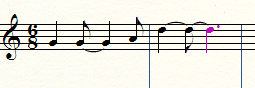
First of all, I note that the tenors' attack on the F in the piano at measure 2 seems too tense to me.
At the level of notation, I noticed that in some places you indicate phrase slurs and in others you do not; initially, I thought you only omitted them in the presence of repeated notes (what are your thoughts on this) ...but then I noticed that in other parts of the piece (I mean in the presence of melodic movements) you don't include them... do you expect something different between where they are and where they aren't, if not... what is different?
Another aspect relates to the presentation of the text. An 'Ave' at measure 22, even if the musical intention is clear, I don't know if I can feel it; even though the title of the prayer is Ave Maria, I am not sure that 'Ave' is the central word of the prayer. It works for the beginning since the text starts from there, but after that, an 'Ave' at measure 22? This concept then, in my opinion, has reflections in the finale; after the Amens, 'Ave Maria' returns again.
Amen stands for 'so be it'; I bring up Messiaen's thought (who was also an expert in liturgy) in this regard to make what I say next more effective:
from Messiaen's Visions de l’Amen:
Ernest Hello: «Amen, word of Genesis, which is the apocalypse of the beginning. Amen, word of Apocalypse, which is the Genesis of consummation»
«Amen assumes four different meanings: Amen, let it be! The creative act. Amen, I submit, I accept. Thy will be done! Amen, the hope, the desire that it be, that You give to me and I to You! Amen, this is, decided forever, consummated in Paradise. Where we reach the life of creatures who say “amen” simply because they exist [...]»
In your piece, the first cycle of Amens says "So be it" to the content of the entire prayer; the second seems to me to refer only to Ave Maria.... where 'Ave' is just the greeting.
Perhaps in both cases (measure 22 and the finale), one could play only on the name of the Madonna or something more important than 'Ave', for example, Sancta.
It is more a theological problem than a musical one; after all, music is at the service of the sacredness of the text. How have you approached this issue? I was thinking of examples from the repertoire... but nothing serious comes to mind that has approached the text this way. Ideas?