Bianca, I'm not adding anything because you have already been pushed too hard on this matter and the risk is getting overwhelmed. These are certainly aspects that are clarified in a few composition lessons.
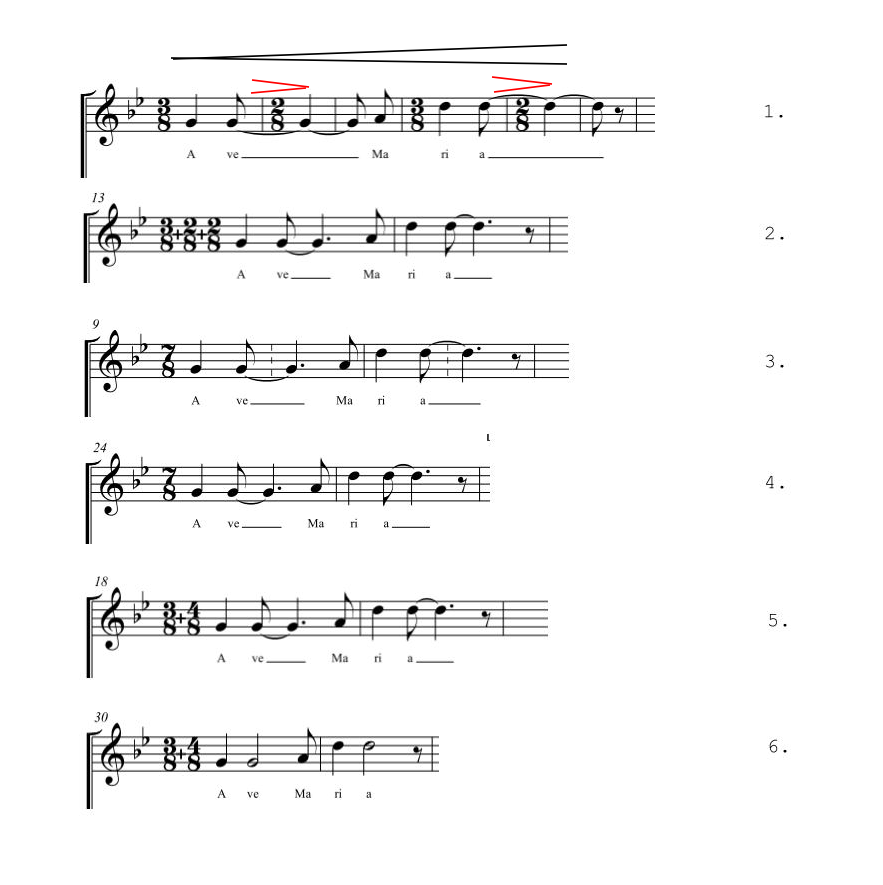
I noticed that you also added the indications regarding dynamics; useful considerations could be made as early as the first lines.
Another thing (then that's it, then I'll move on to stressing RStrauss... otherwise you'll end up not being able to stand me) that I suggest is to pay attention to passages like measures 43-44; the D-B-E is certainly not a very logical or easy thing to intone, definitely B-E, just as the contraltos would be facilitated by singing G-F#-E instead of G-Gb-E. I understand that in your head the sound might be the same, but for those who don't have the famous little keys, it's a whole different chapter.
Bianca, I won't add anything because you have already been pushed too hard on this matter and the risk is getting overwhelmed. These are certainly aspects that are clarified in a few composition lessons.
I noticed that you also added the dynamic indications; useful considerations could be made as early as the first lines.
in my opinion, for example, because there is a risk that it becomes à-ve-è Ma-rì-a-à like this, which is why I hadn't indicated anything...
>One other thing (then that's enough, then I'll move on to stressing Strauss... otherwise you'll end up not being able to stand me)
Don't even joke about it, I do the workshop specifically for these things... otherwise what for? One tests oneself precisely on the communicative process; then if there are divergences or misunderstandings, it is right to argue so that they can be clarified.
Here is indeed the following, for those who still have a bit of patience
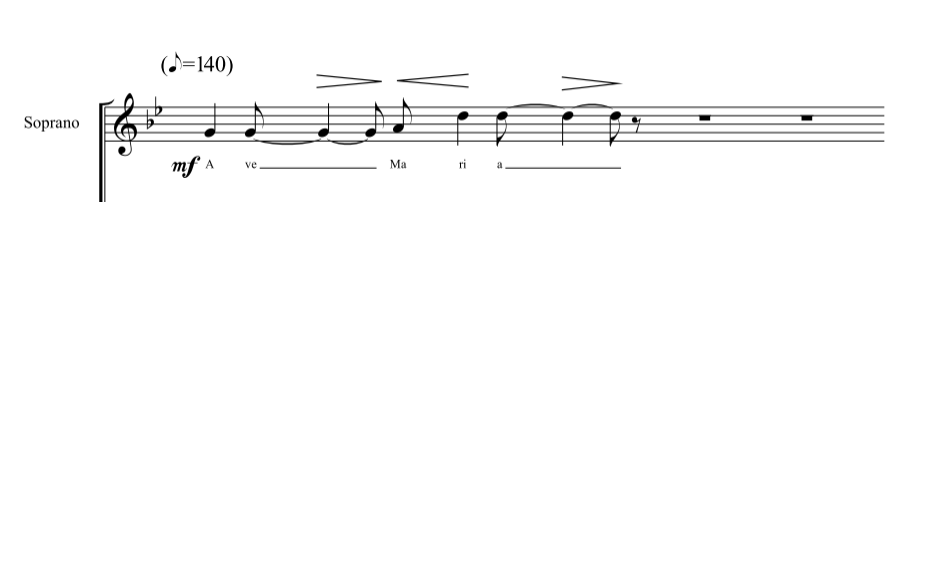
I have included some possible notation cases (I wasn't able to write down the free meter).
I would like to know, according to each of you, which one is the most understandable or which ones are incorrect...
Combinations of them are obviously also possible.
In the first example, I have also clarified a possible problem with the crescendo sign (which I wouldn't include anyway...)
Thank you all for your cooperation and patience.
I formed an idea, which then turned out to be the first one I had.
The solutions you provided would actually all be fine, but there is the constraint of the tonic accents, which must be respected; otherwise, those singing will no longer understand anything.
In reality, I have the feeling that you are getting a bit stuck in these time changes, simply because it is the text that is complicating things.
The main thing you attempted to do is to place the syllables A and Ma on the theoretically strong beats, in order to preserve the accents.
Ok, but in this way, whatever tempo you indicate, if you do not respect the accents of the text, what the choir sings will always be different from what you write musically, because the choir will sing following the conductor, and when the conductor makes the gesture on the downbeat, the choir will consequently do so even with incorrect syllables.
I'll take a risk and make a proposal to you:
Why not write without a time signature, indicating the accents on the syllables where you want them and only indicating the reference of the tactus?
By doing so, the conductor will conduct following the accents, as happened with Gregorian chant or the Renaissance, and the choir will do the same.
in my opinion, for example, because there is the risk that it becomes à-ve-è Ma-rì-a-à
As confirmation that you are an intelligent person, the fact is that you cannot not indicate anything:
Bianca wrote:
the reason why I hadn't indicated anything...
indicate everything necessary so that the performer can do their job. Consider that before the '900 there was an executive practice that guaranteed a certain "result" because one moved, composers moved, in terrain known to everyone.
Nowadays, and this also responds to some prompts from Thallo in the topic dedicated to choral music, the composer cannot not indicate anything... on the contrary, they are often forced to be "redundant."
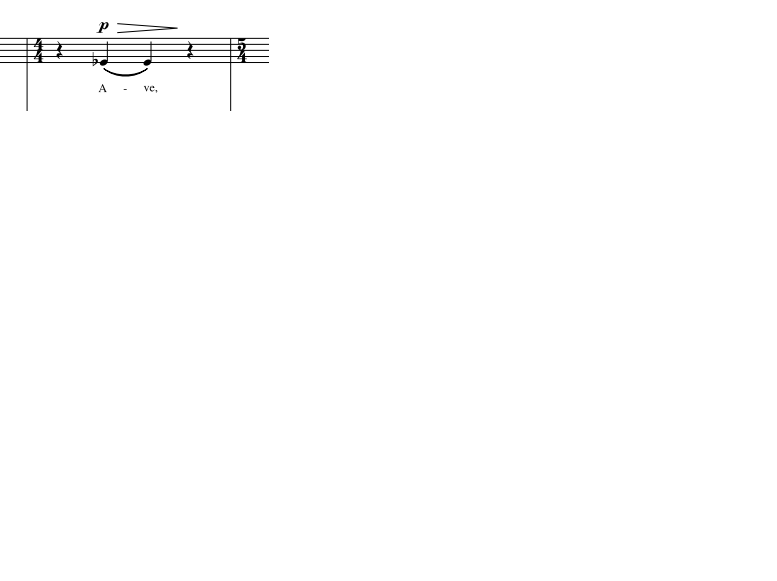
Returning to the rhythm, of many proposals for the 'ave' only one convinces me which is not marked. It starts with 4/4, take the last proposal and add a tied eighth note to the sol of "ve"
I formed an idea, which then turned out to be the first one I had.
In reality, I have the feeling that you are getting a bit stuck in these time signature changes, simply because it is the text that is complicating things.
The main thing you attempted to do is to put the syllables A and Ma on the theoretically strong beats, in order to preserve the accents.
By doing so, the conductor will conduct following the accents, as happened with Gregorian chant or the Renaissance; the choir will do the same.
>Ok, but in this way, whatever time signature you indicate, if you don't respect the accents of the text, what the choir sings will always be different from what you write musically, because the choir will sing following the conductor, and when the conductor makes the gesture on the downbeat, the choir will consequently do so even with incorrect syllables.
i didn't quite understand, do you mean that the accents of the text do not correspond? To me, it seems that the meter is: F-d-d, f-d, f-d and therefore:
A(F-d)-ve(d, f-d, f) Ma(d)
-ri(F-d)-a(d, f-d)
or am I wrong?
>I'll venture a proposal:
Why not write without a time signature, indicating the accents on the syllables where you want them and only indicating the reference of the tactus?
i would like to, but I don't know how to do it. Suggestions (you can even tell me to go to hell at this point)?"}
Returning to the rhythm, of many proposals for the 've' only one convinces me, which is not marked. It starts with 4/4, take the last proposal and add a tied eighth note to the sol of "ve"
but that way I would get a 've' longer than what I would want. Maybe a pause, but then one has to see what happens to everything else...
As confirmation that you are an intelligent person, the fact is that you cannot not indicate anything:
indicate everything necessary so that the performer can do their job. Consider that before the '900 there was an execution practice that guaranteed a certain "result" because one moved, composers moved, in terrain known to everyone.
Nowadays, and this also responds to some prompts from Thallo in the topic dedicated to choral music, the composer cannot not indicate anything... on the contrary, they are often forced to be "redundant".
>Ok, but in this way, whatever tempo you indicate, if you do not respect the accents of the text, what the choir sings will always be different from what you write musically, because the choir will sing following the conductor and when the conductor makes the gesture on the beat, the choir will consequently do so with incorrect syllables.
i didn't quite understand, do you mean that the accents of the text do not correspond?
To me it seems that the meter is: F-d-d, f-d, f-d
and therefore:
A(F-d)-ve(d, f-d, f) Ma(d)
-ri(F-d)-a(d, f-d)
or am I wrong?
>I'll venture a proposal :
Why not write without tempo, indicating the accents on the syllables where you want them and only indicating the reference of the tactus?
i would like to, but I don't know how to do it. Suggestions (you can even tell me to go to hell at this point)?
The measures you posted here are okay, but at this point you need to revise a bit of the whole text.
Conducting and accompanying choirs for many years, I have learned that often the same effect is obtained by simplifying things.
If the mixed meter you have chosen is intentional and aims to give a certain character to the piece, I must tell you that I obtained the same effect using the ancient method.
To conduct 'alla antica' means to give the beat for every tonic accent of the word and to mark the weak movements with other gestures that often follow the syllables and the dynamics.
I tried conducting with your meter, then I tried conducting following the text 'alla antica' and the result was the same.
The measurements you posted here are okay, but at this point you need to review the entire text a bit.
Directing and accompanying choirs for many years, I have learned that often the same effect is achieved by simplifying things.
If the mixed meter you chose is intentional and aims to give a certain character to the piece, I must tell you that I obtained the same effect using the ancient method.
Conducting in the ancient style means giving the beat for every tonic accent of the word and marking the weak movements with other gestures that often follow the syllables and dynamics.
I tried conducting with your meter, then I tried conducting following the text in the ancient style and the result was the same.
So why complicate things?
you are perfectly right, but what I was saying is that I don't know how to write a rhythm-free score using Finale or something else. If there is a notation software that does it, I could try anyway. I'm looking around...
you are perfectly right, but what I was saying is that I don't know how to write the score without a time signature using Finale or something else. If there is a notation software that does it, I could still try. I'll look around...
In the meantime, to not show the time signature, go with the "treble clef" function and among the "do not show" choices there should be the time signature in clef.
for the bar lines, you have to modify the staff type and you can always find it in the same function above if you have Finale from 2009 backwards, while in newer Finale versions you find it in score management.
look, not to be harsh, but when a syllable starts on a weak beat and continues onto the strong beats, it is a syncopation :-) unless you indicate a considerable diminuendo on the syllable "-ve" and on the final "a" of "Maria", the accent will fall there. Or even worse: without any indication, the "right" way to perform a syncopation is by accenting it or by accenting it with a messa di voce in crescendo.
look, not to be harsh, but when a syllable starts on a weak beat and continues onto the strong beats, it is a syncopation :-) unless you indicate a considerable diminuendo on the syllable "-ve" and on the final "a" of "Maria", the accent will fall there. Or even worse: without any indication, the "right" way to perform a syncopation is by accenting it or by accenting it with a messa di voce in crescendo.
mah? this seems a bit strange to me, I thought a syncopation was something else (namely note on the strong beat - double duration note on the weak beat), but at this point I'm losing my mind and making no sense anymore )
I hope Frank won't mind if I quote his attached score: to me, here it really does seem like it is A-ve
I mean, it's a 4/4 so F-d-f-d writes: rest (F) - A(d) - ve(f) - rest(d)
I mean, there is a diminuendo and to me it is A-ve (not A-vè), but metrically the A is on the weak beat and the ve is on the strong beat.
Besides, I would never read it as Avè anyway because I know Latin and the text tells me what the voice must do (which is a bit the sense of what rstrauss was saying before) and therefore there wouldn't even be a need for the diminuendo (I repeat - for me)...
I also understand on the other hand that without dynamic indication you could interpret a crescendo (on my word, see what I wrote before regarding this, with the attachments), obviously only with "supporting" instruments....
If instead it is just a matter of dynamic indications then .... and say so immediately, no! :D
In the meantime, to not show the time signature, go with the "treble clef" function and among the choices "do not show" there should be the time signature in clef.
for the bar lines, you must modify the staff type and you will always find it in the same function above if you have Finale from 2009 backwards, while in newer Finale versions you will find it in score management.
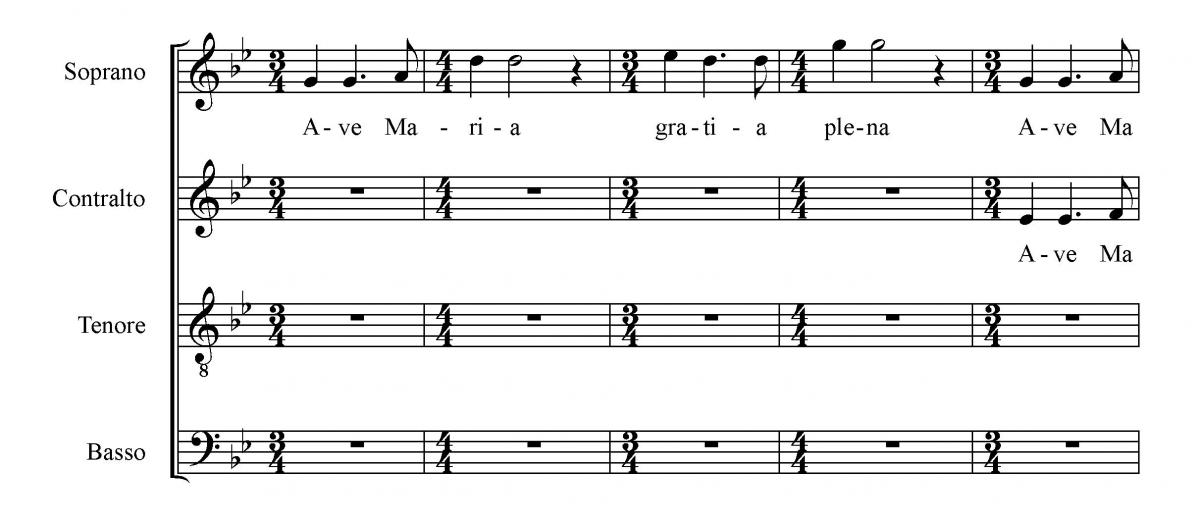
Curiosity: what would change by rewriting the beginning as you see below?
Would your musical idea be irremediably distorted?
I am asking because such complicated metric writing makes the piece substantially unmanageable for most choirs (and I'm not just talking about amateur choirs: there are also professional choirs that, faced with a page like this, wouldn't take it very well).
The issue interests me not for the specific case, but in more general terms. I too often find myself facing the problem of complexity. My writing is difficult, and sometimes I have had a hard time with musicians who were not very good, or very willing. Beyond choral writing (the choir indeed presents quite peculiar variables), one must also take into account that ensembles, even excellent ones, often have few rehearsals available. If you can convey your idea with writing that can be immediately deciphered and performed without problems, why adopt a writing style that complicates life for those who have to play/sing? In this way, you risk that your own musical idea won't come through (precisely because the musicians themselves don't understand it, since they are too busy "playing the notes"): it is something I experience firsthand, and I continue to work on.
PS obviously I fear that making music with software instead of with flesh and blood people won't help, in this case.
Curiosity: what would change by rewriting the beginning as you see below?
Would your musical idea be irremediably distorted as a result?
I am asking because such complicated metric writing makes the piece substantially unmanageable for most choirs (and I am not just talking about amateur choirs: there are also professional choirs that, faced with a page like this, would not take it very well).
The issue interests me not for the specific case, but in more general terms. I too often find myself facing the problem of complexity. My writing is difficult, and sometimes I have had a hard time with musicians who were not very good, or very willing. Beyond choral writing (the choir indeed presents quite peculiar variables), one must also take into account that ensembles, even excellent ones, often have few rehearsals available. If you can convey your idea with writing that can be immediately deciphered and realized without problems, why adopt a writing style that complicates life for those who have to play/sing? In this way, you risk that your own musical idea does not come through (precisely because the musicians themselves do not understand it, since they are too busy "playing the notes"): it is something I experience firsthand, and I continue to work on it.
PS obviously I fear that making music with software instead of with flesh and blood people is not helpful, in this case.
I agree.
Anecdote: in one of my quartets, adhering to the technique I studied, I indicated F double sharp because I was in the key of D# major.
I heard one of the musicians say: but why F double sharp... wouldn't G be better?
Priceless, for everything else there is Mastercard !!!!"}