I had to step away for a moment; the next step would be to define (even at the level of a legend in the title page of the pieces) how you want to manage "atypical" meters. In short, how you intend to handle the 11/8 in question.
You will notice that reflecting in these terms will better help you understand what you are looking for or were looking for in that moment, and it is not certain that you will then discover the true nature of certain indications chosen, as you were saying, for your own "convenience" ... but precisely, without indications, only yours (for now).
If it is not clear to you... think of others, then one can travel through fantasy and do whatever they want within your meters, but precisely that is compensating according to one's own poetics for a factual lack.
but it is very clear to me, and it is more or less how it is in playback
To go to an extreme, one could even do something else, like reverse engineering, i.e., taking the playback and extracting the score to see what happens...
Anyway, I will try to see about adding some indications of the type you are mentioning, and we will see if I have understood...
but it is very clear to me, and it is more or less how it is in the playback
Try providing the conductor who will perform your piece with the playback as support for the score as well; you'll see they will be happy to note down the indications themselves. In any case, if the metric design is clear in your mind, it's enough to put it back into the score... it's truly just a matter of half an hour. Among your objectives, try to eliminate the "more or less," since there is no longer an established performance practice... your desiderata must clearly emerge.
I must specify that to sing Bianca's parts, I had to ignore the tempo changes and sang in a Gregorian style, following the tonic accents of the words; this certainly distorts Bianca's intentions, but there was no other way.
I also tried conducting, but with these types of changes it is truly difficult—not impossible, but without the indications mentioned by Frank, one cannot succeed or risks going out of context.
I do not expect everything to be as clear and intuitive as in mine, but some additional indications are needed.
So, I'll try to provide an example, I hope I understood correctly and that these are the type of indications that can help make reading clearer. If it goes well (but I have my doubts) I will proceed with the rest
So, I'll try to provide an example; I hope I understood correctly and that these are the type of indications that can help make reading clearer. If it goes well (but I have my doubts), I will proceed with the rest
Bianca, let me try to give my opinion:
the 7/8 arises from the function of 3/8+4/8, so your idea is achievable by writing a 5/8 and a 2/8; also consider the reverse (3/8+2/8-2/8 does not exist) your 8/8 is practically a 6/8 and a 2/8; also consider a reverse
If I were you, I would reason with this metric structure:
Therefore, in mirror form, I would write 2/8|5/8|5/8|2/8|6/8|6/8|2/8|5/8|2/8
A beautiful, gripping structure; it expands in the center and contracts at the end... without the need for legends (to be placed at the beginning of the score and not at every time signature change), which in this specific case could only concern the 8/8; the other meters are in common use and there are already existing solutions.
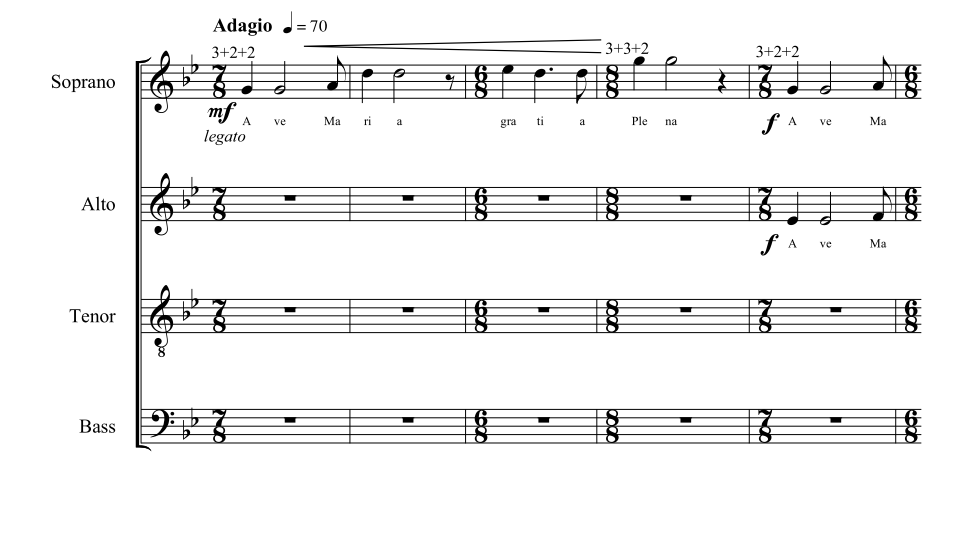
I don't know if the eighth note of measure 3 is the same as that of measure 2, so you should note it in the score and so on, discussing every time signature change and especially when you move from binary time to ternary time.
So, I will try to provide an example; I hope I understood correctly and that these are the type of indications that can help make reading clearer. If it goes well (but I have my doubts), I will proceed with the rest
this certainly clarifies how one should conduct a hypothetical choir and, above all, clarifies where the strong beats are.
With these indications, one can return to the text and check if the tonic accents correspond to the strong beats.
C
cromatismo
Member
Reply 128 by cromatismo
Posts
79
rstrauss wrote:
this certainly clarifies how one should conduct a hypothetical choir and, above all, clarifies where the strong beats are.
With these indications, one can return to the text and check if the tonic accents correspond to the strong beats.
I agree, but it is a notation that isn't used... Faria's proposal should be taken into consideration. I point out that if, for example, between measures 2 and 3 an eighth note were equal to an eighth note, the pulse would be slower than the 6/8 divided into 3 compared to the previous one divided into 2. Or keep the pulse constant and reduce the time of the subdivision.
I don't want to be simplistic, but there are a lot of examples in the repertoire and, above all, there is one of the pieces from the workshop that exemplifies how to indicate tempo changes... aren't we splitting hairs?
- if the first measure is in eighth notes, why is the metronomic indication a quarter note?
- indicating the structuring of compound meters is not only useful for understanding the strong accents of the measure; it also serves, as Frank used to say, for conducting. Which is the step following or contemporary to solfège. Which is the step following or contemporary to reading this score. You are writing "3/8+2/8+2/8" above, but in the notes you are writing something else entirely. The durations of the first measure, if they want to be consistent with the compound meter indicated by you, should be a quarter note, an eighth note tied to a quarter note which is itself tied to another eighth note, and then the eighth note on the A. And so on. THIS is making a metric indication intelligible IN music (not just in the head of the writer).
- and, as was to be demonstrated, if those are the metric divisions you indicate, syncopations abound.
- I still do not understand WHY :-) there are hundreds of contemporary pieces written practically without meter. What is the use of those two measures in 7/8 if then comes the one in 6 and the one in 8?! Put the dashed bar lines, but only where needed, not to subdivide long notes, which makes no sense. Let me explain better... in the famous first two measures, the accents of the 7/8 (3+2+2) are not felt, because there are only 3 figures per measure, and one is of two quarter notes, so too long to allow you to make anything rhythmic felt within it. The first two measures could easily be in a free meter, especially since the voice performing them is solo. I would dare say it would also be more beautiful, because it would allow for greater performance or interpretive freedom...
C
cromatismo
Member
Reply 130 by cromatismo
Posts
79
Regarding what Thallo is saying, if I am not mistaken, Donatoni would write everything in 4/4 and put the accents wherever they were needed... practically, the barline in his writing served only to prevent the performer from getting lost. And this is not news, look at the Flemish composers.
As was being said, one should always make clear choices, in short: take a position.
@Bianca
I read that you were referring to playback and potential reverse engineering aimed at tracing the pulse... I say that Pollini, when he studied Chopin's studies, did not take Rubinstein's recording and deduce the indications... he started from the score and delivered to humanity his own interpretation of the score itself.
Great Thallo for asking why the meter is in eighth notes and the beat is in quarter notes...
Bianca, you have a musical mind, it's just a matter of communicating it clearly... I guarantee you that no choir director would take your piece into consideration, not because it lacks value, but because its eventual value would not come through. This forum, in my opinion, is an exception because for educational purposes the forum member tries to help and understand what isn't working, but in real life, you send the score to a director, they open it, if they don't understand by the second measure... they close it... and they don't even say thank you.
All this not to tear you down, but to urge you to also take care of the presentation part of your work. To be truly practical, it is a matter of just a few hours... and thinking about all these things before and during the writing of the piece would help you to be more aware and effective.
> 7/8 is born from the combination of 3/8+4/8, so your idea is achievable by writing a 5/8 and a 2/8; also consider the reverse (3/8+2/8-2/8 does not exist)
in what sense does it not exist?
your 8/8 is practically a 6/8 and a 2/8, also consider a reverse
> If I were you, I would reason on this metric structure:
Therefore, in mirror form, I would write 2/8|5/8|5/8|2/8|6/8|6/8|2/8|5/8|2/8
ok, I can try that
>(to be placed at the beginning of the score and not on every time signature change), which in this specific case may only concern the 8/8; the other meters are in common use and there are already existing solutions.
ok, but if the compound meters are not all the same, what do I do? whereas if they are standard, what is the purpose of the legend?
> I don't know if the eighth note of measure 3 is the same as that of measure 2, so you would have to note it in the score and so on, discussing every time signature change and especially when moving from binary meter to ternary meter.
do you mean to indicate (eighth note = eighth note) ?
I wouldn't want to be simplistic, but there are plenty of examples in the repertoire and above all there is one of the pieces from the workshop that exemplifies how to indicate tempo changes ... aren't we splitting hairs?
> Regarding what Thallo says, if I am not mistaken, Donatoni would write everything in 4/4 and put the accents where they were needed... practically, the barline in his writing served only to prevent the performer from getting lost. And it is not news, look at the Flemish.
i agree on this, as I was saying previously when I mentioned writing in a more traditional way
>I read that you were referring to playback and potential reverse engineering aimed at tracing the pulse... I say that Pollini, when he studied Chopin's studies, did not take Rubinstein's recording and deduce the indications... he started from the score and delivered to humanity his own interpretation of the score itself.
i disagree on this, but it is not important here...
>Bianca, you have a musical thought, it is just a matter of communicating it clearly...
and you don't know how much I would like to understand how to do it! here you keep telling me that it's a matter of half an hour, but it's been two days and I still haven't understood a thing
finale, I haven't used it for an eternity, and I tremble at the thought of getting back into it, but I am certain there is a possibility to mark the metronome indication at the crotchet...
anyway, I don't think it takes half an hour to change everything. I mean, maybe on the finale yes. But certainly if you had posed the problem before starting to write, everything would have been resolved in 5 more minutes of work... I believe the current solution is to rewrite everything as a sequence of 3/8 or 2/8. Simply.
Because irregular and compound meters, unless they are immediately justified and intelligible, are just smoke and mirrors
finale non lo uso da tempo immemore, e tremo all'idea di rimetterci su, ma sono certo che ci sia la possibilità di segnare l'indicazione metronomica alla croma...
comunque, io non penso che ci voglia mezz'ora a cambiare tutto. Cioè, forse su finale sì. Ma di certo se ti fossi posta il problema prima di iniziare a scrivere, tutto si sarebbe risolto in 5 minuti in più di lavoro... la soluzione attuale credo sia riscrivere tutto come una sequenza di 3/8 o 2/8. Semplicemente.
Perché i metri irregolari e composti, a meno che non siano immediatamente giustificati e intellegibili, sono solo fumo negli occhi
in effetti era anche una delle alternative che avevo considerato all'inizio...
>7/8 is born from the function of 3/8+4/8, so your idea is achievable by writing a 5/8 and a 2/8; also evaluate the reverse (3/8+2/8-2/8 does not exist)
in what sense does it not exist?
3+2+2 exists, but I fear that generally 7/8 is understood as 3+4 or 4+3. To avoid any ambiguity, although there isn't much:
Depending on the number of beats contained in each measure – from 2 to 7 – the meter is called:
binary (2 beats)
ternary (3)
quaternary (4)
quinary (5)
senary (6)
septenary (7).
Meters greater than ternary (therefore 4, 5, 6, and 7 beats) are considered secondary, while binary and ternary are called primary; secondary meters are considered the sum of two or more primary measures; a common example is the quinary meter, given by the sum of a binary meter plus one ternary, or a ternary plus one binary, depending on the position of the accents.
8 is anyway pure invention or rather, one falls into the case of Donatoni ... the meter no longer has properties but is only a form of visualization