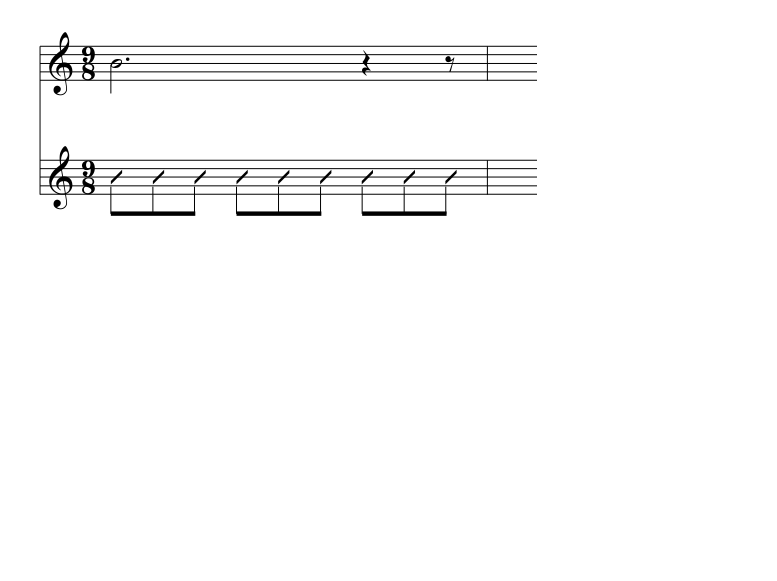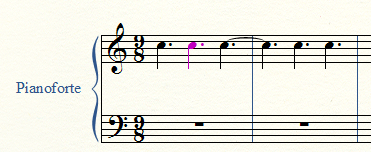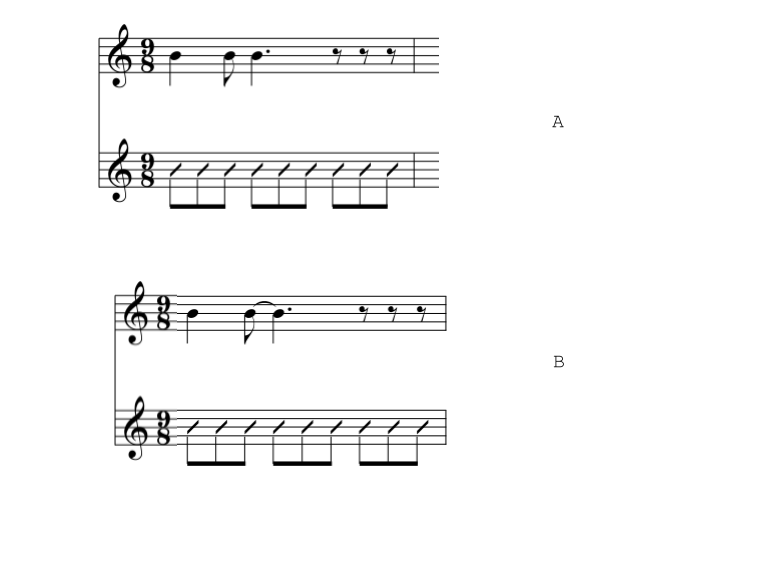
Bianca wrote:huh? to me this seems a bit strange, for me a syncopation was something else (namely a note on the strong beat - a note of double duration on the weak beat), but at this point I'm losing my mind and I can't make sense of anything anymore )
I hope Frank won't be mad at me if I quote his attached score: to me, here it really seems like it is A-vè
I mean, it's a 4/4 so F-d-f-d writes: rest (F) - A(d) - ve(f) - rest(d)
I mean, there is a diminuendo and for me it is A-ve (not A-vè), but metrically the A is on the weak beat and the ve is on the strong beat.
Besides, I would never read it as Avè anyway because I know Latin and the text tells me what the voice must do (which is a bit like what rstrauss was saying before) and therefore there wouldn't even be a need for the diminuendo (I repeat - for me)...
I also understand from another perspective that without dynamic indications you could interpret a crescendo (on my word, see what I wrote before regarding this, with the attachments), obviously only with "supporting" instruments....
If instead it is just a matter of dynamic indications then .... and say so immediately, no! :D
In this topic, it is truly difficult to talk to you... I don't know, it seems like you really don't grasp what we are saying...
1) no, syncopation is a precise thing. It is a shift of the rhythmic sense obtained by prolonging a note that begins on a weak beat until or beyond a strong beat;
2) hence, the example from Frank's piece is not a syncopation, because the note on the weak beat and the note on the strong beat are not connected with a tie (legatura di valore), meaning they are two different notes; and I admit my jaw dropped when you used that as an example...
3) to perform a syncopation does not mean pronouncing "a-vé" and singing a syncopation does not mean pronouncing "a-vé"; the vocal literature of every era is full of syncopations on unstressed notes, and we could talk for years about the various meanings and ways of singing syncopations. For me, the discussion we are having about syncopation has a few specific points: you said there wasn't any, and since I am a pain* in the neck I had to contradict you; in those initial points it makes no musical sense at all, precisely because, from what I understand, you wrote it unintentionally, that is, without knowing it was a syncopation and without wanting to signify a syncopation; but you wrote it and therefore you must remedy it, meaning you must ensure there is no syncopation effect, which in literature means many things, certainly not "a-vé", but a rhythmic shift, a messa di voce with crescendo, or even just a different, more marked "sense" given to the syncopated note; there are many ways to remedy it, including changing the arrangement of the accents in the measure to eliminate the syncopation, or putting precise expressive indications that eliminate any possible reading of the syncopation.
4) To summarize, you made a road sign, you made it in the shape of a triangle because you liked it that way, but everyone who looks at it says "ah, it's a danger sign". Because it is a triangle, and all drivers know that a triangle is a warning sign. And here we are talking about syncopation.
5) you have changed the meter very often, using many other forms for all the other signs. And many of these forms mean, in the eyes of musicians, things that are not actually in your score, or contradict each other.
6) if I were a composition teacher, and fortunately I am not, because my students would probably kill me after half an hour in horrible ways, I would advise you to practice simplicity :-) at least metrical simplicity. Personally, I believe it is very difficult to write an Ave Maria in 4/4; I imagine it is even more difficult to write it with phrases that all last 4/4. But I think such a castrating exercise could be useful :-)"