Technical problems and their resolution

it's all the fault of those little strings!

75 replies 12,237 views

Started by

magnalf

Member

Member

Opening post by magnalf

Posts
56
City
Correggio

Hello everyone.

First, I should mention that I have a used Yamaha U1 upright piano, purchased 2 years ago for my daughter who is taking private lessons. I have also approached the instrument by trying to play for pleasure, having a long-standing youthful passion as a guitarist.

About a year ago, while trying to play pianissimo, I noticed that key 59 (G5) does not emit any sound if pressed with the same light pressure exerted on adjacent keys; trying to analyze the reason, I press the key very slowly to see if I can perceive the cause. I notice that at about 50% of the total travel, the key becomes harder and then makes a click as it descends all the way down.

So, I remove the protection to look at the action and I see that the escapement lever does not escape with the same ease as the other keys exactly at the moment when the key becomes harder.

Shortly thereafter, on the occasion of tuning, I call the "technician" who sold me the piano and point out this problem to him. He tells me it is a regulation issue and after adjusting the eyelet screw of the escapement button, he tells me that it is now resolved (according to him) and that the piano just needed to be played more often and everything would be fine. In reality, yes! It had improved, but I still felt that slight click.

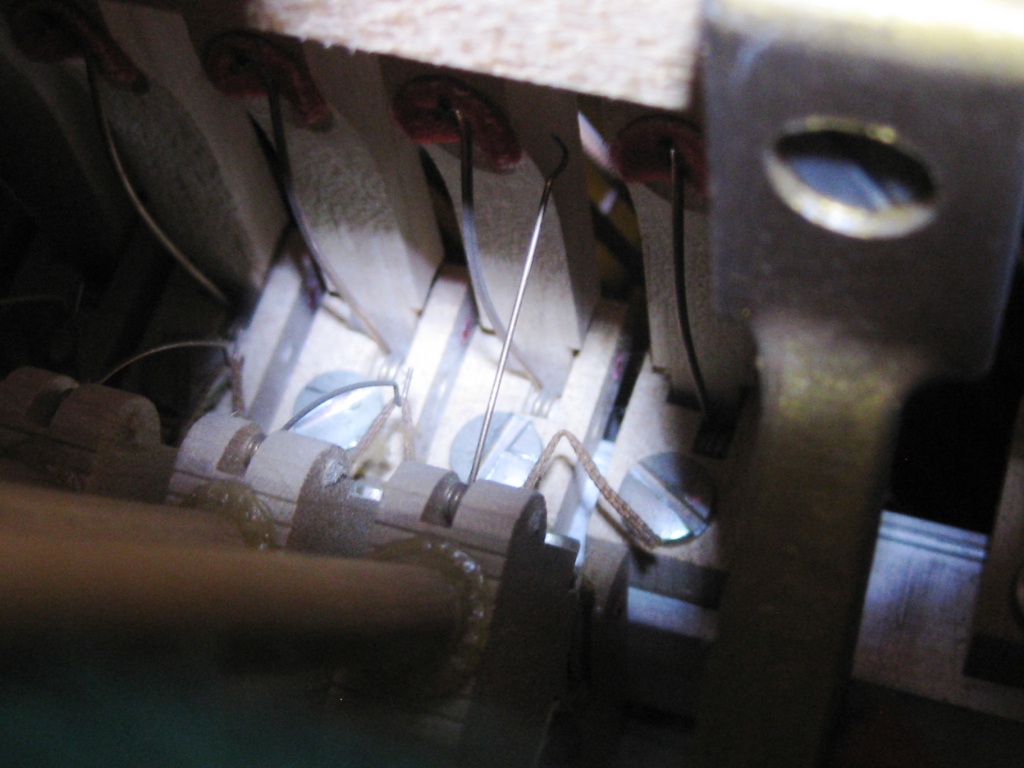
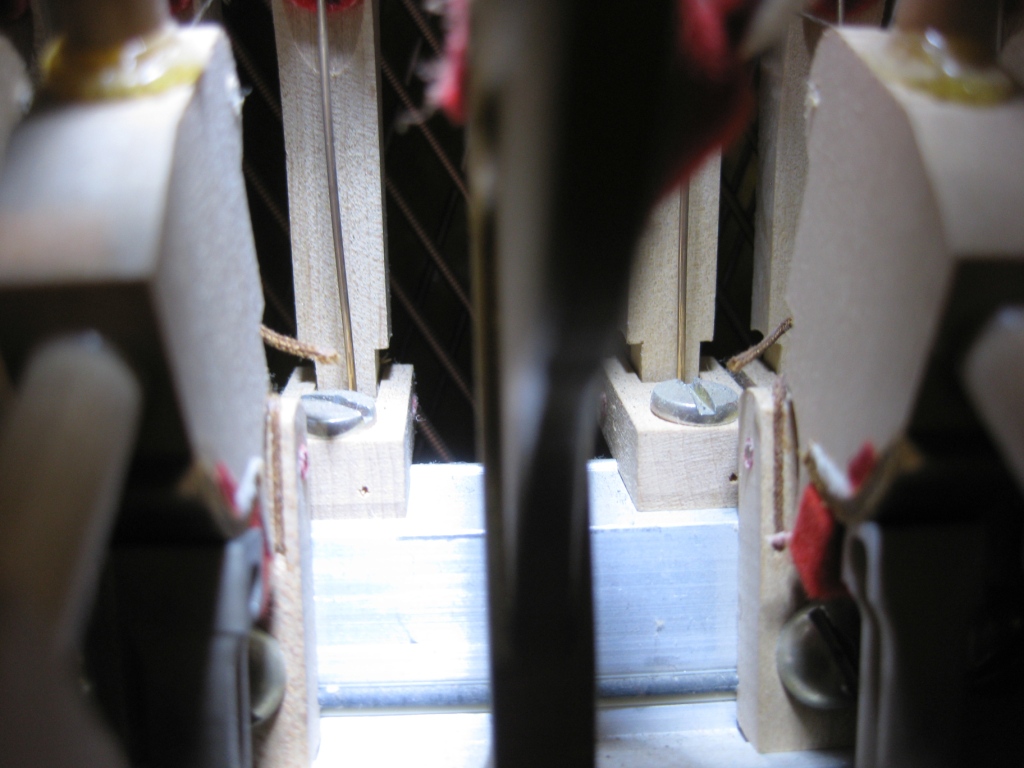
One month ago, as if by chance, while playing pianissimo, key 52 (C5) becomes completely stuck; it goes down 1mm and no further, I do not press harder sensing that something has gone out of place. I re-watch your magnificent tutorial on the action and decide to carefully examine all the components of the mechanism following their function. I discover that the string attached to the repetition lever fork is torn and the spring has lifted and hits directly against the damper blade located right in front of it. Returning it toward its normal position, the key unblocks and descends, but unfortunately when playing, the spring—no longer held by the string—lifts up again and we are back to square one. So, I slightly bend the spring so that it fits exactly between one damper blade and the adjacent one. I then go back to check the first key, 59, which had the click. Same reason: the string is torn and the spring brushes against the damper blade, creating enough friction to cause that click.

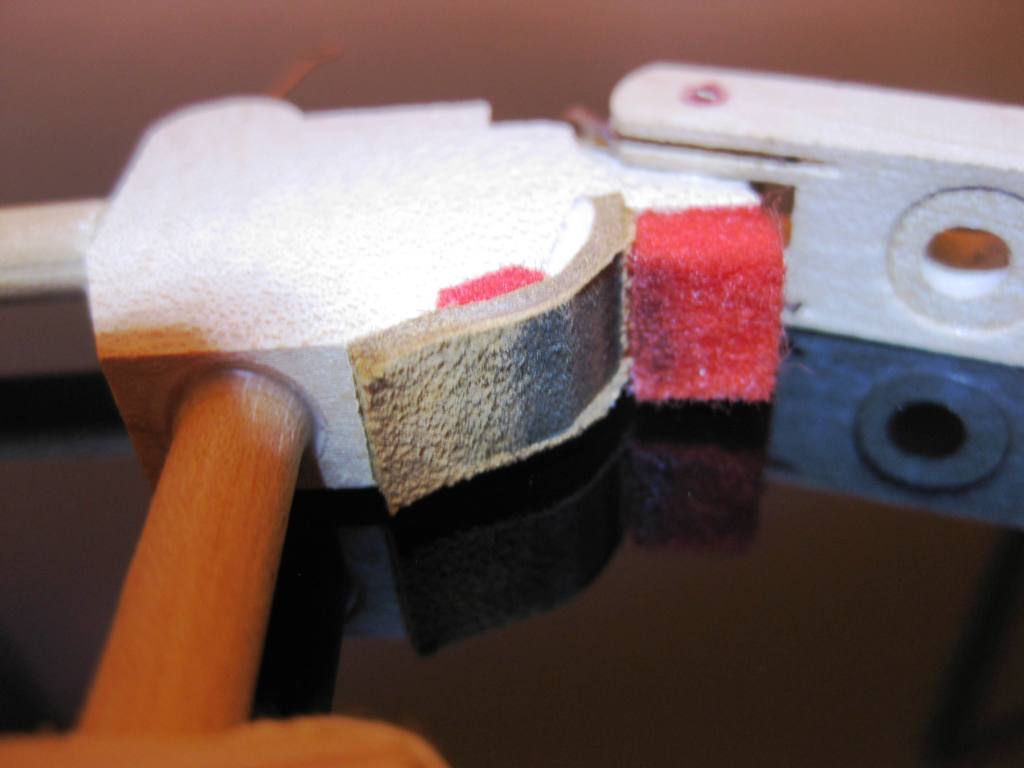
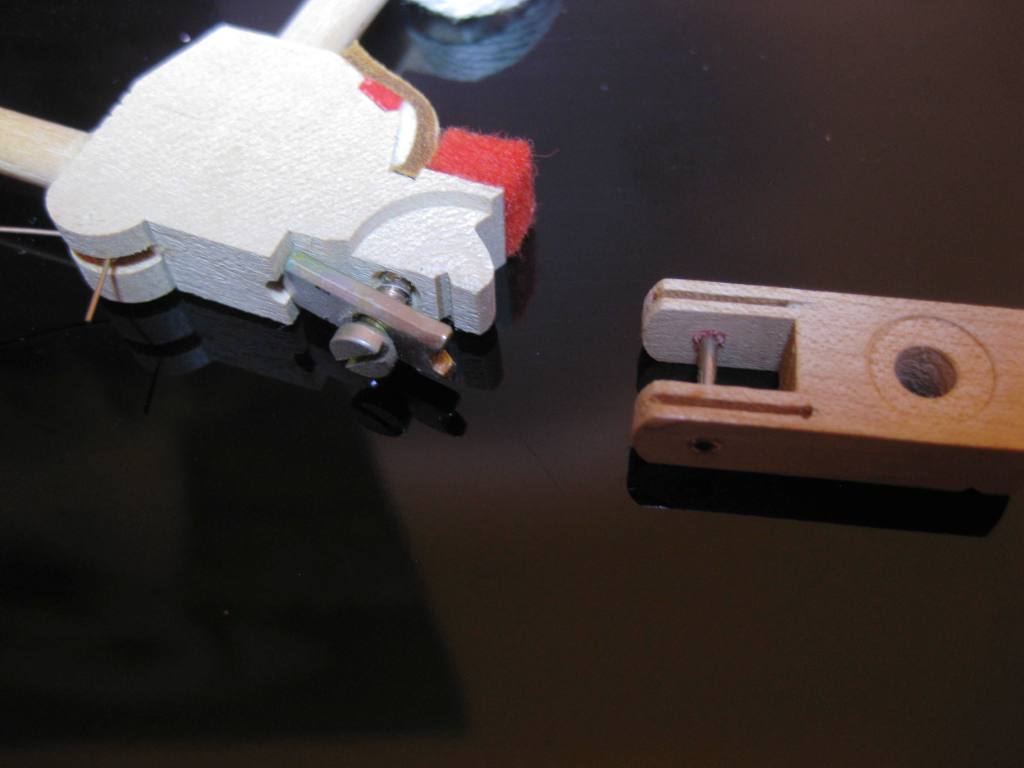
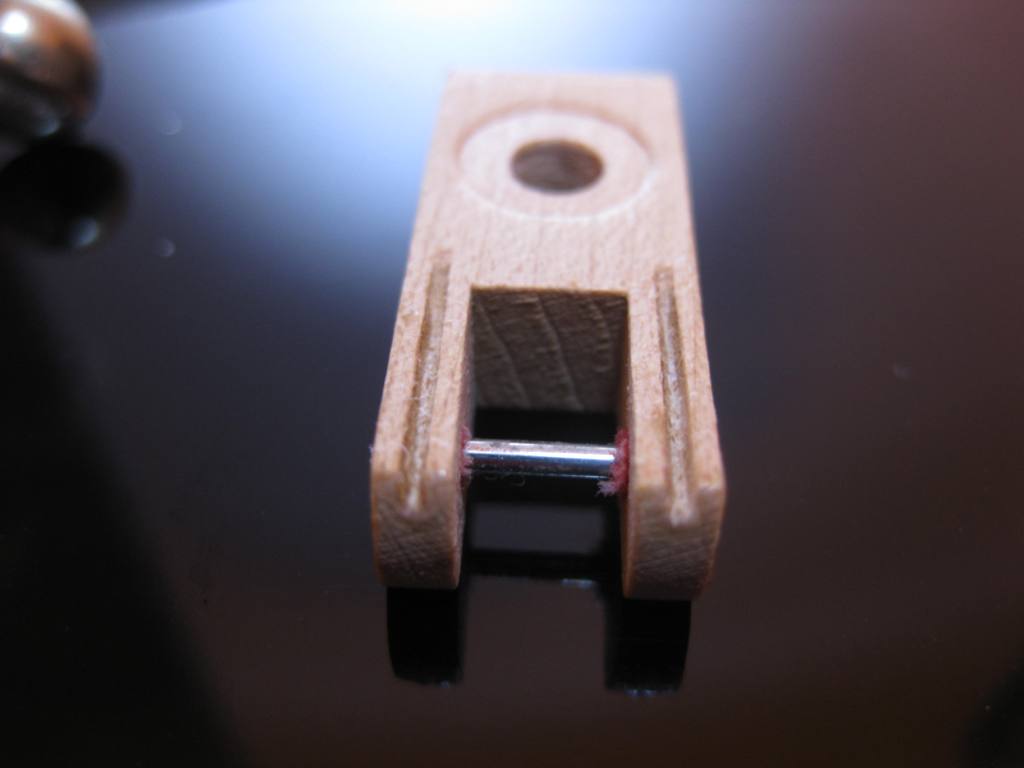
Worried, I analyze all the keys. Another 9 have torn strings, but in these latter ones, more fortunately, the spring has slipped between one blade and another. I attach a couple of photos of the torn strings.

Now I am playing in these conditions where the hammer returns less quickly and with some extra oscillation before stabilizing. But my low level as a "piano plunker" (I don't dare call myself a pianist, I wouldn't want to offend anyone!) doesn't make me notice any problem. But I believe that a pianist, in the true sense of the word, would notice it, and furthermore, I am bothered by the thought of those little springs lying there at the mercy of the keys, and it seems to me I can hear them imploring: "we only ask to be able to do our duty!".

After this endless chronicle, I come to the question. Should I assume that I will soon have to expect more torn strings? What could be the cause? Age? The piano is from around 1975 (deduced from the serial number). What procedure is necessary to repair them?

thanks for listening to me

Alfredo
AttachmentAttachment

Member

Reply 2 by giovannig

Posts
514
City
Monza

It is not a big problem, the intervention is simple and any technician is able to do it; it is necessary to replace the torn straps.

It is likely that others will come unglued or break if they are weak or if the clips are too heavily loaded. If there is such a risk, it is better to check them all preventively (but it takes a little time and it is more convenient to bring the action to the workshop where everything is available and one can work more calmly).

Any adjustments to the centering etc. will have to be made on the piano upon delivery of the repaired action.

Bye

Moderator

Reply 3 by pianoexpert

Posts
3,876
City
rocca di papa

Yes. They must be replaced, but you also need to relieve some of the tension from the springs that push too hard. That is why the strings break. You can see very clearly that the free spring is straight. Instead, it should be slightly curved. This way it is too stiff. The string must be suitable and, above all, made of cotton, otherwise it "squeaks." You need to disassemble the individual hammers and replace the broken strings, placing them in their seats even with a tiny drop of glue. They must be of identical length to the old ones. Good luck with the work.

Member

Reply 4 by magnalf

Posts
56
City
Correggio

Hi Giovannig,

Thanks for the advice, but what does checking the other laces consist of? Does analyzing the breaking point mean verifying if the cord is damaged at that point? Then you talk about possible centering etc. when reassembling the action, but what kind of centering are we talking about? Could you be more descriptive? I am very interested in this topic.

Bye

Member

Reply 5 by magnalf

Posts
56
City
Correggio

Thank you pianoexpert,

Where can these small straps be found? Regarding the glue, if I am not mistaken, it must be natural and hot-melt type.

Do you think this is a job I can do by myself? I should mention that I have good manual dexterity and an excellent degree of precision, but as with all jobs I have never done before, I need advice from experts.

Have a good day

Member

Reply 6 by giovannig

Posts
514
City
Monza

Rely on a technician, all the time saved! These are simple jobs but a minimum of experience is required.

When the hammers are removed, they must be re-centered on the strings, and if they are grooved or flattened, it is better to reshape them properly while they are down.

Moderator

Reply 7 by pianoexpert

Posts
3,876
City
rocca di papa

Dear giovannig, I greatly appreciate your input, but I am opposed to shaving, let alone the partial shaving of the hammers. I believe that you, magnalf, can intervene. Unfortunately, the cord is found in supplies, but you can also try at a haberdashery. As long as it is cotton. It can even be done cold (white glue). You only need a minimum amount! The fissured seat on the forcola is already capable of holding the cord by interlocking. Glue is an extra safety measure. Try it on one hammer and remember to record the exact length of the cord. Naturally, as per giovannig's valid concern, you must re-center the hammers so that the "grooved" part hits the strings perfectly, otherwise the pitch of the off-center hammers will change. Good luck with your work

Member

Reply 8 by giovannig

Posts
514
City
Monza

I don't know, I didn't see the hammers, it was a hypothesis.... Of course, if they are only marked, it is better to do as you say, center them on the old marks. But in the event that they are quite grooved and crushed (this is certainly not the case), how do you avoid shaving? Are you against it in the sense that in those cases you believe it is better to change them?

Ciao

Moderator

Reply 9 by pianoexpert

Posts
3,876
City
rocca di papa

Yes, I prefer to change them. I have argued more than once how shaving modifies the strike point and the geometry of the action, which is intended for such alignment of parts that must have very precise tolerances to guarantee good repetition. Furthermore, in order not to make the hammers too small, they are often shaved into a rounded shape, especially on the highs. This error leads to an indeterminacy of the strike point, which in the case of the high notes is very important to avoid generating dissonant harmonics.

Member

Reply 10 by giovannig

Posts
514
City
Monza

Well, that makes sense; if the piano is important, it makes even more sense to replace them.

However, perhaps in an amateur context or for those who do not have the money to face the expense of a replacement, one could also perform a shaving to reshape the hammers, preferably without completely eliminating the grooves—that is, by trying to leave the string imprints to avoid heavy voicing work.

Member

Reply 11 by magnalf

Posts
56
City
Correggio

Thank you Maestro Ferrarelli,

I will try it on a hammer for now, then I will let you know how it went. Perhaps I will still have some questions when I set about analyzing how to proceed.

Anyway, the hammers do not seem very marked to me. Of course, I haven't seen many great ones, but from what the seller told me, this pf has been played little. I will send you a photo to ask for your opinion.

Good evening

Member

Reply 13 by magnalf

Posts
56
City
Correggio

Hello,

here come the first photos arrive,
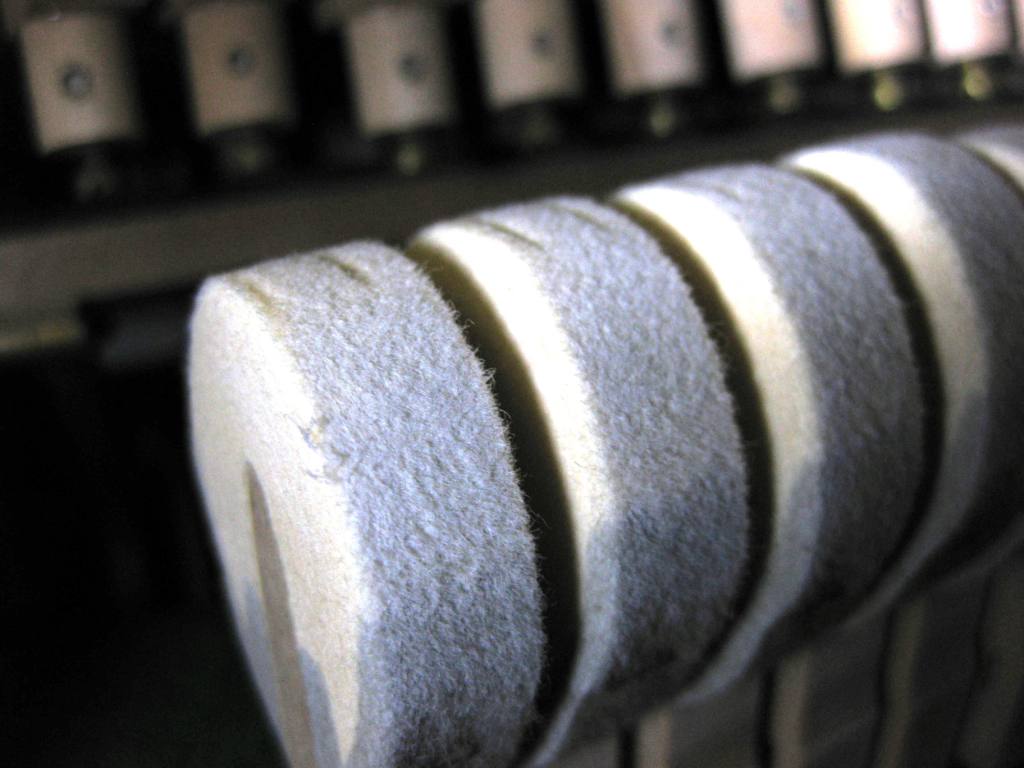
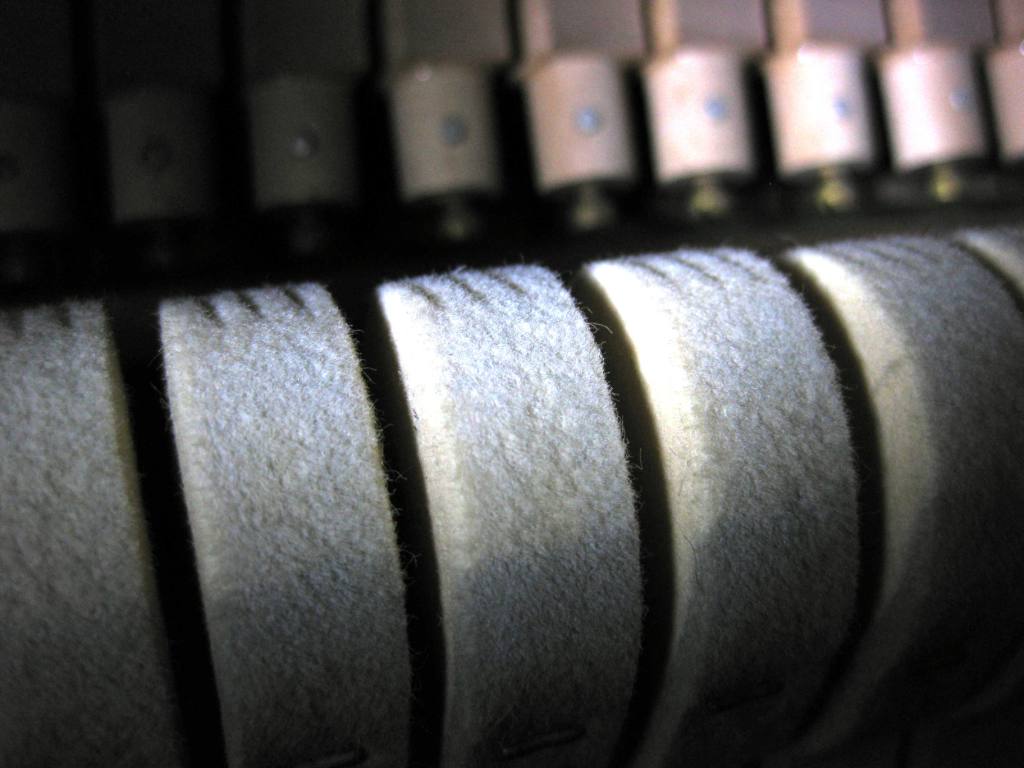
do the hammers look very worn to you?

the is also a photo with the nut skin, does it look very hollowed out to you?

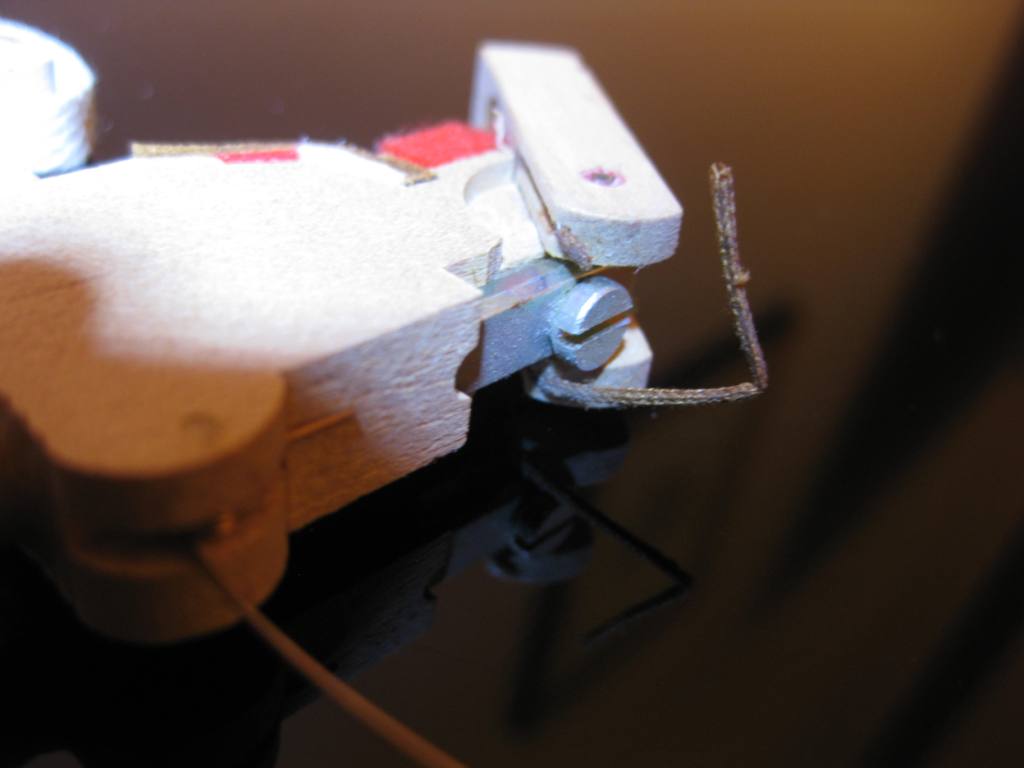
As far as the cord goes, I disassembled one hammer, then I disassembled the hitch pin, then cleaned the grooves.

You can see the torn cord; as soon as I picked up the cord, the end that was still attached came off with extreme ease without having to pull at all. I believe it was very damaged at the point of flexion. At this point, I think I will have to change them all.

I would therefore like to buy the cord from an online supplier. Can I attach a photo to ask if it is the right type or am I breaking some rule?

With about ten meters I would have plenty to do the whole pf [grand piano], at a cost of €5, but the minimum orderable amount is €50, so to reach the minimum I would like to purchase a tuning key, even though it is not my intention to tune the pf (from what I have read, one cannot just improvise, it takes experience) but simply to touch up some unisons that have a slight beat.

But I see that professional keys cost several hundred €, whereas an economical one is around €40. But what is the difference to have a price ratio of 1:5? Do you advise against getting one for €40 or could it be fine?

bye, see you soon

AttachmentAttachmentAttachmentAttachmentAttachmentAttachment

Moderator

Reply 14 by pianoexpert

Posts
3,876
City
rocca di papa

Perfect hammers! Perfect walnut skin!. Very good work! Just pull the cord from the slots. Slightly dampen the new cord in the part that goes into the slots and push them into them with a small iron and the job is done. There is no need to change them all! you can do the work with an identical horn purchased at a haberdashery. Take a sample with you. As far as the key is concerned, be careful that it has a star nozzle and not square. 40 € seems low to me. Good luck with the work. Well done!

Member

Reply 15 by giovannig

Posts
514
City
Monza

In my opinion, with 70/80 euros you might find a good wrench, but it must be the right one, otherwise you will damage your wrists. Generally, a tuner has several wrenches/heads....a professional wrench costs on average 300 euros.

Ciao

Member

Reply 16 by magnalf

Posts
56
City
Correggio

Thank you Paolo,

you say to pull the cord from the slot to extract it, but it was so stuck that I had to use a little tool that allowed me to clean the wood perfectly.

I extracted hammer No. 31, which is the side one of the central group, so when I have to disassemble one of those in the middle of the group, I must necessarily disassemble them all progressively to reach the broken one. So I thought that since they are disassembled, I'll do the work.

giovannig

can you tell me the substantial difference between a professional wrench and an amateur one? The one I identified has a star nozzle with a hole for pins 6.60<7.00mm. I measured with calipers the side of the pin which goes from 5.6mm at the tip to 6.8mm near the string. Do you think that wrench is okay regarding the nozzle size?

bye

Member

Reply 17 by giovannig

Posts
514
City
Monza

Sometimes the declared size is correct depending on the ankle, then as soon as you try it, the one they send you is wrong!

Anyway, yes, if you have a 6.90 ankle, it's fine.... the difference between a 300 euro key and a 70 euro one lies in the precision with which it transmits your movements; it's difficult to explain. Even the material of the head is different.

You did well to clean off all the residual glue; when using white glue on old or already glued wood, it's good to do this, especially if you don't know what kind of glue they used before.

Member

Reply 18 by magnalf

Posts
56
City
Correggio

So if I understood correctly, it is important that the key does not wobble when inserted into the ankle, otherwise the nozzle marks the ankle laterally damaging it, as well as preventing the correct movement (springiness).

But what about those cheap ones with different material (I assume with a less hard steel)? Do they deform after a short time?

bye and thanks

Member

Reply 19 by giovannig

Posts
514
City
Monza

They certainly mark the ankles, then regarding the bounce I don't know what you mean; for me the ankle must rotate on its axis, I don't like to overwork them... It must be blocked and with experience you learn to feel it, yes there are several small movements that can be made but it becomes difficult to explain in words. In addition to fixing the ankle, it is also important to let the string extend while pulling it... anyway the key must be right and must cover the ankle almost up to the bend [ricciolo].

Member

Reply 20 by magnalf

Posts
56
City
Correggio

I see that there are keys with different angles between the neck and the beak. Which one is most suitable for an upright?

By "moleggio" I was referring to Paolo Ferrareli's indication in his video tutorial (lesson no. 4 Tuning and voicing)

Log in to participate