Yes okay, but he has "the touch" and it is certainly not his first tuning experience, he can afford to settle the key (caviglia) even like this. In my opinion, until one acquires the right sensitivity, one must limit oneself to simple movements: pull, extend the string with the hammer, increase slightly and return to pitch; one should also change the position of the key depending on the hardness of the key (caviglia).
I would suggest a key that is possibly tilted and not high, with a short "beak".
In practice, one will then encounter keys that jump, soft keys, extremely hard keys... in short, one needs to acquire a certain sensitivity; then everyone has their own technique as long as they do not stress the key too much because it is not an advantage for its stability.
I mean that you tighten the string so that it grows (clockwise) and then return to the correct height (counter-clockwise) slowly, trying to let the string stretch through hammer strikes.
Move it as much as necessary, of course, possibly without jerking and in a continuous manner.
Once you believe you have done it, you play the note loudly and check that it remains stable; otherwise, it means that the hitch pin was not fixed properly and that the piano will go out of tune as soon as the technician leaves.
Then practice teaches that there are various small movements of the key and various positions, but it is good to start with the obvious things: basically, the hitch pin is made to rotate in a hole with a certain amount of friction.
I agree with everything giovannig suggests to you. Tuning is a complex matter. In different pianos, the situation is different. The slight spring/flexing must be gentle. I prefer to make fewer movements and not stress the hole too much. At Steinway House, they advise against flexing. I have seen some Steinways that have suffered from this practice. It could promote ovalization and premature failure of the hole....anyway ..opinions. Playing loudly is also correct. Tune strongly, seat it very strongly, listen softly. This way, we are all in agreement, the string moves well throughout its entire length, pulling with it even the part beyond the bridge. Hearing a tuner tune "under voice" (quietly) means you are not witnessing a tuning!
In my opinion, it is worth buying a good key....it's not said that you won't become passionate about tuning in the future. In the meantime, magnalf, start pulling up those strings that bother you....little by little you will discover other little things! Naturally, these small suggestions do not apply to giovannig, whom I feel is very well-versed in both theoretical and practical matters. Research is fundamental to understanding. And all of us can exchange notions, only notions. Knowledge is made our own by accessing experience. Notion + experience = knowledge
I will treasure your advice regarding tuning; the subject intrigues me more and more, perhaps I will open a discussion in the appropriate section, so that I hope to involve other friends as well.
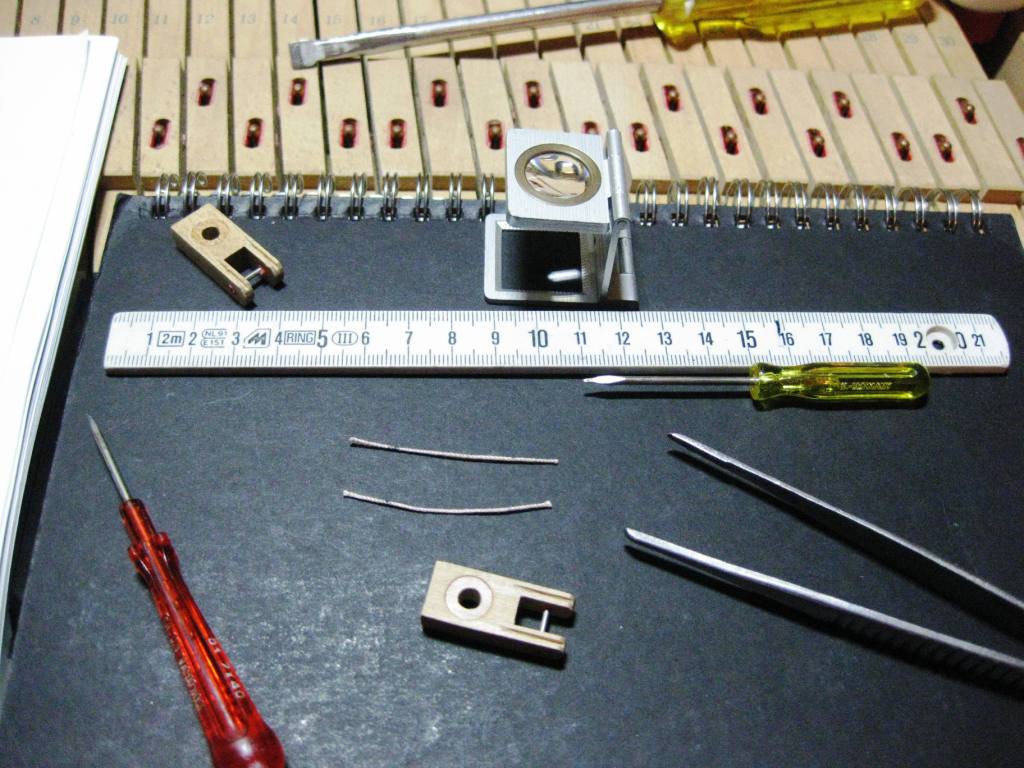
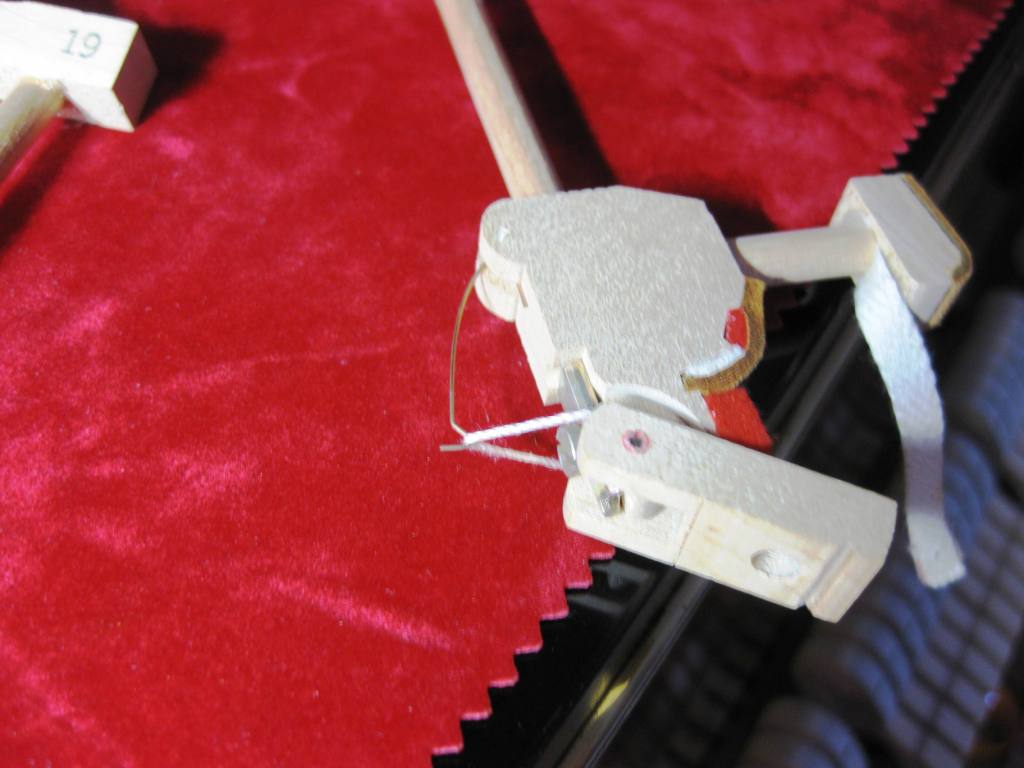
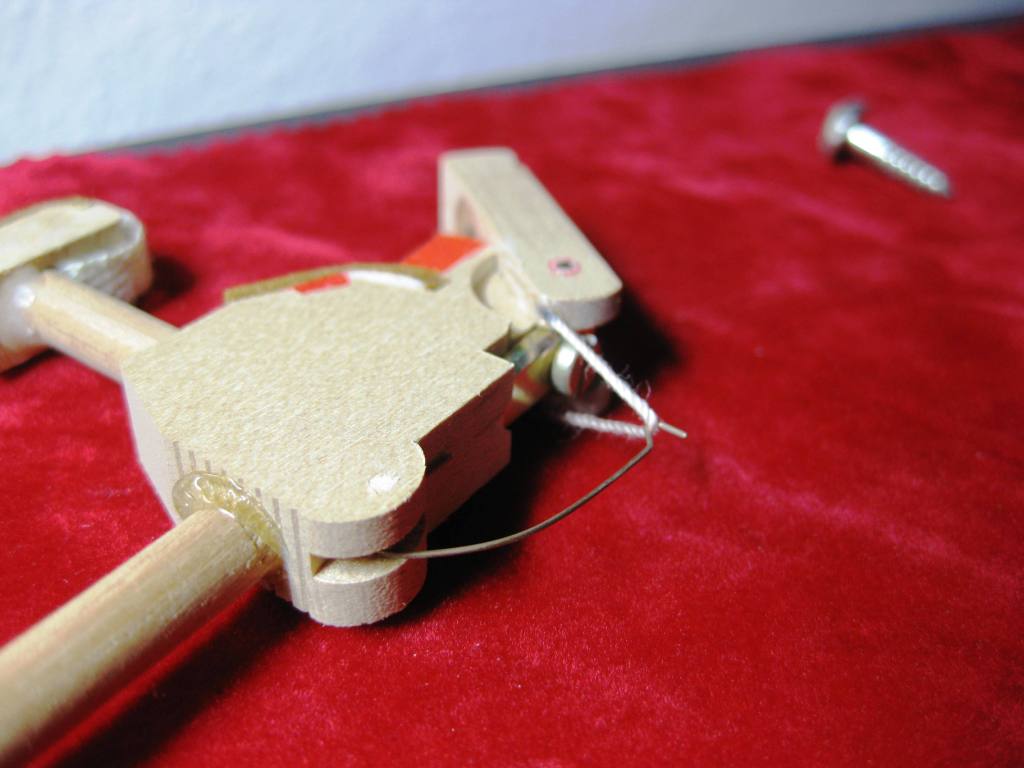
But returning to my strings, I have just finished gluing them onto the tuning pins. I'll leave them overnight to dry properly and tomorrow I will install them.
I found a cotton cord of the same section in a haberdashery, except it is a twisted cord while the original is a tubular cord with crossed threads. Do you think this could be a problem?
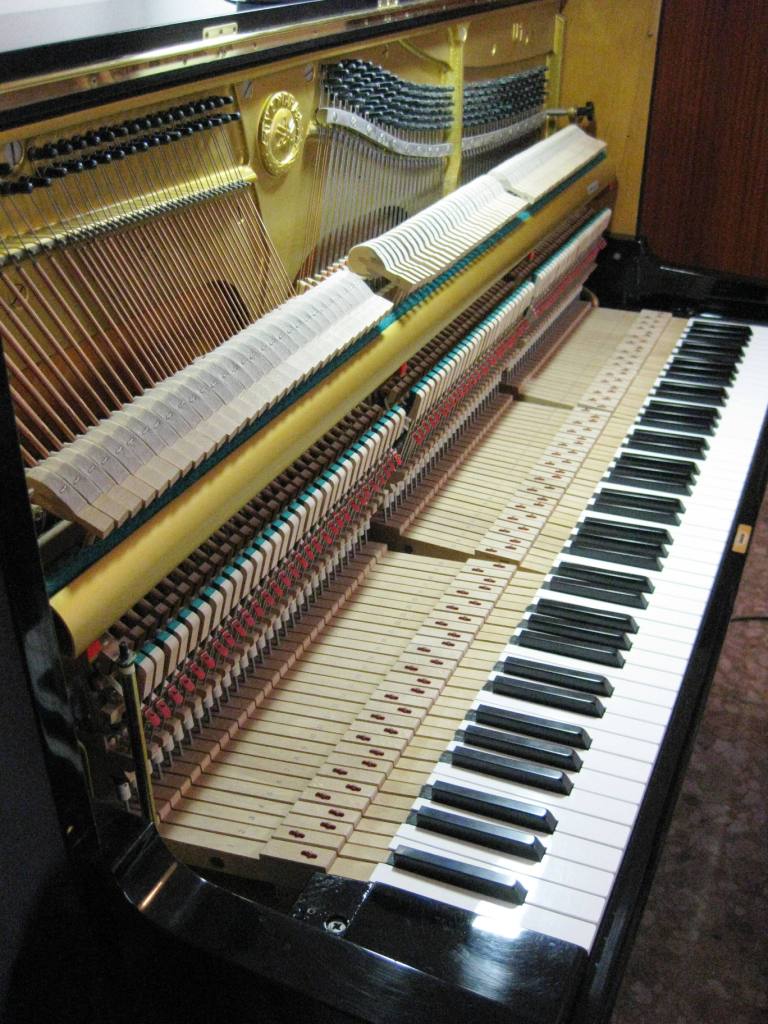
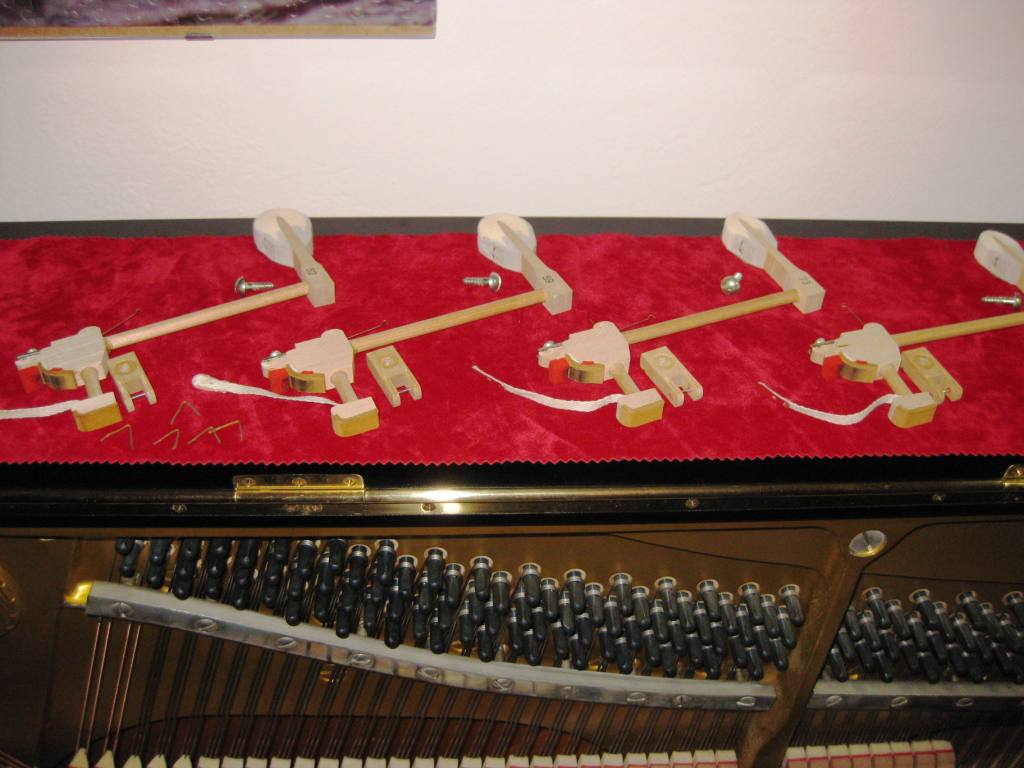
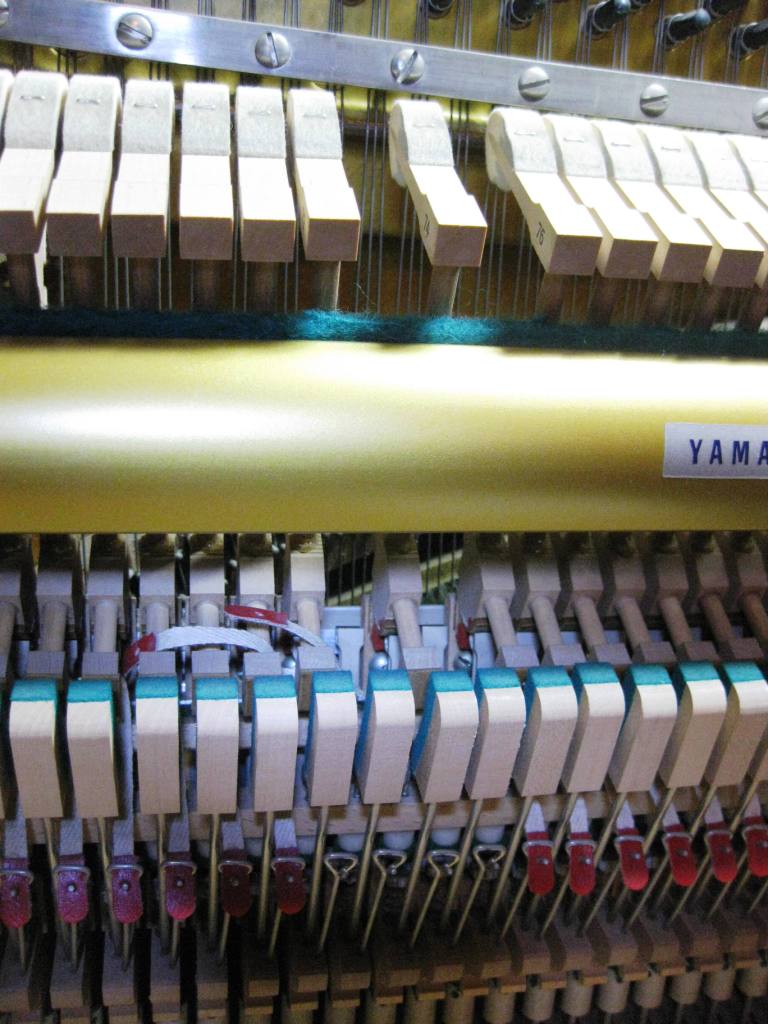
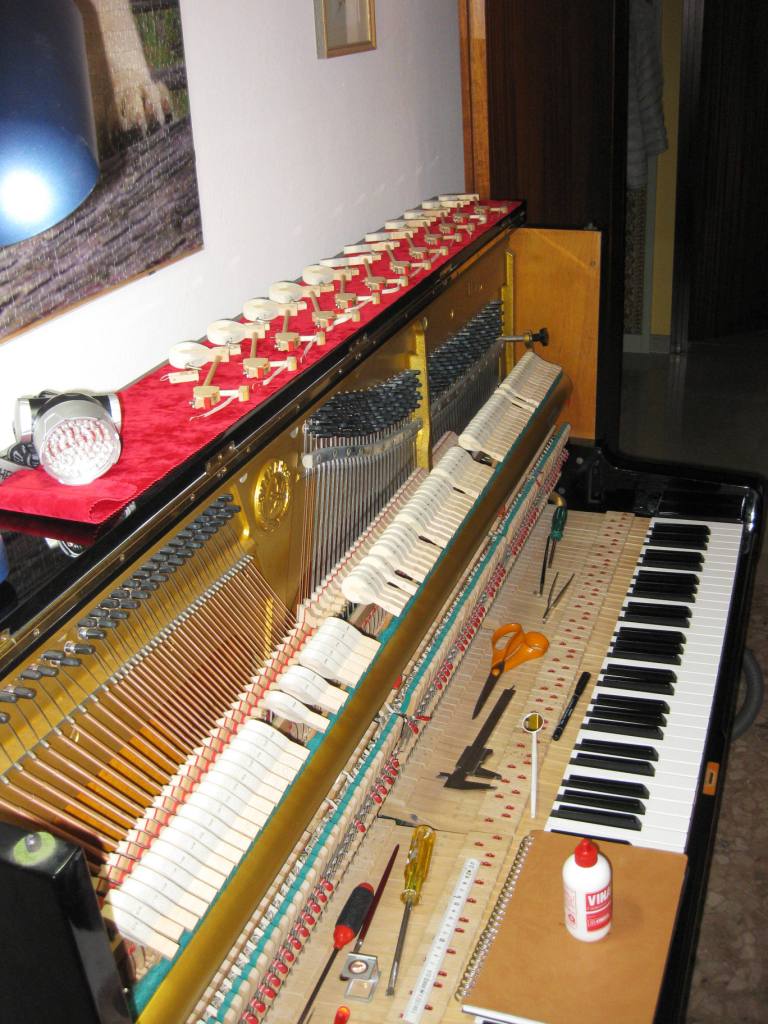
I have already taken photos which I will send tomorrow once the work is completed. I didn't change them all, as I said, but only the broken ones (14). I only managed to disassemble the hammers involved. Then I will repair them as I go, although I predict that soon I will have to get back to work; in fact, since I started the discussion, another one has already been added.
I thought I would have to disassemble them sequentially until reaching those involved because I had little space between one hammer and the next to insert the screwdriver. But I modified a screwdriver that allowed me to graze the escapement lever and access the hammer fixing screw.
Of course, repairing all 88 meticulously, as I think I have done, would take about 30/35 hours. A professional perhaps less. But how much would it have cost me if I had had it done?
Look, I recently restored some suspension springs on the stand for a Feurich of my own; they had been removed to make it heavier (this involves removing the stand, inserting the pin or the cord that holds the spring, then reassembling the stand and discharging the spring to get the right descent weight... it took me 8 hours... a job more tedious than strenuous, so a technician can ask for whatever they want!)
It seems like excellent work to me. The cord used is perfect. Well done. It always pleases me when I manage to encourage a friend to try possible works on the piano. However, one must always respect the experience and competence of prepared Technicians who, if conscientious, place themselves well at the service of the instrument. Congratulations
I forgot to document a detail that seems interesting to me. While I was disassembling the hammers, on two of them I found a small piece of paper attached to the capstan, positioned on one side, which sits between the capstan and the frame when the hammer is assembled.
I don't have a photo; I didn't think it was important right away, but I will provide one.
I made sure not to remove it; in fact, one of the two, which was partially detached, I fixed with an extremely thin layer of glue.
To an expert, its function will be obvious, but for a novice like me, I can only guess its use.
But before expressing myself, I would like to hear your authoritative explanation. I would have to bring up the third-class lever to explain it.
It is used to correct the direction of the hammer. All hammers must be parallel during the stroke, and with the templates one can correct any deviations; with the right template, the direction is corrected towards the left and vice versa.
The little star next to the Topics indicates that you have written at least one post in that topic. In simple terms, the topics where the star appears next to them are those in which you have actively taken part in the discussion.