

But I don't understand, if I don't agree, do I not have the possibility to express my thought?
Member
Reply 61 by micamahler
- Posts
- 428
- City
- Val Maira
Started by
Member
Member
But I don't understand, if I don't agree, do I not have the possibility to express my thought?
Member
The keys, regarding the photos from the PC again, seem to have been dirtied with something greasy.... You can see it under the hammers.... a mess in my opinion! There is no procedure that involves dirtying the keys.

Administrator
Ok now you have expressed it...
Member
@mephisto I think they messed up a bit on that piano, sorry but I was away for work and from the phone I hadn't seen it well (the photos are very clear).

Member
I absolutely agree with Davehammerklavier, there are too many cases of poorly executed work (actually terribly: hammers glued crookedly, screw replacements that strip the threads, hammers aligned in a wave pattern, etc...) and with absolute disregard for the poor pianist who finds themselves forced to have the work redone and, in extreme cases, even having to replace the piano.
If the piano doesn't sound as it should, the technician's response is: it's you who doesn't know how to play!, or you are deaf!
Perhaps some conscientious technicians still exist, but to find one, one is practically forced to undergo a robbery in advance!
The AIARP membership is a joke, actually a true and proper robbery!

Moderator
And here we go again! I once again invite everyone to moderate their judgments, especially regarding trade associations which, no matter how things go, are accredited by Europiano. Anyone who remains dissatisfied with a job can, if that professional is a member of the Association, refer to it to express doubts and dissatisfaction.
The purpose of this site and this Forum, I repeat for the umpteenth time, must be to better understand one's own instrument and therefore interact better with one's Technician. Knowing how things stand allows one to intervene with valid and detailed arguments that make it clear, if necessary, to any professional who applies principles somewhat superficially, to take responsibility or even to refrain from performing interventions.
It is not possible to use terms like those used in the last sentence of the previous post. Each of us can express our own opinion, but with moderation, without over-generalizing our negative judgments.
I, who am not a member of AIARP, respect the initiative, but sometimes I agree and sometimes I do not with the line adopted by some members, even as I recognize the high competence of some of them. This work requires particular attention and continuous growth. Every pianist must seek and find the Technician who satisfies them. Every Technician should worry about questioning themselves and seeking the opportunity to "grow," to always move forward. The two figures meet well when the level and expectations coincide. I repeat another thing I have said many times. It is a case of entrusting small interventions to the Technician and seeing how they respond to the requests and needs of the pianist. When we see "crooked hammers," we are already ahead, because we entrusted that professional with very delicate work.
Member
Once, when I was still unable to tune the piano by myself, a technician called for tuning had, on his own initiative, shaved down (new) hammers of my upright one by one because, according to him, the sound was too violent! Having ruined the hammer rail (so much so that the technician who intervened the next time proposed a replacement), I had to get rid of the piano, which I liked very much.
Both are still part of the AIARP/Europiano board.... But that means nothing, there are many very good ones.
This is to say that sometimes even a simple intervention can cause damage, so one must only hope to fall into the right hands.
Once, a friend tried to complain about the poor work of a technician belonging to the aforementioned association with several members of the Board; the response after the description of the havoc was more or less this: "impossible, he is a very capable person"
Someone else, more astute, (finally) took legal action and managed to win the lawsuit against a technician who destroyed his piano and, while reassembling it, forgot to insert the wedge in the center support of the plate because he had lost it!!! The point where all the tension is concentrated.
In short, people complain more and more about incompetence in this field, and are increasingly taking action to do it themselves, also due to rather high estimates. Here in the north, some go as far as asking 4000 euros for the replacement of a hammer rail, often when the hammer rail is still good and the value of the intervention exceeds that of the piano.
Member
Anyway, for the record, tomorrow together with my technician and the owner, we will disassemble a Steinway that was destroyed by a "restoration" intervention....
They scraped at least two millimeters of material from the soundboard and then bleached it with hydrogen peroxide, burning the wood so much that the grain raised.
Not to mention the ribbing done halfway with cracks that reopened once the instrument acclimated, and the glue spilled from the ribbing still present under the soundboard, solidified!
Dull bass strings, the top octave is mute, dampers not working, and a voiceless piano, with the action not even taken into consideration, and many other little things that make you want to pull your hair out.
The soundboard will have to be replaced...... unfortunately.
The technicians had the instrument in their hands for an entire year!!!!
An instrument that was also the subject of discussion on this forum.
I understand it can be annoying, but Mike is right when he says that there are pianists who have to spend twice as much, also because of major interventions done poorly.

Member
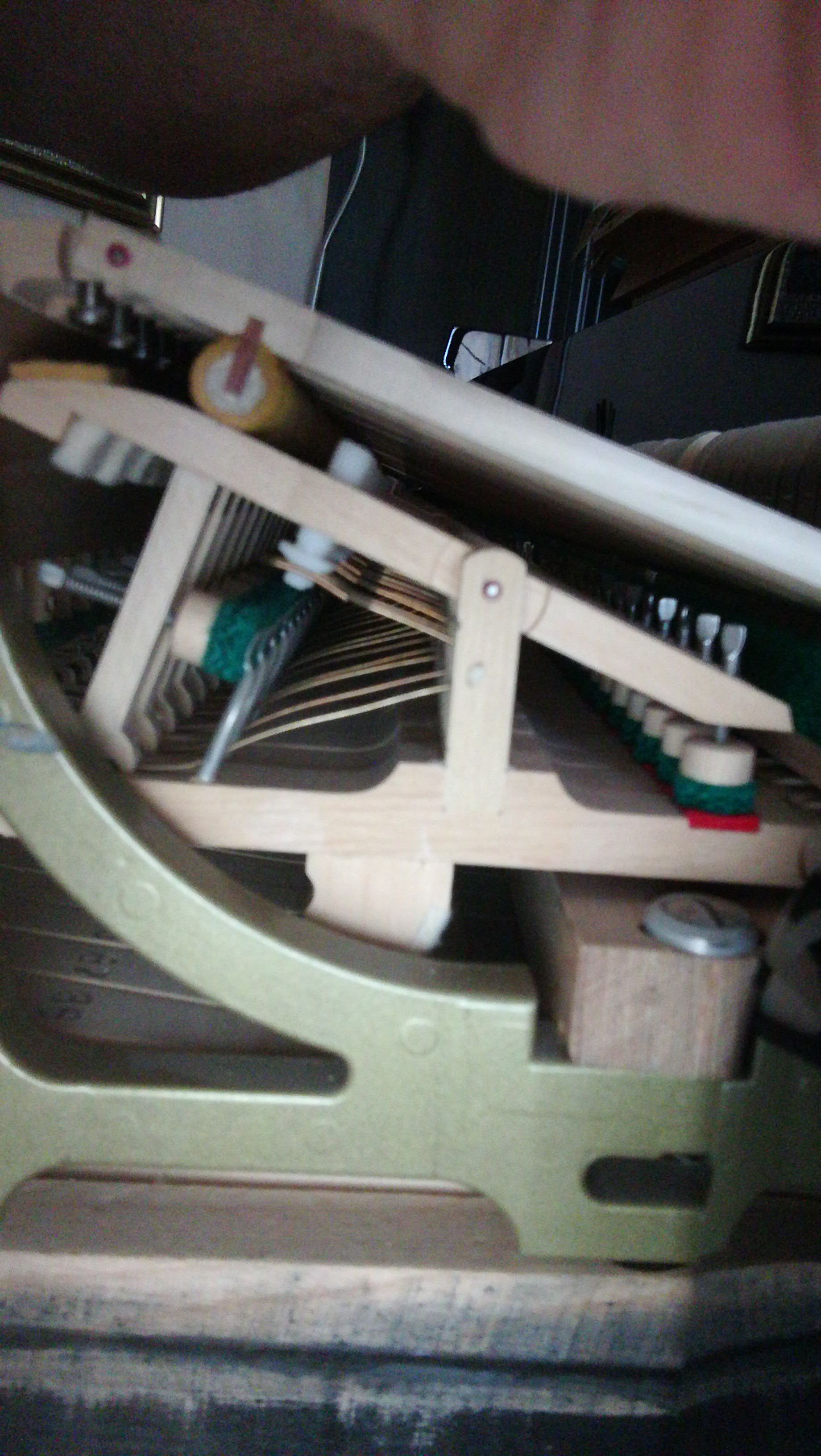
I own a Schimmel (branded Pleyel, but it is always a Schimmel), so I know it well. I think the action parts have been replaced.
Schimmel uses a very convenient screw for adjusting the spring tension.
Paolo, have you noticed that the original hammer is made of hornbeam (I don't understand why add lead if it is already heavy enough on its own!) while the others are made of mahogany? In my opinion, there was an attempt to exceed one of the piano's limits. All brands have limits, even Steinway. As magnificent as the Schimmel is, its limit lies precisely in the weighting and the masses. I think Yamaha's weighting is ideal (and I believe even more so in the smaller models).
Moderator
In my opinion, but I can't see very well, those trestles have the return spring at the forcola! Which weight are you talking about?
Member
In a posted photo, the Schimmel 208 had a lead core in the first original hammer (in maple). The others are in mahogany. My action's repetitions have the return spring to the capstan, which, from what I understand, was eliminated from the Schimmel 208 (after installing a lighter hammer rail?).
Moderator
Certainly! Why increase the masses only to then help them with a spring?????? The weights were added against all good sense! Mahogany is lighter.
Moderator
In my opinion, the hammers are all mahogany.... perhaps the pianist requested more weight... or the keyboard had been over-weighted. Everything against common sense. The entire dynamics is altered. The keyboard must not be over-weighted. There is also this widespread belief that one needs a weighted keyboard to study better. "so when one finds a piano that is 'hard' we won't have problems". Nothing could be further from the truth. Trying to build muscle is useless; on the contrary, with a keyboard having a falsified let-off weight, the entire proprioception of movements and micro-movements changes, and many technical problems remain unresolved. Try it and see. Correct let-off and correct return!
Member
I challenge you to play Debussy WELL on a heavy keyboard!!!
Member
pianoexpert wrote:On 20/1/2020 at 08:13, pianoexpert said:
In my opinion, but I can't see very well, those jacks have the return spring at the key lever! Which lead are you talking about?
Sorry for the delay, but I had lost track of the discussion! Why is it that sometimes I don't receive notifications?
Yes, these small weights worsened the touch quite a bit. The excessive weight caused the touch to be "pointed towards the forte" and prevented me from getting there with gradualness. Pianoexpert is absolutely right.
Anyway, it will surprise you to know that the hammer of the first large bass, different from the others, actually weighed less... (Compared with the one next to it and having removed the weights from both). It is also thinner in diameter and certainly less compressed... A sign that appearances with hammers are deceiving.
In the photo you see, the piano didn't even have the return springs at the key lever installed.
And this is regarding the old action
---------------------------
The new hammers, however, ordered from Schimmel via Renner and installed later, in addition to weighing less than those you see in the photo, arrived pointed, meaning "thinned out even on the sides".
The wood still seems to be mahogany, and they weigh less.
Despite already weighing less, I felt the need to install the return springs at the key lever to improve the touch and make it even more multifaceted. And in effect, I like it much more; it is less direct.
At the moment, in addition to having the return springs, the keyboard has no lead inside the keys; conversely, it was less easy, always a bit pointed towards the forte.
I was thinking that perhaps it would sound even better with another lighter set of hammers, but since I have no experience, I wouldn't know how to choose. The answer might lie in the "first bass". I have no idea.
Moderator
I don't see any photos
Moderator
Excuse my confusion. It is a remote discussion and I .... am a man of the '900! Are Francesco and Musik the same person? Because I no longer understand which instrument we are talking about!
Member
pianoexpert wrote:2 hours ago, pianoexpert said:
Excuse my confusion. It's a remote discussion and I .... am a man of the '900! Are Francesco and Musik the same person? Because I no longer understand which instrument we are talking about!
Yes, indeed there is a lot of confusion, the post is very old, we are two different people.
Francesco started it in January to ask for clarification on the topics we had covered, but I only realized it now. It is not clear to me if he also has a Schimmel (?)
Furthermore, Francesco had also responded to a second old discussion, if I am not mistaken, the one where I was replacing the hammers. So he knows everything.
Regarding the springs, I was referring to the photo I published in the past on the stand, which is not very clearly visible; I wanted to tell Francesco that he wasn't installing return springs to the knuckle. But today he installs them and I prefer it. I still own it, but I suspect it would sound better with a lighter hammer action, perhaps without springs.
Moderator
I believe so too
Member
It's me, Francesco, and I am not Musik. I own a Pleyel that is actually a Schimmel (it only has the Pleyel name and vaguely its timbre). Even today, Schimmel grand pianos are factory-fitted with a return spring to the lever that allows the key to drop less and reduces inertia. However, in my opinion, it has two critical issues: the first is that the sensation of the "balance lever" is lost (you can feel the key being pressed) and the return (which I must say is very lively) is due to elastic force rather than weight; the second critical issue is that every spring is strongly influenced by friction forces, and when excessive, this sensation is amplified. Furthermore, the key can absurdly weigh as much as 20g during descent but, if the hammer is heavy, it is certainly felt. I have seen several discussions where it seems to me I have seen the rests elsewhere.