Eagle wrote:If for that, there are 2 schools of thought.
There is those who use the notes of the key and those who generally respect the logic of descending chromaticism (therefore flats) or ascending (sharps)... the substance doesn't change and honestly neither does the form.
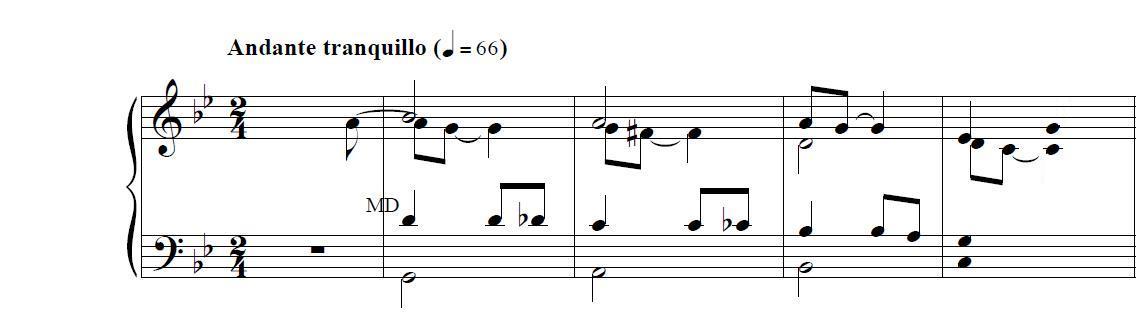
But I agree with what you are writing; in fact, if we take the descending chromaticism, forgetting about the rhythm for a moment:
d re do dob sib
has as its counter-movement:
sib si do do# re
In the event of using this latter fragment in the piece, we could have... always thinking of G-:
I6 V/IV IV #IV V
This would also have a logic at a functional level.
But returning to the original, eventually writing it as d c# c b bb and always thinking of G-, if it is "true" that one would have the notes of G- (? B natural) it is also true that :
#IV going to IV? ... the raised fourth is a form of tonicization of the fifth, it should go up
B going to Bb? In G minor it would be a change of mode. Of course, Scriabin would have used it as an appoggiatura
(major third towards minor third), but he would have used another context.
In fact, a theme by Scriabin was already used in the last LAB for the piece for pf; it's better to change from time to time, also to provide variety
Considering that ultimately d flat and c flat are passing notes in a descending chromaticism and functionally I don't see much added value in C# and B natural, now I think that PuntoCoronato perhaps was referring to something else and I am curious.
Anyway, after having thrown Grieg down the toilet, torn Scriabin to pieces, and criticized the theme of the next LAB for the pf (of which I haven't named names yet, but I think it contains a flaw and not one of writing) ... I am not surprised by anything
I join Eagle's request, what do you mean PuntoCoronato?