I mean, I just want to know out of curiosity if this theme had been written by Schubert, would he have used C# and G natural in your opinion?
I don't know
However, in my theory book it is written that in descending chromatics flats are used and in ascending ones sharps are used; reasoning in tonal terms, I think Eagle is right... being passing notes and not being important notes for the purpose of identifying the degrees of a scale or a harmony, perhaps it is just a matter of writing convenience....
I just posed the question to my teacher like this: "Do you see anything strange in this theme?"
...he played it for me and asked me...what isn't working?
....
P
puntocoronato
Member
Reply 24 by puntocoronato
Posts
18
I will also ask my teacher, let's see what he says........
It is possible that I am mistaken.
P
puntocoronato
Member
Reply 25 by puntocoronato
Posts
18
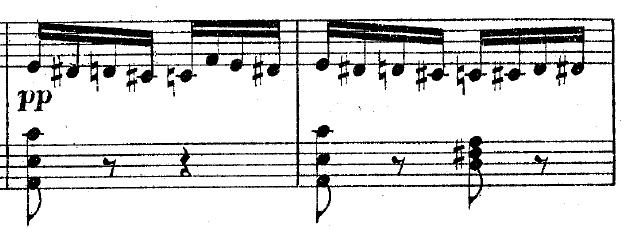
Can you explain to me why in this passage and throughout the entire piece, the composer (Rimsky-Korsakov) and like him all the other great classical music authors always use the augmented fourth and seventh degrees in a descending manner? I don't think it has anything to do with the underlying chord, let alone whether they are actual or passing notes, but it only concerns the tonality.
PS the piece in question is the famous Flight of the Bumblebee.
For me, this theme could very well be a slow central movement of a three-movement sonata. However, it would be an incomplete sonata, so perhaps I will orient myself towards a piece in sonata form, but one that can stand alone.
E
Eagle
Member
Reply 27 by Eagle
Posts
264
puntocoronato wrote:
Can you explain to me why in this passage and throughout the entire piece the composer (Rimsky-Korsakov) and like him all the other great classical music composers always use the augmented fourth and seventh degrees in a descending manner? I don't think it has anything to do with the underlying chord, let alone whether they are actual notes or passing notes, but it only has to do with the key.
PS the piece in question is the famous Flight of the Bumblebee.
But was Rimsky-Korsakov a contemporary of Schubert? You know that at a certain point everyone did whatever they pleased, even using unusual degrees and chords (they were called neo-classicists).
It would have been nice to look for, as invited, an example in Schubert... it was already said further on that one can use B-natural in G minor... honestly Puntocoronato, does B-natural seem like a note of the key of G-major to you?
E
Eagle
Member
Reply 28 by Eagle
Posts
264
For example, the D# with an E flat below you, what key is it in?
You know it would have been better to have an Eb in G-, would it be in key? Or what are we talking about?
For me, this theme could very well be a slow central movement of a three-movement sonata. However, it would be an incomplete sonata, so perhaps I will orient myself towards a piece in sonata form, but one that can stand alone.
...but this is only half a theme; in my opinion, it is too little to make any kind of reasoning... one could complete it with sixteenth notes or triplets of eighth notes and it would truly change everything... then there would also be the second theme
For example, the D# with the E underneath for you, what key is it in?
You know that an Eb in G- would have been better, would it be in key? Or what are we talking about?
But if the Eb were in key, it would start on a ... enharmonically repeated note. Are we sure we aren't, for example, in G major?
I think the whole score is needed... I remember that the laboratory theme is in G-
T
Talentuoso
Member
Reply 32 by Talentuoso
Posts
206
I had witnessed a similar discussion in the past; it ended with everyone sticking to their own idea.
What matters and what remains is the music; I have looked through quite a few repertoire pages and haven't come across a similar situation... just to satisfy PuntoCoronato's curiosity.
I would take a quick look at Beethoven's Sonata Op. 2 No. 2, particularly in the rondo - Grazioso; there is use and "abuse" of chromaticisms... Beethoven seems closer to Schubert to me in terms of period.
At measure 79, it seems to me that the pattern follows the tensions/relaxations between hypothetical chords, using flats and sharps ascending, as a reflection of possible tonicizations... it's a pity it doesn't feature true chromatic descents... let's just say I am looking into it
T
Talentuoso
Member
Reply 33 by Talentuoso
Posts
206
Anyway, either one decides to look within early Romanticism or the further one goes, the more the discussion becomes emancipated... scholastic harmony is that classical kind (with 1000 exceptions compared to what books and theorists say)... we shouldn't be misled by the triads of the theme, keeping in mind that they represent only a small piece of perhaps 200 measures. How many Jazz pieces start on triads and then later hell breaks loose?
Once in the conservatory I was playing "Rose rosse" jokingly, a teacher approaches me and says: "Yes, but in the accompaniment you used parallel fifths...."...
T
Talentuoso
Member
Reply 37 by Talentuoso
Posts
206
Guys, I've been playing it on repeat and it is a truly beautiful theme
I was "messing around" with it by adding another voice in the bass ... trying to complete it; it provides several possibilities even when venturing outside the key and inserting quartal chords ...
... we'll see, I hope to participate by September. I don't know if strictly in a sonata form... but still...
T
Talentuoso
Member
Reply 38 by Talentuoso
Posts
206
I got lost
puntocoronato wrote:
do they always use the fourth degree and the augmented seventh degree in a descending manner?
In my opinion, playing on the fourth, sixth, and seventh degrees of the scale is always worthwhile because these are degrees that are often found altered, and in a melodic minor scale, the sixth and seventh are "augmented" by definition.
What I haven't really found are examples with the augmented third... all the classic chromaticisms play within the second tetrachord of the scale (perhaps including the fourth degree as well) ... but the third... no?
You have to go much further; actually, in some Scriabin preludes one finds, for example (in E minor-) G# G b ... major third, minor third ... otherwise little, the harmonic context changes so that we are no longer on the third degree as happens here.
This thing made me reflect, but based on what has it been established that this theme must necessarily be classical?
I, on the other hand, am starting to wonder....what have they done or what are they doing to you?
Instead of asking ourselves how the theme should be, why don't we ask ourselves why it is like this and how to enhance its characteristics?
On the other hand, this is the starting material; knowing Frank and reading Geppino's remark... something is probably being missed. We will see what needs to be done.
Compliments on Maestro di Faria's openness... Eagle makes it more a matter of schools of thought and I don't know how much openness there really is. I like Talentuoso's approach.
Deal with it... even the best make mistakes every now and then ahahah
geppino12575 wrote:
Once in the conservatory I was jokingly playing "Rose rosse", a teacher approaches me and says: "Yes, but in the accompaniment you used parallel fifths...."...