Workshops

Sonata Form Workshop 2012

206 replies 24,038 views

Started by

Frank

Moderator

Moderator

Opening post by Frank

Posts
3,838
City
-

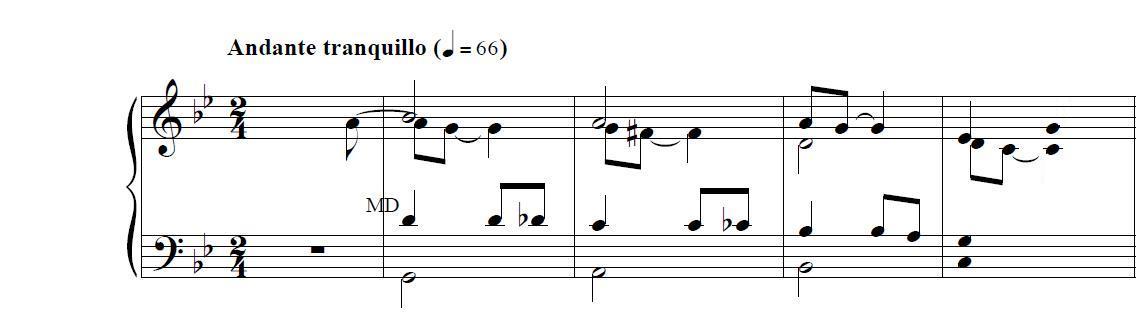
Write a piece in sonata form based on the attached theme.

Instrumentation: free (*)

First publication 30/09/2012

Participants: no limitation, anyone who wants to try their hand at it

----

(*) Since there were those speaking of an orchestra, the attachment can also be understood as a "reduction"

Attachment

Member

Reply 2 by Zaccaria

Posts
105
City
Non disponibile

I am trying to do the analysis:

Measure 1: I

Measure 2: VII6

Measure 3: I6

Measure 4: IV

It seems quite clear to me, what I cannot explain is why it sounds so good despite a relatively complex harmony or at least less elaborate than the one from the piano lab?

Are the last notes like that because they are free?

Moderator

Reply 3 by Frank

Posts
3,838
City
-
Zaccaria wrote:

Are the last notes like this because they are free?

Yes, in reality I didn't propose the classic 8 bars and something relatively simple because sonata form is demanding; it's better to provide just a starting point and leave forum members free to wander with their imagination and complete the first theme as they please (which is also more rewarding) … so it is more open in terms of number of possibilities.

Furthermore

- in its essentiality, it easily lends itself to being orchestrated for different ensembles

- if someone doesn't have time to write a movement of a sonata or whatever comes to mind, they have a starting point to participate by also proposing a short piece for pf, so that those who are not advanced in their studies can also be involved... just putting it out there

Member

Reply 4 by Eagle

Posts
264
Zaccaria wrote:

what I can't explain is why it sounds so good despite a relatively complex harmony, or at least less elaborate than the one in the pf laboratory?

The fact that the triads never arrive directly and are always hidden by delays, the presence of chromaticism, the voice leading, the starting on the upbeat ... these are all (and together) excellent ingredients for a good theme.

The harmony in general does part of the work, and anyway a VII5dim (even if in first inversion), a I 76, etc. always help ... I would say they are a classic

I would complete it by reaching 5, 6, or 8 bars to define the first theme...

Member

Reply 5 by AbateFaria

Posts
640
City
-

I agree Eagle... and the initial A is a bit misleading for a clean start on the I degree, resulting in I°98, as also happens in the fourth measure IV°98

Almost almost a nice little romanza to listen to under an umbrella ....

Member

Reply 6 by Zaccaria

Posts
105
City
Non disponibile

Thanks for the explanations, I am sketching out a possible response. Eagle's point about 5, 6 or 8 bars throws me off a bit...

Member

Reply 7 by puntocoronato

Posts
18

a curiosity..... But who wrote the theme? Is it by a famous author?

Member

Reply 8 by puntocoronato

Posts
18

According to the studies I am conducting, there are two writing errors in this fragment.

What do you think? Am I wrong?

Member

Reply 10 by Eagle

Posts
264
Zaccaria wrote:

Thank you for the explanations, I am sketching out a possible response. Eagle's point about 5, 6 or 8 bars throws me off a bit...

Based on the possibilities offered by the theme, I feel like 5, 6 or 8 bars are needed to complete the theme. If you want to write a romance, with 4 bars of response you still reach 8

I hope this is clearer

Member

Reply 11 by Eagle

Posts
264
Frank wrote:

...are you referring to the 2 chromaticisms?

If that's what you mean, there are 2 schools of thought.

There is those who use the notes of the key and those who generally respect the logic of descending chromaticism (therefore flats) or ascending (sharps)... the substance doesn't change and honestly neither does the form.

What do you mean PuntoCoronato?

Moderator

Reply 12 by Frank

Posts
3,838
City
-
Eagle wrote:

If for that, there are 2 schools of thought.

There is those who use the notes of the key and those who generally respect the logic of descending chromaticism (therefore flats) or ascending (sharps)... the substance doesn't change and honestly neither does the form.

But I agree with what you are writing; in fact, if we take the descending chromaticism, forgetting about the rhythm for a moment:

d re do dob sib

has as its counter-movement:

sib si do do# re

In the event of using this latter fragment in the piece, we could have... always thinking of G-:

I6 V/IV IV #IV V

This would also have a logic at a functional level.

But returning to the original, eventually writing it as d c# c b bb and always thinking of G-, if it is "true" that one would have the notes of G- (? B natural) it is also true that :

#IV going to IV? ... the raised fourth is a form of tonicization of the fifth, it should go up

B going to Bb? In G minor it would be a change of mode. Of course, Scriabin would have used it as an appoggiatura

(major third towards minor third), but he would have used another context.

In fact, a theme by Scriabin was already used in the last LAB for the piece for pf; it's better to change from time to time, also to provide variety

Considering that ultimately d flat and c flat are passing notes in a descending chromaticism and functionally I don't see much added value in C# and B natural, now I think that PuntoCoronato perhaps was referring to something else and I am curious.

Anyway, after having thrown Grieg down the toilet, torn Scriabin to pieces, and criticized the theme of the next LAB for the pf (of which I haven't named names yet, but I think it contains a flaw and not one of writing) ... I am not surprised by anything

I join Eagle's request, what do you mean PuntoCoronato?

Member

Reply 15 by puntocoronato

Posts
18

Premising that I want to learn and not argue.

According to the studies I am doing and according to the canons of classical music, in that passage one should use C# even if we are descending and it is a natural B.

Am I wrong? Keeping in mind only classical music, say up to Romanticism?

That is, I just want to know out of curiosity: if this theme had been written by Schubert, do you think he would have used C# or a natural B?

Moderator

Reply 16 by Frank

Posts
3,838
City
-
puntocoronato wrote:

Exactly


...I suspected as much, you will have read that however there aren't many reasons, it is precisely a matter of conventions... of course, if you are thinking about decontextualization, do whatever you deem appropriate


You will have noticed that in previous workshops no one takes offense if someone lays hands on the themes, the important thing is to get your hands dirty... this is truly simple, I hope the most timid ones find their courage

Moderator

Reply 17 by Frank

Posts
3,838
City
-
puntocoronato wrote:

Premising that I want to learn and not argue.

According to the studies I am doing and according to the canons of classical music, in that passage one should use C# even if we are descending and it is B natural.

Am I wrong? Keeping in mind only classical music, say up to Romanticism?

That is, I just want to know out of curiosity if this theme had been written by Schubert, would he have used C# and B natural in your opinion?

If you cite Schubert, you are in the very early Romanticism; you know that it is articulated over 3 periods... I see B natural really poorly for an early Romanticism. You find it in Scriabin, which is late Romanticism.

The C# probably yes, but one would need to see the type of harmonization

Member

Reply 18 by Eagle

Posts
264

...they are actually passing notes, perhaps Schubert wouldn't have even used them

It is not just a matter of writing style, but of content...despite the triads, it is a more advanced writing style.

Member

Reply 19 by Eagle

Posts
264
puntocoronato wrote:

Premising that I want to learn and not argue.

Of course... in fact, your question is very stimulating.

Perhaps there is much more to learn from Jazz musicians; after all, how it sounds is what matters... the rest are truly just peripheral details

Member

Reply 20 by Zaccaria

Posts
105
City
Non disponibile
Eagle wrote:

Based on the possibilities offered by the theme, I feel 5, 6 or 8 bars are enough to complete the theme. If you want to write a romance, with 4 bars of response you still reach 8

I hope this is clearer

I'm struggling a bit with Eagle, and lucky you for being able to even do variations on the themes...

Log in to participate