

As per the subject: what is meant by "romantic mythologies" regarding Beethoven?
... perhaps there was a "Beethovenian intention" to overturn the conventions of classical harmony?
Started by
Elfo
Member
Member
As per the subject: what is meant by "romantic mythologies" regarding Beethoven?
... perhaps there was a "Beethovenian intention" to overturn the conventions of classical harmony?
Member
It seems to me that Beethoven adheres strictly to the rules of harmony (see also modulations) and does not betray them like some later Romantics.
Perhaps it can be said that Beethoven inserts into his compositions that emotional component which subsequently had a great influence on the history of music. Even though various musicians and musicologists define Beethoven as an emblem of rationality.

Moderator
Someone more experienced than me will surely answer you.
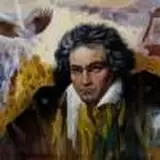
I am only saying that when one speaks generically of "romantic mythology," one refers to a set of values, especially ethical and aesthetic ones, typical of Romantic culture. One of the most common refers to the artist; a sort of philosophical ethics of the Romantic artist is developed. To make art means to search infinitely for something that does not exist, to suffer various conflicts, the heaviest of which (generally) is the one between form and content, between matter and spirit. This philosophical ethics of the artist thus becomes so pervasive as to give rise to various figures of the ideal "artist" (and, by extension, of the Romantic man). Literary cycles (and artistic ones in a broad sense) are born and developed around characters such as Caravaggio, Tasso, Beethoven, Ernani, although the two quintessential Romantic men are often identified as Werther and Faust (entirely fictional characters). The set of characteristics and behaviors that Romantic aesthetics has attributed to these characters has formed over time a sort of "romantic mythology." Which, therefore, is quite different from actual history/historiography, in the sense that the difference between events that actually occurred and aesthetic "parables" is precisely what gets lost.
Member
What you write is perfect, Claudio!
After Beethoven's death, there arose an immediate need to reconstruct the composer's biography. The first writings appeared in 1838 and consisted of a small biographical-memorial volume by the physician Franz Gerhard Wegeler, a childhood friend of Beethoven, and the musician Ferdinand Ries, a student of Beethoven since 1803.
In 1840, the first imposing full-scale biography appeared by Anton Schindler, Beethoven's amanuensis from 1812 until his death. This biography is actually full of falsifications, facts distorted or invented by Schindler himself and, all this already contributed to creating mystifications and falsehoods regarding Beethoven's personality. On the other hand, it was Beethoven himself who created the preconditions for all this. In a letter from 1825, he indeed wrote that he never, ever sought to deny any news, true or false, spoken about him: the most striking example was when, due to the vanity of his surname, someone thought he was of noble origin; he was quite careful to deny all this, also because it served his purpose in the lawsuit he brought against his sister-in-law for the custody of her son, who was also his nephew.
But there is another way in which the composer's behavior allowed the myth to be born: the phrases he often wrote in his diary or in his letters. Phrases that helped the Romantic movement paint him as a hero who sacrificed everything for his art. Let us not forget that the “sons of Beethoven,” his successors, recognized only his greatness through the music of his second style, also called the “heroic style,” while they did not understand the immense works of his third style.
But let us let Giovanni Carli Ballola tell, from his Beethovenian biography, briefly what happened next: « Beethoven projects his immense light onto the entire musical civilization of the 19th century, even if, as everyone knows, to a greater or lesser extent elsewhere. His presence was felt like that of a redeeming and tutelary deity, and the Romantics looked to him not so much as a precursor, but as one of their own, the first and the greatest. Nothing remains more indicative, in this respect, than the famous passage contained in the essay on “Beethoven's Instrumental Music” which Hoffmann included in Kreisleriana and published in 1814, while the Maestro was alive and active: « Beethoven's music moves the lever of terror, horror, fright, and pain, and arouses precisely that nostalgic and infinite desire that is the essence of Romanticism. He is therefore an exquisitely romantic composer: and could this not be the reason why his vocal music is less successful, as it does not allow for the character of indefinite nostalgia, but only represents determined feelings experienced in the realm of the indefinite with words? »; where that process of mythologization could not be revealed in clearer terms, which, through capricious interpretations, would culminate with the writings of Richard Wagner through the heroic furies of Berlioz and the Schumannesque hunting for the hidden senses concealed in the Symphonies and Sonatas.
The Romantic movement naturally focused only on those aspects of Beethoven's work, such as tragic desolation, heroic arrogance, or even the pantheistic giving oneself to the enchantments of nature, that could coincide with the mythical and legendary Beethoven who succeeded the historical one and was only partially identifiable in him. Regarding Beethoven, they wanted to ignore his Enlightenment training, his substantial optimism, his faith in man and reason, and, obviously, his own distrust of the Romantic movement; just as other peculiar aspects of his art, such as healthy and rugged joy and humor, were pushed into the background. In addition to his spiritual message, his human personality, and the ideal content of his work, his revolution in the field of form was also misunderstood: they wanted to see in it only the longing for individualistic freedom, the irrepressible impulse of a rebel intolerant of traditional schemes, whereas it was primarily about the creation of new formal dimensions, of new and extremely more complex constructive orders. »

Member
Fully agree with the things written
1) by Thallo (the artist's struggle to reconcile form and content in the work of art)
2) by Daniele (the exaltation-annexation of the "heroic style" by the Romantics at the expense of other aspects of Beethoven's art)
I would add
1) the deaf musician: deprived of the comfort of hearing his own creations
2) the firm will [his words] to want to "seize fate by the throat"
3) having refrained from ending one's own life [source: Heiligenstadt Test.] only in the name of one's own Art
more myth than this?! . . .
Moderator
it's the beginning of the end recently I was reading an article on the change of perspective in musical historiography, and this discussion is perfectly timed for our topic: these romantic mythologies fit fully into what is often defined as right-wing historiography, the idea (to simplify) that history is made by individual personalities. Before Romanticism, music histories were stories of national musical tastes. With Romanticism, personal music histories begin to be made, as was also mentioned in the topic on art and nature, speaking of Savinio and his way of defining a pre- and post-Beethovenian musical history. Well, from a historical point of view, it makes sense to speak of pre- and post-Beethoven only if I consider Beethoven a myth and not a person and if you are content with speaking about the impact of his music in an anecdotal way... The reasons for this way of doing art history are many; today (for many years now, actually) there is an attempt to tackle new fields, new ways of reconstructing the past
Member
Perhaps I will surprise you, Claudio: but I would be happy to!
It is time to redeem Beethoven from... Beethoven or, more precisely, from the paradigm that his myth has helped to build. Only in this way can he truly appear in all his necessity, beauty, and sublimity, beyond the excessive influence and domination he imposed on a century and a half of music history.
Moderator
unfortunately I have never read anything on the subject, but it is also worth saying how Beethoven's studies were precisely the first to dismantle some typical "myths" of interpretation of works in light of biography and biography in light of works. Fortunately, in fact, we have not only compositions from Beethoven but also sketches, and the study of sketches (considered a "revolutionary" thing to this day, unfortunately) succeeds in giving a true historical nature even to the compositions. In a certain sense, it transforms them from points into segments, activities in evolution. Similarly, studies on the history of reception are trying to separate the various possible "identities" of Beethoven: the historicized one, the performed one, the narrated one, all different entities in different times
Member
«the historicized one, the played one, the narrated one, all different entities in time»
Beautiful! . . . A mythical Beethoven . . . 'polytropos' as much as Odysseus
Hi Thallo,
regarding your post from yesterday (on the methods of historiography) I would like to ask you something: you said that the 'old ways' of doing music history have many reasons at their base. I perceive only one (without prejudice to considering others), but . . . these reasons, in your opinion, are they all unfounded, senseless?
bye
Luca
Moderator
it would be a case to open a specific topic...
the issue is very complicated and evolving. The methods and objectives of every discipline change with the discipline, over time, in the places where the discipline is studied, according to schools and ideologies etc. Musicological disciplines are very heterogeneous, and moreover relatively young (compared to disciplines such as, I don't know, philosophy...). The discussion on the "method" of musicological disciplines is relatively recent and essentially began with a sort of analysis of the methods implemented to date. If the analysis of the methods of musical analysis (for example) is relatively easy, the analysis of the methods of musical historiography is less easy. They are implicit methodologies, not declared (except in rare cases). Even the awareness that a method exists in musical historiography is difficult to grasp. Even today, the vast majority of bibliographic contributions dealing with music history do not have a methodological introduction, do not demonstrate that they are taking the problem into consideration and, often, go against some of the objective progress of general "History."
Thus, studying musical historiography means, anyway, joining History and Musicology, using their (individual) means and methodologies to create means and methodologies (of synthesis).
In this light, there are histories of music that use neither the means nor the methodologies of General Historiography in a clear way. Even more so, there are histories of music that do not use musicological methodologies. Censoring these histories by saying they are poorly made is relatively easy, at least in an academic sense. If poor Savinio had written music history (because, let us remember, he wrote criticism, which is different), it would have been easy to dismantle him using simple historiographical methods. More difficult, and anyway useless, is setting out with the intention of "dismantling" other histories of music. The good historiographer uses everything as if it were a source. Furthermore, for some time now, so-called reception history has brought us face to face with the problem that historiography MAKES history. To give an example, Beethovenian mythology has influenced subsequent music history and general history. What sense would it make to limit oneself to saying "ah! Beethoven was not a super-hero! Methodological sacrilege!!". Today, it is cooler to go back through all the books that praised Beethoven, provide an account of common points, perhaps discover some cross-references, thus building a SCENARIO. In short, not just facts, but also the imaginary; understanding not only what happened in what we are used to calling music history (i.e., the history of compositions), but also understanding what happened in other, less renowned histories of music, such as the history of musical institutions, the history of consumption, the history of criticism, the history of theories etc.
In short, everything counts.
... but from an academic point of view
from a personal point of view, as Gadamer would say, we have the RIGHT to say that we do not like a reading, that we do not share a quotation or a point of view or an entire encyclopedia. We too are part of the signifying circuit of history (and of music)."
Member
[without opening a specific topic... actually, I like observing how topics transform by moving to new interesting themes... they seem like "variations"! ]
Thank you Thallo,
for explaining the “labyrinth of historiographical and critical methods and aims” to me: conscious, unconscious, subconscious, implicit, declared.
However, I return to your previous post in which you noted that, alongside an old historiography (defined as ‘right-wing’) where the history of music is made up of individual personalities, new methods of reconstructing the musical past have been appearing for some years now.
It seems to me, however, that this old way has its reason (the only one I see). Namely, the fact that musical works – objects far more concrete than "Music" – are created by individual personalities: by musicians, by men. And therefore, the fact that a history of music is also focused on those personalities seems to me a sensible thing, down-to-earth: it seems to me like calling a spade a spade.
You wrote that before Romanticism, histories of music were stories of national musical tastes. Fine. This too is a good thing [and I thought "Ah... so this is the 'left-wing' historiography" ].
Why do I say that even this way has its reasons?
Because a Bach or a Beethoven do not 'fall from the sky' as wise deities, but to arrive at creating what they have left us, they breathed the air of their times, of their places; they grew in the humus of the tastes and styles that preceded them.
I do not know how much the ‘new ways’ take up that old perspective you mentioned and which I called ‘left-wing historiography’.
But don't you think – that is what I am asking you – that ‘right’ and ‘left’ could exist together fruitfully?
More than ‘right’ and ‘left’… Don't you think one could speak of a ‘Newtonian’ historiography (where interest is focused on those ‘fascinating corpuscles’ that are the various composers), and of a ‘quantum’ historiography (more attentive to the climate, to the ‘vibrations’, that characterize an era)?
Succeeding in reconciling these approaches leads to an interesting scenario. What do you say?
Ciao!
Luca
Member
LucaCavaliere wrote:without opening a specific topic...
...just for the sake of reporting
http://www.pianoconcerto.it/forum/index.php?/topic/2175-storiografia-musicale/
Moderator
LucaCavaliere wrote:alongside an old historiography (defined as ‘right-wing’) for which the history of music is made by individual personalities, new methods of reconstructing the musical past have been side-by-side for a few years now.
It seems to me, however, that this old way has its reason (the only one I see). That is, the fact that musical works – objects far more concrete than “Music” – are created by individual personalities: by musicians, by men. And thus, the fact that a history of music is also focused on those personalities seems to me a sensible thing, down-to-earth: it seems to me like giving ‘bread to bread and wine to wine’.
Fundamental premise: every method has its pros and cons, so here we are essentially performing a rhetorical exercise; we are practicing speaking well and ill of one or the other, while remaining aware that every book is different from another, every outcome is different.
That being said, the example is easily made: practically the entire repertoire of cantus planus (so-called Gregorian) has no author. And we are talking about centuries upon centuries of music. In our hypothetical book of music history, what do we talk about when we get there? Of other medieval, and even Renaissance, authors, we know very little, and often the information is so doubtful that it becomes, precisely, mythography. What do we do there? You pointed out something very correct, drawing from it, in my opinion, the wrong consequence: music is made of works, but not necessarily of authors. Let us speak of works, then. Not all of Bach had "historical importance," in the sense that the historical weight of the Passions is immensely greater compared to the historical weight of the secular cantatas.
The discussion on Bach has also crept into my other comments, so I will make a brief mention to clarify my position: we consider Bach as a point; we level out the ARTISTIC level of all his compositions and give them the same HISTORICAL WEIGHT. But this is incorrect. Different centuries have "chosen" different pieces of the Bachian repertoire, giving them different values, different weights (and different interpretations). And these weights are also different compared to the weights that Bach himself gave to his compositions: as usual, one must remember that the most consistent part of the Bachian catalog is made of cantatas! We, on the other hand, have trained generations of pianists on the English Suites and generations of composers on the chorales...
You wrote that before Romanticism, music histories were stories of national musical tastes. Fine. This too is a good thing [and I thought “Ah… then this is the ‘left-wing’ historiography" ].
in the '1700s' people spoke a lot about taste and national spirit... but left-wing historiography is quite different; these are not terms I am obsessed with, but they are in fairly common use. To summarize, left-wing historiography focuses on sociology, on economic and social scenarios; right-wing historiography on characters. War and Peace begins with a famous critique of history made only of characters, claiming the value of peoples on the stage of history. Academically, very few historians (real historians, not music historians) have remained engaged in biographical works. Also because what we lack today are precisely the scenarios. The problem with music history is that we have few analytical means to extract "discoveries" from the analysis of these blessed scenarios. That is, if I discover that in the theater of Udine between 1850 and 1870, 60 works by Truffozio Anonimelli were performed, and I find the scores, and I analyze them all, it's not as if the book I write about it will change the fate of the universe... and this is because art histories, regardless of everything, remain histories of works of art...
But... one must always expect anything. Because Truffozio Anonimelli could also have been a healthy worker who perhaps had a cousin living near Liszt, and to the trained eye of a good analyst, something interesting might appear even in his works... Furthermore, if Truffozio Anonimelli had the monopoly on that theater, then it becomes, de facto, History. Perhaps not exactly music history (understood as the essential history of musical art), but History.
Why do I say that even this way has its reasons?
Because a Bach or a Beethoven do not ‘fall from the sky’ as wise deities, but to arrive at creating what they have left us, they breathed the air of their times, of their places; they grew in the humus of the tastes and styles that preceded them.
to grasp the exception we must understand the rule. Understanding the rule of Bach's contemporaries, for example, would mean resigning oneself to the idea that on the surface, Bach is veeeery conservative. There are people who consider him the father of counterpoint, when rather he was the last of the children"}
(in chronological order). But it is the scenario that allows us to understand why the same person wrote the Musical Offering and the Brandenburg Concertos.
I don't know how much the 'new ways' take up that old perspective you mentioned and which I have called 'leftist historiography'.
But doesn't it seem to you – that is what I am asking you – that 'right' and 'left' can coexist fruitfully?
of course, everything would need to be adapted

Member
thallo wrote:Different centuries have "chosen" different pieces of the Bach repertoire, giving them different values, different weights (and different interpretations). And these weights are also different compared to the weights that Bach himself gave to his compositions: as usual, one must remember that the most substantial part of the Bach catalog consists of cantatas! We, on the other hand, have trained generations of pianists on the English Suites and generations of composers on the chorales...
Not to mention that in the second half of the twentieth century, something of Bach became truly pop, meaning catchy even to those who have not the slightest interest in "classical music": for example the Aria from Suite BWV 1068 (thanks to Quark), the Badinerie from Suite BWV 1067 (thanks to Nokia).
Who knows if the musicology of the future will deal with these phenomena, perhaps reading them in a different light than the commodification of Adornian memory...
Member
RedScharlach wrote:Not to mention that in the second half of the twentieth century, something of Bach's became truly pop, meaning catchy even to those with no interest whatsoever in "classical music": for example the Air from Suite BWV 1068 (thanks to Quark), the Badinerie from Suite BWV 1067 (thanks to Nokia).
Who knows if the musicology of the future will deal with these phenomena, perhaps reading them in a different light than the commodification of Adornian memory...
Not to mention this type of initiative
http://www.pianoconcerto.it/forum/index.php?/topic/1523-red-bull-flying-bach
Moderator
RedScharlach wrote:I wonder if the musicology of the future will deal with these phenomena, perhaps reading them in a different light from the commodification of Adornian memory...
It could also be interesting to do an in-depth study regarding the Sociology of Music; it was mentioned here without too many "implications"... I find it a very interesting field.
http://www.pianoconcerto.it/forum/index.php?/topic/1607-sociologia-della-musica
Member
«practically the entire repertoire of cantus planus (so-called Gregorian) has no author. And we are talking about centuries and centuries of music. In our hypothetical music history book, what do we talk about when we get there? Of other medieval, and even Renaissance authors, we know very little, and often the news is so doubtful that it becomes, precisely, mythography. What do we do there?» [Thallo]
it's true Thallo. All unknown authors.
It seems obvious to me that in our hypothetical book these chapters would have - serenely - only the 'left side'.
«music is made of works, but not necessarily of authors. If we are talking about works, then let's talk about works» [Thallo].
I strongly agree. The works... first and foremost!
ciao!
Luca
Member
... the historical weight of the Passions is immensely greater than the historical weight of the secular cantatas.
The discourse on Bach has also crept into my other comments, so I will make a brief mention to clarify my position: we consider Bach as a single point, smoothing out the ARTISTIC level of all his compositions and giving them the same HISTORICAL WEIGHT. But this is wrong. Different centuries have "chosen" different pieces of the Bach repertoire, giving them different values, different weights (and different interpretations). And these weights are also different compared to the weights that Bach himself gave to his compositions: as usual, one must remember that the most substantial part of the Bach catalogue consists of cantatas! We, instead, have trained generations of pianists on the English Suites and generations of composers on the chorales...(Claudio)
Well Claudio, this is your point of view, regarding which I could say that I both agree and disagree. I will try to explain why.
I perfectly agree when you state that not all of Bach is artistically at the same level; to deny it would be nonsense but, I think it is equally essential at this point, to state that this discourse concerns all great composers and, when I say all, I mean truly none excluded. Just as there existed a lesser and greater Bach, one can say the same of Mozart, Beethoven, Wagner etc. I say this not out of excessive pedantry but because I know many who claim that in Mozart everything is great and not banal, and even this is a big nonsense.
Having clarified this, if it is indubitable that the Passions – at least those two that have unfortunately only reached us – represent a Himalayan peak in the Bach repertoire, it is equally true that it is one thing to compare them to secular cantatas and quite another to compare them to sacred ones. I say this out of an excessive desire to clarify because, in your discourse, you then seem to lump them all together by stating "that the most substantial part of the Bach catalogue consists of cantatas".
Against approximately 196 sacred cantatas, there are only 16 secular cantatas: if one considers that his contemporary German composer, Telemann, considered more famous and greater in Bach's time, composed about 2000 of them, the number of Bach's is not actually that large, even when proportioned to the overall catalogue of both composers.
But having said that, what I wish to remind here is that with sacred cantatas, Bach reached astounding musical conclusions, with a vocal quality that only occasionally and to superficial observers – I am obviously not talking about you Claudio, but my discourse is intended to be of a general nature – can seem mannered: perfect adherence to the text, even in moments of great virtuosity which are often supported by the presence of one or more obbligato instruments competing with the voice. These are hundreds of arias worthy of appearing in true anthologies. Bach is never gratuitous or pleonastic, but requires commitment and participation, artistic awareness and humility. Today Bach appears to us as a universal spirit, who embraced the religious sphere and the secular sphere of music in equal measure, in a way in which the spiritual element and the worldly element still constituted a unity.
Understanding the rules of Bach's contemporaries, for example, would mean resigning oneself to the idea that on the surface Bach is veeeery conservative. There are people who consider him the father of counterpoint, when rather he was the last of the children (in a chronological sense). (Claudio)
To me, Claudio, the word conservative does not seem the right one. I prefer to define Bach's way of composing with a manner so dear to Fedele D'Amico: a "synthesizer" of his era.
Here, two myths of Romanticism were mentioned, one relating to the figure of Beethoven and the other to the figure of Mozart. A part of that same Romanticism considered Bach's music "archaic" (does this remind you of anything?) and this thought can only be explained by a substrate of misunderstanding.
If Bach had not been a synthesizer of his time, he would have bowed to the fashion of the galant style then in vogue, as Telemann did, who is today rightly relegated to a much minor role and, if it were up to me, would be even lower, despite occasional attempts to re-evaluate him. The era of the galant style is, from my point of view, one of the most mediocre musical periods and fortunately Bach the father – unlike his children – did not subject himself to it because, if he had, we wouldn't be here today talking about one of the greatest geniuses of music.
Furthermore, those who claim that Bach was the father of counterpoint are saying another nonsense. However, counterpoint has varied greatly depending on the era and, tonal counterpoint reached its peak in the centuries of the Baroque and Bach was its high priest: its most [incomplete sentence]"},
celebrated and unified, the Fugue.
I have already said it and I repeat: today, with the benefit of hindsight, we can affirm that Bach was past, present, and future.
After him, homophony triumphed and, if with Haydn and Mozart there were the first, occasional awakenings of polyphony, this recovery in Beethoven was more tenacious and meditated. Beethoven composed his music with the aim of being the heir to all European music from its very beginning. He would have wanted to be the proponent of a synthesis of eras that were only apparently irreconcilable but, this project of his was truly realized a century later by Schoenberg and Stravinsky, and this despite their diametrically opposed but intersecting musical paths: they are truly the integral heirs (and probably the last) of all the history of music. But these are already other discussions!
As for how to write a history of music, we'll see about that on the other side!
Ciao Claudio!
Moderator
Two things:
Agreement on the specifications regarding the cantatas. When I spoke of the cantatas considering them the most substantial part of Bach's oeuvre, I was referring to numerical consistency; they are major from an artistic standpoint, but, alas, they could easily be taken as examples of wonderful works that had little historical weight. The cantata, as a genre, has already had a history that is not exactly exhilarating; I challenge anyone to find me a cantata in the season of some renowned institution or concert association—it is a challenge in which we all lose, unfortunately, and I say this even as a singer. Bach's cantatas are practically the only ones widely performed today in the world, and it is precisely by comparing this current situation with the situation in Bach's time (of which the abundance of Telemann's cantatas is also symptomatic) and with the artistic value of these works that we understand how selective we have been with Bach (and with everyone else; you are opening a can of worms in this sense).
Second thing: regarding Bach's... archaism... if you continue to be the Daniele of multiform ingenuity whom I have read about in other messages, then this is a reference to the dispute about Bach's "old age" now—I don't remember in which topic I said that thing, but I remember it had to do with modes of listening. In that milieu, my argument is almost banal: whoever listens to Bach today (and has listened to him over the last 200 years) knows that Bach is generically "classical music" or, even more so, "baroque music." And it is past music; it must be listened to in a precise way, conveying values and meanings that for an infinitesimal minority of people (arrogantly, "us") are current values and meanings, but which for the majority of people are that ugly, distant, and incomprehensible thing that is "Culture." For me, the mere simple fact that today the aforementioned Passions are performed in suit and tie and listened to in suit and tie, or sprawled on the sofa with headphones, becomes an ENORMOUS difference, a filter for the meaning, the value, the evaluation, the metabolization of a repertoire that, when it was written, had an essential relationship with ITS OWN modes and its own practices, both performative and receptive.
All this discussion would be less generic if we could find the original message. But I will end by saying that even C.P.E. called his father "the old wig."
Member
«I challenge anyone to find me a cantata in a season of any high-profile concert organization or association» [Thallo]
"Between 1994 and 2003, in collaboration with the Municipality of Milan (...) the complete performance of over 200 Cantatas by Johann Sebastian Bach, an absolute monument of music of all time, was thus realized for the first time in Italy, in 97 concerts, almost all hosted by the most beautiful and historic Milanese churches, and some by the Palazzo Reale" (Source: Società del Quartetto)
. . . . have I won something!? . . . or perhaps Bach's were excluded from the challenge?