

Feldman wrote:Gosh, he is a composer I don't know. I will try to listen to the pieces you indicated
As for Di Lanza, I don't know if Red knows his parody of Messiaen ... it didn't seem bad to me, at least if I remember correctly...
Started by
Member
Moderator
Feldman wrote:Gosh, he is a composer I don't know. I will try to listen to the pieces you indicated
As for Di Lanza, I don't know if Red knows his parody of Messiaen ... it didn't seem bad to me, at least if I remember correctly...

Member
Frank wrote:As for Di Lanza, I don't know if Red knows his parody of Messiaen ... it didn't seem bad to me, at least if I remember correctly...
Mess... no, I had never heard it, I am listening to it now.. thanks for the tip!!
Member
Feldman wrote:In an article, it was said that Donatoni used "thematism" only in certain works and not in others, when it is enough to analyze his works, but above all write music, to understand that thematism is a constant always present in the practice of every composer (except for specific cases linked to modernist aesthetics which have obviously retired today and rightly left a beautiful legacy to those who write today).
I must say that I continue to have my doubts... I believe it is due to a matter of principle. It seems to me, in general, that in your interventions you go hunting for universals, whereby narrativity unites Bach, Mozart, Beethoven, Debussy, Donatoni, and so too the idea of climax/anticlimax, and so too thematism. From my point of view, the differences are—in general—more interesting than the analogies.
Of course, even in Contrapunctus IV of The Art of Fugue I feel a culminating point (precisely at m. 131), but it seems more profitable to me to see what the differences are between this climax and the climax of the Prelude to Tristan und Isolde, rather than deriving from it the general principle that the climax is indispensable to form (and the fact of calling both events a climax might hinder rather than facilitate the hermeneutic approach).
Similarly, thematism is a classical concept; it is connected to well-determined historical and stylistic phenomena (A.B. Marx and colleagues teach us), and the fact of extending it indefinitely before the Baroque and after late Romanticism, instead of strengthening it, weakens it.
I fear that our points of view are irreconcilable
PS: can you indicate to me the excerpts of the article that speaks about thematism in Donatoni? thanks!
PS 2: but in your opinion, is your namesake Morton narrative? is he thematic? (I don't mean this as a provocation, eh!)"
Member
RedScharlach wrote:Mess... no, I had never heard it, I am listening to it now.. thanks for the report!!
Here my ignorance resurfaces, I don't know Lanza... much less the mentioned works.
RedScharlach, which link are you listening to it on?
Moderator
Tiger wrote:i don't know Lanza... let alone the works mentioned.
Some information about the composer
http://www.ricordi.it/catalogue/composers/mauro-lanza/
In the Homage to Messiaen, specifically “Mess”, Lanza proposes a complex and articulated stratification of sonic materials.
Member
Frank wrote:Some information about the composer
http://www.ricordi.i...rs/mauro-lanza/
In the Homage to Messiaen, specifically “Mess”, Lanza proposes a complex and articulated stratification of sonic materials.
Thanks, in the meantime I found this
https://soundcloud.com/maurolanza/mauro-lanza-mess-2008
I think it is the right piece
Member
thallo wrote:La cadenza è un gesto, l'accordo è un gesto, il movimento parallelo è un gesto.
I appreciate Thallo's intervention as always... I must only note the tendency—on the part of some composers and some musicologists—to indefinitely broaden the domain of the concept of gesture, to such a point that everything becomes a gesture (and thus the very concept of gesture becomes effectively superfluous): specifically when a cadence, a chord, a parallel movement, etc., are classified as a gesture.
It seems more useful to me, instead, to restrict the use of the concept to cases where the gesture (understood as the act of sound production) is truly the engine of compositional thought. But this is just my wish, for what it's worth!
A case that speaks for itself: Les guetteurs de sons by Aperghis (after all, it is music that must also be seen, and not just heard!).
From this point of view, I am also very interested in the pieces by Thierry de Mey: the simplest example is Musique de table.

Member
Excuse me, but it seems to me that we are slowly drifting off-topic. The intention behind this topic was not simply to discuss narrativity. Rather, it was about reflecting on what the relationship between narrativity and consequentiality is in a musical work.
I understand that this is somewhat unexplored territory and it might be easier to resort to authoritative considerations, but since this is a forum, I think taking some risks would also be legitimate.
After all, the concept of narrativity (an ugly term that hasn't even achieved widespread use) somehow indicates precisely the possibility of creating meanings in a way that is complementary to (or simply different from) what is achieved through consequential exposition. To put it another way, a text of a scientific or legal nature, for example, is bound to respect certain rules so as not to violate consequentiality; an adventure book is not, or rather, not in the same way. In the first case, success in creating meaning depends mainly on respecting consequentiality, and the "secondary" meanings produced in the discourse are irrelevant; in the second case, it is precisely the "secondary" meanings created in the narration—that is, those that do not fit into or escape the consequential thread of the discourse—that are interesting and fundamental for narratological purposes.
Now, how does all this apply to music?
I believe that transporting literary analysis methods and concepts directly into music is somewhat risky, and for several reasons. Unfortunately, it seems to me that historically musicology, and recently unfortunately also music itself (with the due and numerous exceptions, of course), has always suffered from a certain complex of... "debt" towards one discipline or another. Perhaps this is also a necessary fact. However, personally, I believe that the relationship between narrativity and consequentiality in music has dynamics entirely independent of those found in literature, precisely because music is not literature.
Member
Bianca wrote:Excuse me, but it seems to me that we are slowly going off topic.
In a topic like this, and after almost seventy posts, going off-topic seems almost physiological to me... I believe, however, that interesting insights can emerge
Member
RedScharlach wrote:I must say that I continue to have my doubts... I believe it is due to a matter of principle. It seems to me, in general, that in your interventions you go hunting for universals, whereby narrativity links Bach, Mozart, Beethoven, Debussy, and Donatoni, as does the idea of climax/anticlimax, and so does thematicism. From my point of view, the differences are - generally - more interesting than the analogies.
Well, universals in music are few! Being a very relative art, we can nonetheless trace back to original archetypes. Of course, I am not forcing it by making "Schenkerian speculations" where every constant is an absolute; there are exceptions. For me too, the differences are more interesting, but to talk about them you would have to open a topic for each one, don't you think? And every topic should have at least 200/300 and more pages of analysis on each author!
RedScharlach wrote:Of course, even in Contrapunctus IV of The Art of Fugue I feel a climax (precisely at m. 131), but it seems more fruitful to me to see what the differences are between this climax and the climax of the Prelude to Tristan und Isolde, rather than deriving from it the general principle that the climax is indispensable to form (and the fact of calling both events a climax might hinder rather than facilitate the hermeneutic approach).
Yes, but if we are talking about narrativity here, the constant lies in the fact that it is a common point in all pieces of all eras, dismantling certain musicological convictions that narrativity exists in some and not in others. It exists in all but in different ways (except for certain cases, such as in certain avant-garde aesthetics linked to conceptual research. By already denying "the Ego" in composing—and this applies to both structuralism and aleatoric music—the composer is denying the possibility of making personal choices on an expressive level, therefore....)
Open a topic on Bach and Wagner and let's see the differences.
RedScharlach wrote:Analogously, thematicism is a classical concept; it is connected to well-determined historical and stylistic phenomena (A.B. Marx and colleagues teach this), and the fact of extending it indefinitely before the Baroque and after late Romanticism weakens it rather than strengthening it.
I fear our points of view are irreconcilable.
It depends on what you mean by thematicism. If you mean the melodic conception of the theme, I agree with you; if we are talking about "thematic elements," that is another matter... and we return to the constant. Of course, you don't go looking for thematicism in Donatoni's "Per Orchestra"!
RedScharlach wrote:PS: can you point me to the extremes of the article that talks about thematicism in Donatoni? thanks!
Well, I have to look for it. I tried searching on the internet but couldn't find it. However, I found this, if it might interest you:
http://biennale.st.t...a/it/75913.html
In relation to Spiri, I believe Donatoni intends thematicism as a phenomenon linked to long-distance relationships between figures. The fact is that he nonetheless admits a process of transformation of "recognizable figures" which are, always and anyway, thematic elements subject to development. Then, it is known that Donatoni himself was a joker; he loved to speak in an erudite way, with complex terms, wordplay, simple concepts expressed in an intricate manner... but in the end, it was part of his way of presenting himself, also very ironic in some respects... In reality, to understand his thought, it is enough to analyze and listen to his music.
RedScharlach wrote:PS 2: but in your opinion, is your namesake Morton narrative? is he thematic? (I don't mean this as a provocation, eh!)
It depends on which Morton you are referring to! The '60s, '70s, or '80s?
Member
I forgot: for those who are curious and interested:
Moderator
RedScharlach wrote:Yeah, one could open a topic titled How I build you a climax!
If you prefer, I will move the latest posts to an ad hoc topic
Let me know
There we go
http://www.pianoconcerto.it/forum/index.php?/topic/2647-come-si-costruisce-un-culmine/
Member
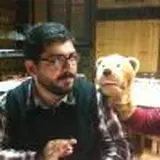
The Gaudeamus prize went to Tobias Klich. Try reading the jury's reasons: who knows what they mean when they write narrative composer!
He is a true narrative composer, who has maximum expressive potential, which grabs you immediately, has a consistent technical approach, well thought of highly sophisticated gorgeous sounds
Member
RedScharlach wrote:I wonder what they mean when they write narrative composer!
He is a true narrative composer, who has maximum expressive potential, which grabs you immediately, has a consistent technical approach, well thought of highly sophisticated gorgeous sounds
Maybe listening to the track can help... I couldn't find the audio
Moderator
I would never show up to collect an award wearing that sweater
Member
Bianca wrote: However, personally I believe that the relationship between narrativity and consequentiality in music has dynamics entirely independent of those found in literature, precisely because music is not literature.
Would you give some examples or elaborate on your thought? I find what you said in this post very interesting (not just the excerpt, the whole thing)
Moderator
I want to repeat myself and be deliberately simplistic. Being narrative, regardless of the field, is that capacity to be remembered.
Literature is not all narrative; there are many experiments built on word anagrams... that no one will ever remember, or if something is remembered (interesting: what and due to what effect?)... it certainly does not happen due to merely linguistic/grammatical/lexical properties.
Idem for music... if one manages to remember and therefore "reproduce" a certain element or piece, whatever it may be... it is narrative; otherwise, it does not narrate and one must passively let it flow.... In this case, it probably leaves nothing even to the listener, unrememberable, non "reproducible", ... non-narrating.
I put "reproducible" in quotation marks because I would not want to reduce the discussion to humming a melody, but rather to its very capacity to be remembered and thus "re-performed"... even internally.
Member
Queneau's exercises in style are remembered precisely for that
Anyway, my question was directed at Bianca for this very reason, because she makes a distinction between literary terminology and musical terminology
Moderator
micamahler wrote:Queneau's exercises in style is remembered precisely for that
perhaps referring to the narrativity ... it was also nice to (re)tell one of the works
...provided that "passively you didn't let it slide"
EDIT
...and without peeking
Member
What are you referring to??


